Ideal customer profile (ICP): define it from your best customers
By Etienne DouillardPublished 10 min read
AI summary
Too long, didn’t read?
Ask your favourite AI to summarise this article and pull out the points that matter for your business.

Contents
- What is an ideal customer profile (ICP)?
- What is the difference between an ICP and a persona?
- Why start from your best customers rather than your market?
- How do you define your ICP in 6 steps?
- What criteria should go into an ICP?
- What does an ICP sheet look like?
- How do you turn your ICP into LinkedIn targeting?
- How do you know if your ICP is good, and when should you revise it?
- Sources
Many small businesses describe their target in one vague sentence: “small manufacturers,” “companies that want to grow.” With a definition like that, everyone is a prospect, so no one really is. The ideal customer profile, or ICP, fixes this vagueness by starting from a reliable source: your best current customers. Here is how to build one in half a day, and how to turn it into concrete targeting on LinkedIn.
What is an ideal customer profile (ICP)?
The ideal customer profile is a description of the type of company that gets the most value from your offer, and that brings you the most in return. It describes a company, not a person: its size, industry, region, structure, and the situations in which it needs you.
A good ICP answers a simple question: “If I could only sign ten new customers this year, what would they look like?” The answer is not “everyone,” nor “the biggest ones.” It is the companies that buy quickly, stay, pay without trouble and refer others.
👉 The ICP does not tell you who you are allowed to sell to. It tells you where to focus your prospecting, in other words your time, which is a small business’s scarcest resource.
What is the difference between an ICP and a persona?
The ICP describes the ideal company, the persona describes the person you write to inside that company. The two work together: first you choose the right companies, then the right people inside them.
| Ideal customer profile (ICP) | Persona | |
|---|---|---|
| What it describes | A company | A person, a role |
| Criteria | Size, industry, region, structure, situation | Job title, responsibilities, concerns, how they decide |
| Question it answers | “Which companies should we target?” | “Who do we talk to, and about what?” |
| Main use | Building the account list | Writing the message and preparing the conversation |
| Example | Growing manufacturer with 50 to 250 employees | Operations director who manages maintenance and production teams |
| How often it is updated | Once or twice a year | Every time you meet a new role in a meeting |
A single company often has several personas: the owner who signs, the manager who owns the topic, the user who will live with the result. On this point, see who gets involved in a B2B purchase depending on company size.

Why start from your best customers rather than your market?
Because your current customers are the only proof you have: they bought, paid for and used your offer. A market study tells you who could buy; your track record tells you who actually buys.
Starting from the market pushes you to aim too broadly. You lock onto the biggest industries and the best-known companies, and forget that these are often the hardest to reach. Starting from your customers reveals unexpected common traits: a specific size, a particular structure, a moment in the company’s life.
⚠️ Watch out for the big-customer bias. The customer that weighs the most in your revenue is not necessarily the most representative. If it took eighteen months and three meetings at headquarters to sign them, they are not a model to repeat every week.
How do you define your ICP in 6 steps?
You define your ICP by choosing your ten best customers, noting what they have in common, then writing down the criteria, the trigger situations and the exclusions. Allow half a day for a first version.

- Choose your 10 best customers. Not the biggest: the ones who signed without much friction, who stay, who pay on time and who are satisfied. If you have fewer than ten customers, take all the ones you like working with.
- List their characteristics in a table. Industry, headcount, region, revenue if you know it, type of organization, tools they use, job title of the person who bought.
- Write down what was happening when they bought. A new role, a hire, rapid growth, a new site, a problem that had become visible. This is the most valuable information, and the most often forgotten.
- Look for common traits. Three customers out of ten do not make a trend; seven out of ten do. Look at ranges too: “between 40 and 200 employees” rather than “small business.”
- Do the same with your worst customers. The ones who left quickly, negotiated every line, never used your offer. Their common traits become your exclusion criteria.
- Write the ICP on one page, then test it on your next prospects for two to three months before correcting it.
💡 For step 3, ask your customers directly. “What made you look for a solution at that point?” is a question they understand right away, and their answers give you your future buying signals.

✅ Once this work is done, you have a short, shared document. The whole team knows which companies to target, and why.
What criteria should go into an ICP?
A useful ICP contains three families of criteria: company criteria, situations that trigger the need, and exclusion criteria. Most ICPs stop at the first family, which gives you an accurate list with no priorities.
Company criteria (firmographics) describe who the company is:
- Industry, as specific as possible (“precision machining” rather than “manufacturing”).
- Headcount, as a range.
- Geographic area, if your offer or your team has limits.
- Structure: whether or not there is a department dedicated to your topic, independent company or subsidiary of a group.
- Tools or equipment in place, when they determine whether your offer fits.
Trigger situations describe when the company needs you. These are the observable events that make the topic urgent: a new executive, a hire in your area, headcount growth, a new site, a post about the problem you solve. We have listed many of them in our B2B buying signal examples.
Exclusion criteria describe who not to target, even if the profile looks good:
- ❌ Your competitors and consultants who sell the same thing you do.
- ❌ Companies too small to pay for your offer, or too large to buy without a formal RFP.
- ❌ Subsidiaries whose purchasing is decided at headquarters, if you cannot reach headquarters.
- ❌ The profiles of your worst customers, noted in step 5.
📌 Trigger situations turn a static ICP into a prospecting tool. A company that matches your criteria but is going through none of these situations can wait; one that is going through one moves to the top of the list.
What does an ICP sheet look like?
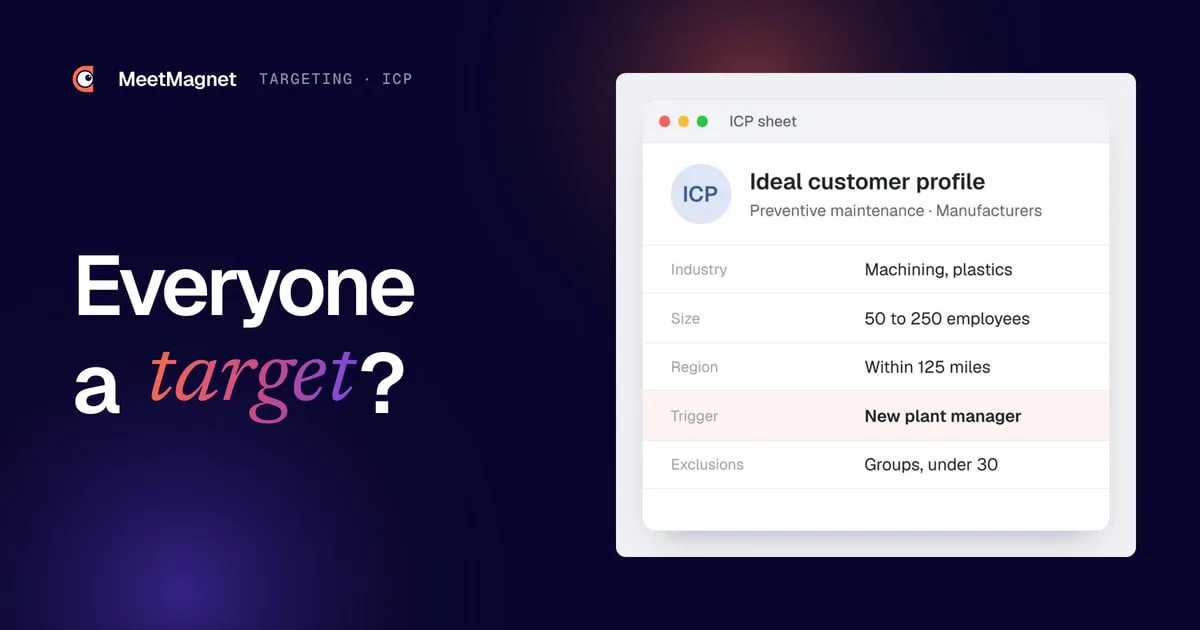
An ICP sheet fits on one page and takes two minutes to read. Here is an example for a company that sells preventive maintenance services to small and midsize manufacturers.
Example ICP sheet
Offer: preventive maintenance contract for production lines.
Company: independent manufacturer, 50 to 250 employees, machining, plastics or food processing, within 125 miles of our technicians. Production in two or three shifts. No maintenance department of more than three people.
Contacts: plant manager or operations director (owns the topic), owner or CEO (signs), maintenance manager where there is one (user).
Trigger situations: arrival of a new plant manager, hard-to-fill or repeated hiring of maintenance technicians, investment in a new line, a post about a production stoppage or a customer audit.
Exclusions: groups that buy maintenance at the national level, companies with fewer than 30 employees, other maintenance companies, companies in bankruptcy proceedings.
Everything is specific and verifiable. A salesperson reading this sheet can tell within minutes whether a company is in the target, who to contact, and what event to look for before writing.
🎯 The test of a good sheet: give it to someone who does not know your company and ask them to find five prospects. If they manage it without asking you any questions, the sheet is clear enough.
How do you turn your ICP into LinkedIn targeting?
You turn your ICP into LinkedIn targeting in two layers: company criteria become search filters, and trigger situations become signals to watch. The filters give you the list; the signals give you the order in which to write.
For the first layer, Sales Navigator offers account filters that map directly onto an ICP: company headcount, headcount growth, headquarters location, industry, annual revenue. On the people side, the function, job title and seniority level filters translate your personas. Exclusion search lets you rule out industries, regions, sizes or specific companies, such as your competitors.
For the second layer, LinkedIn also offers recent activity filters, for example people who changed jobs in the past 90 days or who posted on LinkedIn in the past 30 days, and, on the account side, companies with open job postings. These are starting points: it is up to you to then check that the event really relates to your topic.
The message itself starts from the trigger situation, not from the ICP sheet.
Example
Situation: the plant manager of a 140-employee plastics company, within the target of the sheet above, started in the role five weeks ago. The company is posting its third maintenance technician opening in a year.
Message that misses: “Hello, you’re an exact match for our target of small manufacturers. We offer preventive maintenance contracts. Can we talk?”
Message that works: “Hi Mark, congratulations on joining the plant. I see the maintenance technician role is open again: is that a hire you inherited, or extra capacity you decided to add?”
The first message talks about your target, which interests nobody. The second talks about the prospect’s situation and asks a question he can answer in one line. The ICP was used to choose Mark; the signal was used to write to him.
To go further with this logic, our article on intent-based targeting on LinkedIn explains how to go from a filtered list to prospects who have a reason to talk.
How do you know if your ICP is good, and when should you revise it?
An ICP is good when the prospects who match it reply more, accept more meetings and sign more than the others. If that is not the case after two or three months, you need to correct it.
🤔 Three metrics are enough to judge:
- The reply rate of prospects inside the ICP, compared with those outside it.
- The share of meetings that lead to a proposal. Lots of meetings and few proposals point to an ICP that is too broad.
- The reasons for saying no. If the same reason keeps coming back (“too small,” “we already have a provider”), it becomes an exclusion criterion.
Review the sheet once or twice a year, and with every major change: new offer, new price, new region. Your prospecting plan rests on it, so make it the first page of that plan.
🚀 The real change comes when the ICP is no longer a document filed away in a folder, but the filter that decides every week who to write to. That is what MeetMagnet does: based on your target and the buying intents you define, it tracks on LinkedIn the new roles, hires and posts of the people in your ICP, suggests an opener built on that event, reviewed before sending, and shows in the funnel statistics which profiles actually lead to meetings.

Sources
- “Sales Navigator lead and account search filter definitions”, LinkedIn Sales Navigator Help, accessed October 2, 2026, https://www.linkedin.com/help/sales-navigator/answer/a1452817
- “How Using Exclusion Search in Sales Navigator Can Help You Prospect More Efficiently”, LinkedIn Sales Blog, accessed October 2, 2026, https://www.linkedin.com/business/sales/blog/sales-navigator/exclusion-search-in-linkedin-sales-navigator
Frequently asked questions
What is an ideal customer profile?
The ideal customer profile is a description of the type of company that gets the most value from your offer and brings you the most in return: industry, size, region, structure, and the situations in which it needs you. It describes a company, not a person, which is what sets it apart from a persona.
What is the difference between an ICP and a persona?
The ICP describes the company to target, the persona describes the person to write to inside that company. You first choose companies with the ICP, then choose contacts with personas. A single company often has several personas: the one who signs, the one who owns the topic, the one who uses it.
How do you define your ICP when you have few customers?
Take every satisfied customer you have, even three or four, and focus on what was happening at their company when they bought. Add your best meetings, even those that did not close. Treat the sheet as a hypothesis to test for two to three months, then correct it.
How often should you review your ICP?
Once or twice a year, and with every major change: a new offer, a new price, a new region. Review it sooner if prospects who match it reply no better than the others, or if the same reasons for saying no keep coming back in your sales conversations.
Etienne Douillard
Co-founder and CEO, MeetMagnet
An engineer and entrepreneur for over five years, Etienne works every week with B2B SMEs on signal-based prospecting.
From intent to booking
MeetMagnet spots who has a reason to talk to you right now, writes the opener that stands out, and a real person keeps it on track.