What is a business signal? Definition and examples
By Etienne DouillardUpdated 6 min read
Contents
In an increasingly competitive B2B environment, the key to sales success no longer lies just in the volume of prospecting, but in the relevance and timing of every interaction.
Business signals, genuine indicators of opportunity, let you contact the right prospect at the exact moment they express a need. AI platforms like MeetMagnet specialise in detecting and exploiting these signals to turn traditional prospecting into a precise science of conversion, by automating the identification of the best sales opportunities.
What is a business signal and why does it matter?
A business signal is an event or piece of public information showing that a company is likely to have an immediate or future need for a product or service. Unlike targeting based on static criteria like sector or company size, business signals are dynamic and reveal buying intent.
Identifying these signals lets you shift from intrusive prospecting to contextual, relevant outreach. By positioning yourself at the exact moment the need emerges, you considerably increase your odds of catching the prospect’s attention. This is the very foundation of intent-based targeting to optimise LinkedIn prospecting, a strategy that maximises reply rates.
The main benefit, then, is perfect timing for starting the conversation. A message that arrives at the right moment is no longer seen as outreach, but as an expected solution. This changes the whole dynamic of the exchange and positions the sales rep as an expert rather than just a seller.
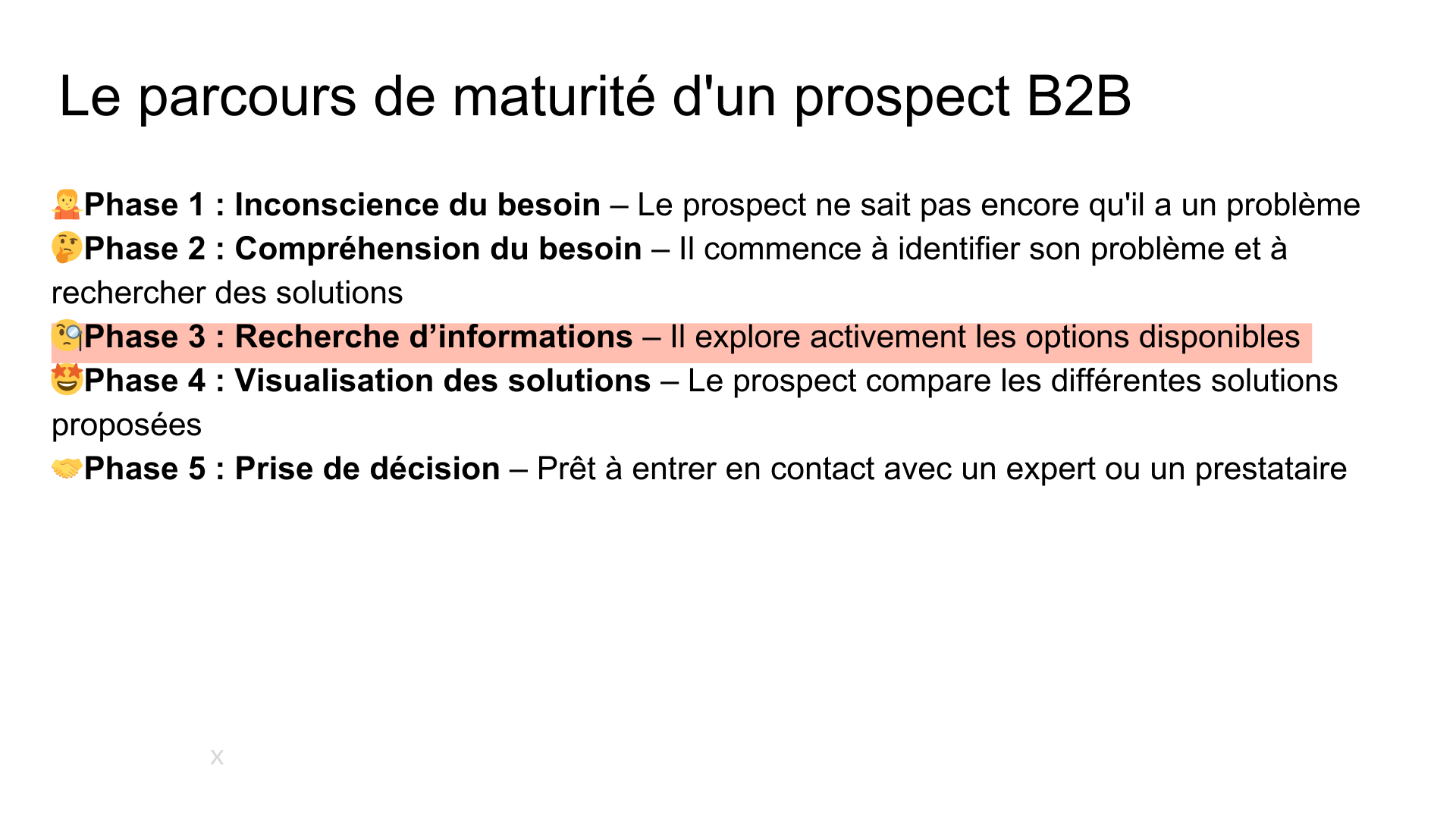
Do you know a B2B prospect’s maturity journey? Because it’s at stage 3 (or stage 2 at the earliest) that you need to reach your prospect. AI prospecting and business signals are how you get there.
This approach lets sales teams concentrate their efforts on leads with very high conversion potential, optimising the return on investment of every prospecting action. You no longer waste time on companies with no current need.
What types of business signals should you use?
In AI prospecting, detecting business signals is essential to target prospects at the right moment. Thanks to artificial intelligence, it’s possible to analyse LinkedIn likes, comments and posts to spot precise sales opportunities.
Here are concrete examples of business signals and why they represent ideal moments to start the conversation.
🔹 Shows interest in stock shortages
A prospect who likes or comments on posts about managing stock shortages reveals a need for logistics optimisation or supply solutions. It’s the ideal moment to offer a relevant solution, because they’re actively looking for answers to a concrete problem.
🔹 Reads up on managing multilingual content
If a decision-maker engages with posts about content localisation, that indicates they’re looking to expand into international markets. A targeted approach with a translation or multilingual management solution can catch their attention.
🔹 Follows projects using architectural LED lighting
A like or a share on LED lighting projects suggests an interest in energy innovation and architectural design. It’s the moment to offer smart lighting solutions or technical partnerships.
🔹 Completes a funding round
A funding round means the company now has new budget to invest in tools, hiring or partnerships. It’s a strong signal to offer scalable solutions that support its growth.
🔹 Rolls out a new content strategy
If a company posts about overhauling its content strategy, it’s in the middle of a digital transformation. Offering automation or content personalisation tools can be very relevant.
🔹 Hires a marketing manager
A marketing hire signals a desire to grow visibility and sales. It’s the moment to offer AI prospecting solutions (for example 😉), campaign automation, or customer data analysis.
🔹 Posts about the importance of waterproofing for roofs
A post on roof maintenance reveals a need for maintenance or durable solutions. A sales approach focused on waterproofing products or services can be very effective.
🔹 Rolls out a security policy
A company that communicates about a new security policy is in the middle of strengthening its processes. Offering cybersecurity solutions, training or audits is highly relevant at this point.
🔹 Shares a carbon footprint report
A published carbon footprint shows a desire for transparency and environmental improvement. It’s the moment to offer eco-design, carbon offsetting or energy optimisation solutions.
How is AI prospecting revolutionising signal detection?
Artificial intelligence lets you detect these business signals every day, giving you a major competitive edge.
By analysing LinkedIn interactions, an AI prospecting solution like MeetMagnet can:
✅ Identify the most engaged prospects (likes, comments, shares).
✅ Write an opener drawn from the signal, reviewed before sending, at the right moment.
✅ Increase reply rates by targeting precise needs.
Without technology, manually tracking these signals across hundreds of potential prospects is a huge, inefficient task. This is exactly where AI prospecting changes the game, by automating this process at scale.
AI prospecting platforms, like MeetMagnet, use algorithms to continuously scan millions of data sources: job boards, professional social networks like LinkedIn, press articles, financial press releases, and company websites. AI doesn’t just collect the information, it analyses and contextualises it. At MeetMagnet, LinkedIn is covered on every plan; job postings, the press or reviews fall under the multi-source option of the Assisted plan.
AI can spot weak signals and correlations invisible to a human, turning a simple piece of information into a qualified sales opportunity. That is what makes AI prospecting effective at detecting business signals and turning them into concrete opportunities.
How do you effectively build signal detection into a sales strategy?
Adopting a business signal detection tool isn’t enough on its own. To get the most value from it, you need to fully integrate it into your sales strategy. The goal is to turn data into real meetings.
The first step is to precisely define your Ideal Customer Profiles (ICPs) and the signals most relevant to them. Each signal should be tied to an outreach scenario. This lets you build a genuine no-code AI prospecting machine. To learn more, see this guide on how to build a no-code AI prospecting machine.
Next, it’s essential to tailor every message to each prospect and each interest.
You’ll also need to sync your prospecting tool with your CRM for larger teams. This integration lets sales reps access qualified leads and their context directly within their day-to-day workspace. Smooth CRM syncing via API is a prerequisite for successful team adoption.
Finally, train your sales teams. They need to understand how to use the context provided by the business signal to run more relevant conversations. Rather than reciting a generic pitch, they can open the conversation by referencing the detected signal, which shows a documented, prospect-centred approach. High-quality prospect qualification upstream frees up time for higher-value conversations.
In conclusion, the era of undifferentiated mass prospecting is over. Sales success in B2B now belongs to those who know how to listen to the market and detect buying intent the moment it appears. Business signals, when harnessed by powerful artificial intelligence, offer a decisive competitive edge. Complete solutions like MeetMagnet don’t just provide data; they orchestrate an intelligent, personalised prospecting strategy, followed by a real person, letting sales teams focus on their real value: building a relationship and closing a sale.
Frequently asked questions
What is the return on investment (ROI) of a business signal detection solution?
ROI is mainly measured by the increase in the prospect-to-meeting conversion rate and the reduction in time spent on manual prospecting. At MeetMagnet, the Assisted plan costs €299 excl. VAT a month. A single signed deal often pays for several months of subscription.
Is setting up this type of platform complex?
No, modern solutions are designed to be intuitive. At MeetMagnet, the Assisted plan includes setup with you: the target, signals and messages are calibrated at onboarding, reviewed on day 7, 30, 60 and 90, then in one meeting a month. Your sales teams focus on selling rather than on technical setup.
How is AI-driven business signal detection different from classic social selling?
Classic social selling often relies on manual monitoring and reactive interaction. AI prospecting through business signals is proactive and systematic. AI constantly analyses millions of data points to detect buying intent at scale, where a human could only follow a few dozen accounts. It turns monitoring into automated, measurable sales actions.
Etienne Douillard
Co-founder and CEO, MeetMagnet
An engineer and entrepreneur for over five years, Etienne works every week with B2B SMEs on signal-based prospecting.
From intent to booking
MeetMagnet spots who has a reason to talk to you right now, writes the opener that stands out, and a real person keeps it on track.