How to qualify a B2B prospect: 4 questions before writing, then live
By Etienne DouillardPublished 10 min read
AI summary
Too long, didn’t read?
Ask your favourite AI to summarise this article and pull out the points that matter for your business.

Contents
- What is the difference between a lead, a prospect and a customer?
- Why qualify a prospect before writing to them?
- What are the 4 questions to ask yourself before writing?
- How do you answer these 4 questions in a few minutes?
- What questions should you ask during the conversation or meeting?
- Should you give each prospect a score?
- When should you disqualify a prospect?
- How do you go from a qualified prospect to a meeting?
A list of 500 contacts is not worth much if 450 of them will never buy. Qualifying a prospect means deciding who you will spend time on, and who you will not. Many salespeople only do it in the meeting, once the time has already been spent. Yet most of the sorting can be done before you even write the first message, with four simple questions, then completed during the conversation.
What is the difference between a lead, a prospect and a customer?
A lead is a contact you know little about, a prospect is a contact you have judged relevant to your offer, and a customer is someone who has already bought. The three words often get mixed up, which muddies both the numbers and the priorities.
| Status | What you know | Example | What you do with it |
|---|---|---|---|
| Lead | A name, a job title, sometimes an email | A business card picked up at a trade show | Check that they fit your target |
| Prospect | The company, the role and a reason to talk now all fit | An operations director who has just started at a small business in your industry | Write them a specific first message |
| Prospect qualified in conversation | Need, decision and timeline confirmed by the person | The same director, who confirms a project for the next six months | Suggest a meeting |
| Customer | They signed | A contract or an order | Serve them, and learn from them |
👉 The move from lead to prospect happens on your side, by checking public information. The move from prospect to qualified prospect happens with the person, by asking questions. These are two different moments, with two different methods.

This table also helps you read your pipeline. If you count as “prospects” contacts you have never checked, your reply rate looks bad when it is really the list that is bad.
Why qualify a prospect before writing to them?
Because the most profitable qualification is the one that saves you from sending a useless message. Every message sent to a company that will never buy costs time, wears down your reputation and skews your numbers.
Qualifying before you write has three concrete effects:
- ✅ You write less, but to people who have a reason to read. Volume goes down, the share of useful replies goes up.
- ✅ Your message is more specific. The information you find while qualifying becomes the material for your opener.
- ✅ Your meetings are better. You show up already knowing why the person said yes.
⚠️ The opposite trap exists too: spending an hour researching each company. Pre-outreach qualification should take a few minutes per prospect. It is there to sort, not to know everything.
What are the 4 questions to ask yourself before writing?
Before writing, check that you have the right company, the right contact, the right timing and a likely need. If any of the four answers is “no,” holding off for now is often the best decision.
- Is it the right company? Size, industry, region, structure: does it look like your best customers? An 8-person company does not buy the way a 300-person company does.
- Is it the right contact? Does the person own the topic you deal with, or can they at least point you to the one who does? The title is not enough: look at what they actually do.
- Is it the right time? Is there a recent event that makes the topic current: a new role, a hire, a post, a new site, a new branch? This is what we call a buying signal.
- Is the need likely? Given what you can see, is it plausible that this company has the problem you solve, and has not already solved it?
💡 The third question is the one most teams skip. Yet it is what decides whether your message lands as an answer to a current concern, or as one more pitch.

On finding the right contact, we break down the roles in a buying committee in who really makes B2B buying decisions. On timing, the question becomes: is this signal serious or is it noise? That is the subject of our method to qualify a buying signal. Here, you are qualifying the person and the company as a whole; the signal is only one of the four criteria.
How do you answer these 4 questions in a few minutes?
By looking in the right place for each question, and by knowing in advance what counts as a yes. A simple grid is enough.
| Question | Where to look | Sign it’s a yes | Sign it’s a no |
|---|---|---|---|
| Right company | LinkedIn company page, website, business registry | Size and industry close to your best customers | Competitor, too small, group that buys at headquarters |
| Right contact | LinkedIn profile, org chart, posts | They describe responsibilities tied to your topic | Intern, unrelated role, leaving the company |
| Right time | Recent activity, job postings, news | Event dated within the last few weeks | Nothing new for months |
| Likely need | Job postings, website, posts, visible tools | The problem is described or can be inferred | A solution already in place, recently announced |
📌 Set your answers in advance: for example “between 20 and 250 employees,” “operations director, maintenance manager or owner,” “event less than 30 days old.” Without written thresholds, everyone qualifies on instinct, and instinct changes with your mood and with how many meetings you have that week.
Once the grid is filled in, the message almost writes itself: the dated event gives you the opener, the likely need gives you the question.
Example
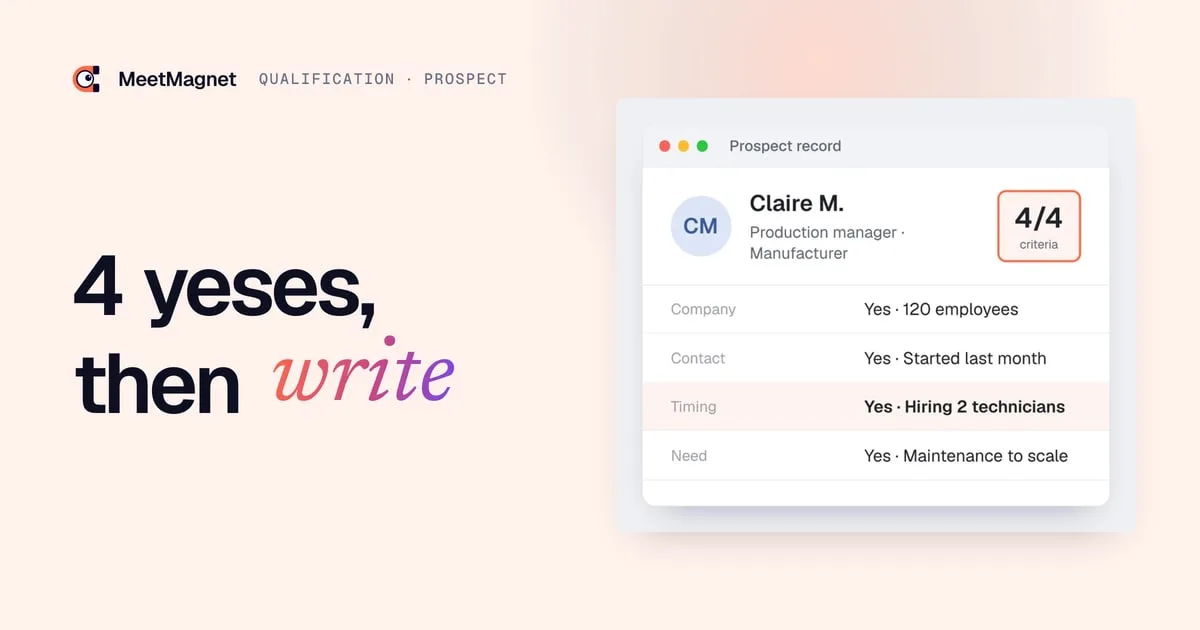
Situation: an industrial maintenance company notices that a 120-employee manufacturer is hiring two maintenance technicians, and that its production manager started in the role last month. Company, contact, timing and need: all four answers are yes.
Message that misses: “Hello, we help manufacturers optimize their maintenance. Would you be available for a 15-minute call?”
Message that works: “Hi Claire, I saw you’re hiring two maintenance technicians, a few weeks after you took over production. Is that mainly to handle more volume, or to bring back in-house what used to be outsourced?”
The first message could have gone to anyone. The second can only go to Claire, and it asks a question she can answer in one line. Qualification supplied the material; the message simply used it.

What questions should you ask during the conversation or meeting?
During the conversation, you check with the person what you had only assumed: the real need, who decides, the timeline and the resources. These are the questions classic qualification frameworks group together.
The best known is BANT: Budget, Authority, Need, Timeframe. For a small business, the framework is useful as long as you change the order and the tone: start with the need, end with the budget, and never turn it into an interrogation.
| BANT criterion | Blunt question to avoid | Question adapted for a small business |
|---|---|---|
| Need | “Do you have a need?” | “How do you handle this today, and where does it get stuck?” |
| Timeframe | “When are you buying?” | “What needs to be sorted out before the end of the quarter?” |
| Authority | “Are you the decision-maker?” | “Who else would be affected if you changed something?” |
| Budget | “What’s your budget?” | “How is this kind of spending usually decided at your company?” |
Other, more detailed frameworks exist, such as MEDDIC or CHAMP. They are mostly used for long sales cycles with several decision-makers. For a small business selling to other small businesses, four well-asked questions cover the essentials.
🎯 Three rules make these questions effective:
- Ask about the past and the present, not the future. “What happened last time?” gets you facts; “Would you buy?” gets you polite answers. We have listed the good and bad customer discovery questions.
- Go back to the signal. The event that made you write is the best starting point for the conversation: “You’re hiring two technicians, what triggered that need?”
- Record the answers in the same order every time. After twenty meetings, you will see which criterion kills the most deals.
Should you give each prospect a score?
A simple score helps you sort when you have a lot of prospects, but it does not replace judgment. For a small business, a score out of four, one point per question validated before outreach, is often enough.
- 4 out of 4: you write this week, with an opener built on the event you observed.
- 3 out of 4: you write if the missing criterion is timing; otherwise, you dig deeper first.
- 2 out of 4 or less: you put the contact on hold and keep an eye out for something happening.
⚠️ A score of 4 does not mean “hot prospect.” It means you have a good reason to write. It is the person’s reply, and then the conversation, that will confirm whether or not there is a deal.
🤔 Should you weight the criteria? Not at first. After a few months, look at the meetings that turned into deals: if timing matters more than size, give it more weight. The score should come from your own results, not from a model copied from somewhere else.
When should you disqualify a prospect?
You should disqualify a prospect as soon as a deal-breaker appears, before or during the conversation, and record it so you do not come back to it by mistake. Disqualifying is not a failure: it frees up time for the right prospects.
The most common cases:
- ❌ The company is outside your target: a competitor, a consultant who sells the same thing you do, an organization too small to pay for your offer.
- ❌ The person has no connection to the topic, and cannot point you in the right direction.
- ❌ The need has been met: a contract has just been signed, or the role has been filled internally.
- ❌ The person has asked not to be contacted again. They come off all your lists, for good.
💡 Tell “disqualified” apart from “not now.” A company with the right profile but no signal is not disqualified: it is waiting for its moment. Make a note of it, and come back when something new happens.
How do you go from a qualified prospect to a meeting?
By writing at the right time, about the event that makes the topic current, then suggesting a short call once the person has shown interest. A well-qualified prospect does not turn into a meeting on their own: the first message is what makes the connection.
In practice:
- First message: the event you observed, a simple question, no meeting request.
- Reply: you qualify through the conversation, using one or two of the questions above.
- Proposal: once the need and the timing are confirmed, you suggest a 20-minute call with two specific time slots.
🚀 The teams that book the most meetings are not the ones that contact the most people: they are the ones that rule out the wrong prospects early and write to the others at the moment the topic comes up.

That is the logic behind MeetMagnet: the buying intents you define are tracked on LinkedIn (new role, hiring, posts on your topic), each prospect arrives with the event that justifies reaching out, and the opener built on that event is reviewed before it is sent, then followed up on LinkedIn and by email. Funnel statistics then show which criteria actually lead to meetings.
Frequently asked questions
What is the difference between a lead and a prospect?
A lead is a contact you know little about: a name, a job title, sometimes an email. A prospect is a contact you have checked and judged relevant: their company looks like your customers, they own the topic and they have a reason to talk about it now. A customer has already bought.
How do you qualify a prospect before contacting them?
Check four points in a few minutes: does the company look like your best customers, does the person own the topic, does a recent event make the topic current, and is the need plausible? If any answer is no, it is better to wait or find another contact before writing.
Does the BANT framework work for small businesses?
Yes, as long as you adapt it. Budget, authority, need and timeframe are still the right topics, but you start with the need and finish with the budget. Ask open questions about the current situation rather than closed questions that make the prospect feel they are being interrogated.
When should you disqualify a prospect?
As soon as a deal-breaker appears: a company outside your target or a competitor, a person with no connection to the topic, a need already met, or a request not to be contacted again. A company with the right profile but no recent event is not disqualified: it is simply waiting for its moment.
Etienne Douillard
Co-founder and CEO, MeetMagnet
An engineer and entrepreneur for over five years, Etienne works every week with B2B SMEs on signal-based prospecting.
From intent to booking
MeetMagnet spots who has a reason to talk to you right now, writes the opener that stands out, and a real person keeps it on track.