Objection handling: the 7 B2B sales objections and what to say
By Etienne DouillardPublished 11 min read
AI summary
Too long, didn’t read?
Ask your favourite AI to summarise this article and pull out the points that matter for your business.

Contents
- What is objection handling in B2B?
- How do you handle an objection, step by step?
- What are the 7 most common B2B objections?
- What should you say to each of the 7 objections?
- Why do you keep hearing the same objections?
- What mistakes should you avoid when facing an objection?
- How do you prepare your answers to objections?
- How do you turn an objection into a meeting?
“I don’t have time.” “It’s too expensive.” “Just send me some information.” Every B2B salesperson hears these lines every week, on the phone, by email or at the end of a meeting. They are not rejections: they are badly phrased questions, worries or polite ways of buying time. Objection handling means understanding what lies behind them, then answering briefly, without pushing. Here is the method, the 7 most common objections and what you can say to each one.
What is objection handling in B2B?
Objection handling is how a salesperson receives a prospect’s reservation, figures out its real cause and responds so the conversation can continue. The goal is not to win a debate. It is to find out whether the topic really exists for the prospect, and when.
An objection is not a rejection. A rejection closes the door (“don’t email me again”). An objection leaves it ajar: the prospect is telling you what is holding them back. That is valuable information, often the first real information in the whole exchange.
There are three families of objections:
- 🤔 Substance objections: price, the current solution, the need. The prospect is genuinely evaluating.
- Form objections: “no time,” “send me some information.” The prospect is protecting themselves from a conversation they did not ask for.
- Person objections: “I’m not the one who handles that.” The topic exists, but you are talking to the wrong contact.
A form objection is not handled with arguments, but with a simple question that keeps the exchange light.
How do you handle an objection, step by step?
To handle an objection, you listen all the way through, rephrase it, ask a question to find the real cause, then answer in one or two sentences.
- Listen all the way through. Do not interrupt, and do not prepare your answer while the prospect is talking. The end of the sentence often holds the real reason (“it’s expensive… for what we’d use it for this year”).
- Rephrase. Say the objection back in your own words: “If I understand correctly, the topic is relevant to you, but not before the January budget?” The prospect feels heard and corrects you if needed.
- Ask a question. Just one, open and specific, that brings out what the objection is hiding: “What would make you say it’s worth the cost?”
- Answer briefly. An answer that addresses the real cause, in one or two sentences, then a simple proposal: a 20-minute call, an example, a date to pick the conversation back up.
💡 The step most often skipped is the third one. People answer the sentence they heard instead of the cause behind it. The result: a pitch about price to someone who in fact had no budget for the next six months.
👉 A simple rule: one objection, one question, one answer. If you string together three arguments, the prospect hears pressure, not an answer.

This method relies on good questions, the kind that get prospects talking about their own situation. We have detailed which ones to ask, and which to avoid, in our article on good and bad customer discovery questions.
What are the 7 most common B2B objections?
The seven objections you hear most in B2B prospecting are: no time, too expensive, we already have a provider, send me some information, bad timing, it’s not me, and we do it in-house. Each one hides a different cause, and therefore calls for a different answer.
| Objection | What it often hides | What to answer |
|---|---|---|
| “I don’t have time” | The topic does not have value in their eyes yet | A 10-second question about their situation, not a pitch |
| “It’s too expensive” | Value is unclear, or no budget was planned | Ask compared with what, then put a number on what the problem costs |
| “We already have a provider” | Satisfied, or afraid of switching | Ask what works well, then what is missing |
| “Send me some information” | A polite way to cut things short | Offer to send one targeted page after asking a question |
| “It’s not the right time” | Another priority, or a topic tied to a date | Ask when, and what needs to happen first |
| “I’m not the one who handles that” | Wrong contact | Ask for the name and permission to mention them |
| “We do it in-house” | Pride, or resources already committed | Ask how, and what it costs in time |
📌 The same sentence can hide two opposite causes depending on the prospect: the middle column gives the most common cause, not the only one.

What should you say to each of the 7 objections?
For each objection, the right answer targets the cause, not the sentence. Here, for each one, is what it hides and a sample answer to adapt to your offer and the way you talk.
1. “I don’t have time”
This is the most common objection on the phone, and the least serious. The prospect is not short on time: they just do not yet see why they should give any of it to you.
Sample answer: “I understand, I’ll take 20 seconds. You’re opening a second branch in Austin: is hiring the technicians already wrapped up, or is that still the big issue right now?” The question shows you are calling for a reason, and leaves them free to continue.
2. “It’s too expensive”
Too expensive compared with what? That is the only question that matters. The prospect may be comparing you with a competitor, with a budget that was never planned, or with nothing at all because they do not see what the solution brings them.
Sample answer: “I understand. What are you comparing it with, another offer or the budget you planned for this year?” Depending on the answer, you talk about the cost of the problem (lost time, missed revenue), a smaller scope to get started, or a budget date.
⚠️ Never lower your price in the minute after the objection. You confirm that the price you quoted was not serious, and the negotiation is only just beginning.
3. “We already have a provider”
Depending on the case, this sentence means “I’m satisfied” or “switching tires me out before I even start.” Criticizing the current provider is the worst possible answer: the prospect chose them, and will defend that choice.
Sample answer: “That’s actually a good sign, it means the topic is covered. What works best with them? And if there were one thing to improve, what would it be?” The second question often reveals a need next to what the provider covers.
4. “Send me some information”
Most of the time, information sent cold does not get read. The request is a courteous way of ending the conversation. Agreeing without asking anything amounts to losing the contact.
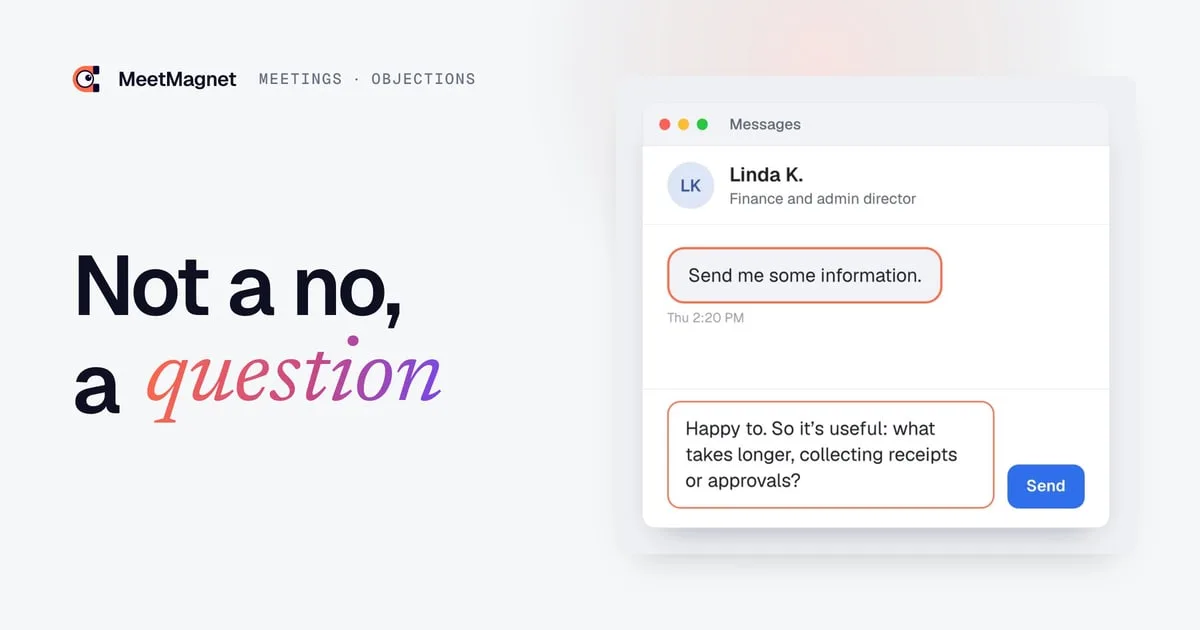
Example
Situation: the finance and admin director of a 60-employee medical supplies distributor answers a first call about expense report management.
Answer that loses the contact: “Sure, I’ll send over our full brochure and follow up with a call next week.”
Answer that keeps the conversation going: “Happy to. So I can send you something useful rather than 20 pages: on your side, what takes the most time, collecting receipts or getting managers to approve them?”
The second answer accepts the request, but ties it to an easy question. You then send one page about her situation, and your follow-up has a specific purpose.

5. “It’s not the right time”
Sometimes it is true: a move, a year-end close, layoffs. Sometimes it is a polite version of “not interested.” The only way to know is to ask when.
Sample answer: “I understand. When would be the right time, and what needs to happen between now and then?” A specific answer (“after the trade show in March”) gets written down with its context; a vague answer tells you the topic is not a priority.
✅ When you get back in touch on the date given, remind the prospect of what they said themselves. It is the best proof that you were listening.
6. “I’m not the one who handles that”
This is good news in disguise: the topic exists at the company. You just need to find the right person, and ideally reach them on someone’s recommendation.
Sample answer: “Thanks for letting me know. Who looks after this at your company? Could I write to them and mention that we spoke?” To find the right contact before you call, see our article on who really makes B2B buying decisions.
7. “We do it in-house”
The prospect is often proud of what their team has built. But “in-house” has a cost they do not always measure: time from people who have other jobs to do.
Sample answer: “That’s often the most logical choice at first. How is it organized today, and how much time does it take your team each week?” If the answer is “not much, it works well,” thank them and move on. If they hesitate, you have found the opening.
And when the prospect simply replies “not interested,” with nothing more? That is a separate case, which we cover in detail in our article on how to reply to a prospect who is not interested.
Why do you keep hearing the same objections?
You keep hearing the same objections because they are born before the conversation even starts: a call that comes at the wrong time, to the wrong person, or with no visible reason.
Look at where your most frequent objections come from:
- A string of “no time” and “send me some information”: the prospect does not see why you are calling them, today. Your first sentence is about you, not about them.
- A string of “not the right time”: your target is right, but the timing is off. You are contacting companies that have not gone through anything recent related to your topic.
- A string of “it’s not me”: the roles you target are not the ones that own the topic.
- “Too expensive” from the very first exchange: you are talking about price before you have talked about the problem.
🎯 Starting from a recent, public event changes everything. A company that has just opened a site, hired in your area or posted a question that touches on it has a reason to listen to you. Objections do not disappear, but they become substance objections, the kind that move the conversation forward.
What mistakes should you avoid when facing an objection?
The most common mistake is answering too fast and for too long, as if the objection were an attack. Here are the ones that most reliably close the door:
- ❌ Contradicting: “No, actually, it’s not expensive.” The prospect feels judged and shuts down.
- Answering with a three-minute pitch. The more you talk, the less they listen.
- Using a canned line learned in a training session (“I understand how you feel, others have felt the same way…”). People recognize it immediately.
- Lowering the price or throwing in an extra at the first sign of hesitation.
- Ignoring the objection and carrying on with the presentation as if nothing happened.
- Pushing after a firm no. A “don’t call me again” ends there, immediately.
👀 Listen to one of your recorded calls, or reread your last written exchanges. Count how many times you asked a question after an objection, and how many times you argued. The ratio tells you a lot.
How do you prepare your answers to objections?
You prepare your answers by listing the objections you actually hear, writing a question and a short answer for each one, then testing them out loud.
- Write down every objection you hear for two or three weeks, with the context: who, what role, at what point in the conversation.
- Group them: the same ones almost always come back.
- For each one, write the question that brings out its cause, then the answer in two sentences at most.
- Say them out loud. An answer that sounds written will not work on the phone.
- Review the sheet every month with what worked and what got stuck.
✅ Keep this sheet short, on one page. It is a reference point, not a script to read: the prospect needs to hear a person, not a procedure.
💬 In writing, the principle is the same: an objection received by email deserves a reply the same day, in three lines, ending with a single question. If the prospect then goes quiet, a well-built follow-up is often enough to pick the thread back up: see our guide to the prospect follow-up email.
How do you turn an objection into a meeting?
You turn an objection into a meeting when your answer brings out a real issue for the prospect, and you then suggest a short call focused on that issue. The meeting is not forced: it becomes the logical next step in the conversation.
In practice, the proposal comes after the prospect has talked about their situation, never before. “You’re telling me that expense approvals get stuck at the end of every month. How about 20 minutes on Thursday to look at how other companies your size have organized it?” The meeting has a purpose, a length and a reason.
🚀 The easiest objections to handle come from a prospect contacted at the right time, for a reason they recognize. That is what MeetMagnet does: it tracks on LinkedIn the intents you define (a new role, a hire, a post on your topic), suggests an opener built on that event, reviewed before sending, and classifies every reply from the prospect, objections included, before suggesting what to say back.
Frequently asked questions
What is the difference between an objection and a rejection?
A rejection closes the door: the prospect asks not to be contacted again, and you stop immediately. An objection leaves it ajar: the prospect tells you what is holding them back, such as price, timing or the solution already in place. It is useful information that calls for a question rather than a pitch.
What should you say to "I don't have time"?
Do not rush through your presentation faster. Ask a short question about a specific fact in their situation, such as a new site or a recent hire, and let them choose whether to continue. Prospects are rarely short on time: they simply do not yet see why you are calling.
Should you lower your price when a prospect says "it's too expensive"?
No, not right away. First ask what the prospect is comparing the price with: a competing offer, an unplanned budget or value they do not see. Depending on the answer, talk about the cost of the problem, a smaller scope to get started or the date of the next budget.
How do you stop hearing the same objections over and over?
Work upstream of the conversation. Many objections come from reaching out at the wrong time, to the wrong person or with no visible reason. Starting from a recent, public event, such as a new role or a hire in your area, gives the prospect a reason to listen to you.
Etienne Douillard
Co-founder and CEO, MeetMagnet
An engineer and entrepreneur for over five years, Etienne works every week with B2B SMEs on signal-based prospecting.
From intent to booking
MeetMagnet spots who has a reason to talk to you right now, writes the opener that stands out, and a real person keeps it on track.