Sales opening lines: examples built on a buying signal
By Etienne DouillardPublished 7 min read
AI summary
Too long, didn’t read?
Ask your favourite AI to summarise this article and pull out the points that matter for your business.

Contents
- What makes a good sales opening line?
- Why don’t opening line templates work anymore?
- How do you write an opening line from a buying signal?
- Which opening lines work for which buying signal?
- How many lines and how many questions?
- Does an opening line on the phone follow the same rules?
- Which phrases should you ban?
- How do you find a buying signal for every opening line?
A sales opening line decides in a few seconds whether your message gets read or ignored. If you run a small business or sell B2B and prospect on LinkedIn or by email, the first line is what counts, not the pitch that follows. And the best opening line is not a clever turn of phrase: it is a sentence that proves you have a reason to write to this person, right now.
What makes a good sales opening line?
A good sales opening line is a first sentence that talks about the recipient’s situation and makes them want to reply. It does not introduce your company or your product. It picks up a specific fact about them, shows you understand what is at stake, and opens a conversation.
An opening line that works almost always has three features:
- It starts from a real fact: a new role, a new site, a hiring push, a topic the person has posted about.
- It says what that fact means for the person, in their own words, not in your jargon.
- It ends with a single question, a simple one that can be answered in one sentence.
👉 The first point is what makes the difference. An opening line without a real fact can be well written and still be interchangeable. The recipient picks up on it straight away.
Why don’t opening line templates work anymore?
Opening line templates no longer work because everyone uses the same ones. “I came across your profile and thought…”, “I hope this message finds you well”, “Quick question for you”: these openers are spotted in a second as mass messages. The recipient does not need to read any further to know the rest is not about them.
The problem is not the wording, it is the missing reason. A template swaps the reason for writing for a structure. Yet what the recipient is looking for, without ever putting it into words, is the answer to one question: why me, and why now?

⚠️ That is also why messages that are too polished, polite and generic get so few replies: they take no risk, so they say nothing. Our article on why prospects don’t reply goes into this in more detail.
How do you write an opening line from a buying signal?
You build an opening line in four steps, starting from a buying signal: a public fact that creates a need for the person.
- Read the signal: what exactly happened? An appointment, an announcement, a post, a job ad.
- Work out what it reveals: what problem does this fact create, or what project does it point to? A new sales director usually has to show results quickly. A company hiring three field technicians is getting ready for more work.
- Write the way you talk: one sentence about their situation, with no flattery and no stock phrases. Never quote the signal mechanically: you do not write “I saw you liked a post”, you talk about what the post was about.
- End with a question: just one, open and easy.

The signals themselves are covered in our 25 examples of B2B buying signals.
Example
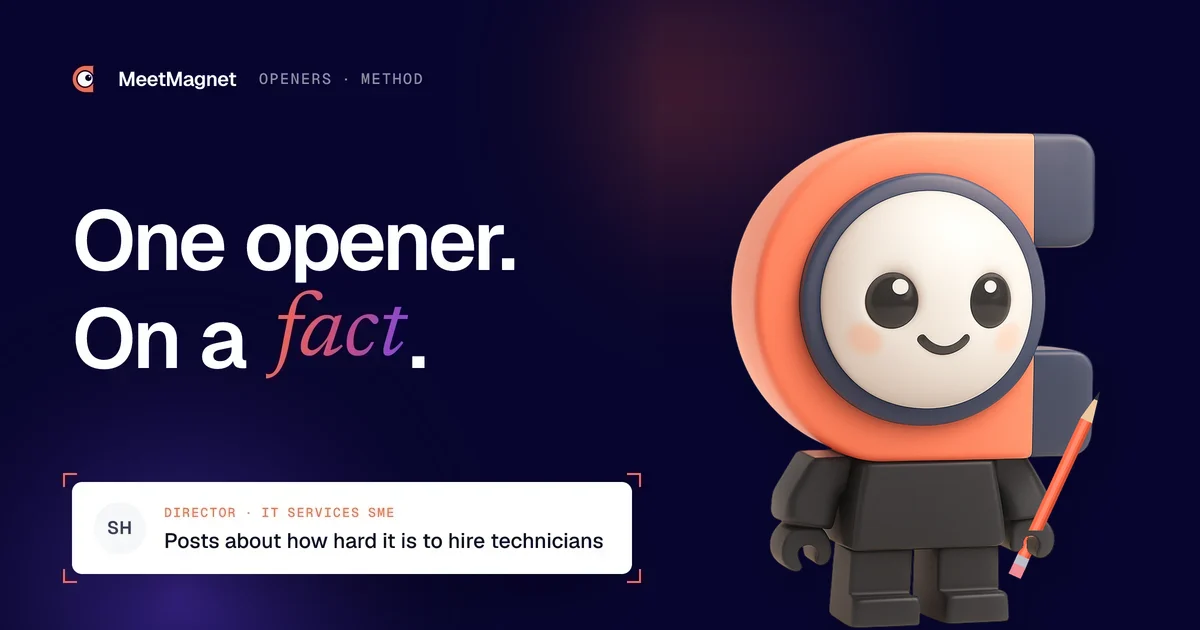
Signal: the managing director of a small IT services firm posts about how hard it is to hire technicians outside the big cities.
Opening line that gets ignored: “Hi, I hope you’re well. I’m reaching out because we help companies like yours grow their revenue.”
Opening line that gets a reply: “Hi Sarah, your post on hiring technicians outside London struck a chord: a lot of MDs are saying the same thing this year. Are you making up for it by subcontracting, or by slowing down on new contracts?”
Which opening lines work for which buying signal?
Here are opening line examples sorted by type of signal. Adapt them to each person’s real situation.
| Signal | Opening line |
|---|---|
| Recent new role | “Three months into a new role is often when priorities get reshuffled. What’s coming first for you?” |
| Active hiring | “You’re hiring two account executives: is that to open up a new market or to keep up with current demand?” |
| New site opening | “A second site in Manchester changes a lot about how you run things. What has taken up most of your time so far?” |
| Post on a topic | “Your post on shrinking margins in construction raised a real question. Do you see the fix on the purchasing side or on pricing?” |
| Reaction to someone else’s post | “Prospecting without a dedicated sales team keeps coming up at the moment. Is that a question you’re asking internally too?” |
| Funding round | “After a raise, there’s usually pressure to speed up on sales. Are you going down the hiring route or the partner route?” |
| Attending a trade show | “You’ll be at the show on Tuesday: are you going mainly to sell, or to scout new suppliers?” |
| Announced software switch | “Moving to a new ERP in peak season is quite a project. How is the data migration going?” |
Notice that none of these opening lines talks about you. They all start from a fact, then ask a question about what the person is doing with it.

How many lines and how many questions?
An opening line fits in one or two sentences, and the whole message in three to six lines. On LinkedIn, the start of the message shows up in the inbox preview: if those first words are generic, the message does not even get opened. The same goes for email, where the preview text next to the subject line often decides whether the email is read at all.
🎯 One question, always. Two questions force the person to choose which one to deal with, and most people then answer neither. The question also has to be easy: it should be answerable in one sentence, without ten minutes of thought.
In an email, the subject line plays the same role as this first line: see our cold email subject line examples.
Once the opening line is right, the rest of the message follows the same logic: a short reason to talk, then the question, and a follow-up later that adds something new instead of repeating the first message.
Does an opening line on the phone follow the same rules?
Yes, with one extra constraint: on the phone, the person decides within a few seconds whether to listen or to cut the call short. Introduce yourself in one sentence, then give the reason for the call straight away, taken from the same real fact: “Hi Ms. Carter, this is Paul Davis, I’m calling because you’re opening a second site in Manchester.” Then ask whether she has two minutes, and ask a single question about her situation.
Avoid “Is this a bad time?”: the easiest answer for the person is to say yes. Our article on how to improve your cold calling covers the rest of the call.
Which phrases should you ban?
❌ Some phrases flag a mass message before they have even been read. You are better off removing them from every opening line:
- “I hope this message finds you well…”: nobody believes you were wondering about it.
- “I came across your profile…”: everyone has seen their profile, it says nothing.
- “Quick question for you”: the question is never quick or small for the person on the receiving end.
- “We help companies like yours to…”: that is a pitch, not an opening line.
- Generic compliments (“great profile”, “inspiring journey”): they ring false and make people uncomfortable.
✅ A good opening line contains none of these phrases, and it could not be sent as it stands to anyone else.
How do you find a buying signal for every opening line?
💡 Writing a good opening line takes two minutes when the signal is right in front of you. The slow part is finding it: going through posts, spotting new appointments, keeping track of announcements. That is the work MeetMagnet does every day on LinkedIn: it spots decision-makers who show a signal, suggests an opening line built on that signal, and lets you review and adjust each message before it goes out.

Frequently asked questions
How do you write a sales opening line?
Start from a real fact about the person: a new role, a hiring push, a post they wrote. Say in one sentence what that fact means for them, in their own words, then end with a single simple question. Avoid talking about your company in the first few lines.
What is the best opening line for prospecting?
There is no universal best line: an opening line that works for everyone works for no one. The best one is the line you could only send to this person, because it rests on a specific fact about their situation and asks a question that actually concerns them.
How long should an opening line be?
One or two sentences. The whole message fits in three to six lines. On LinkedIn as in email, the first words show up in the preview: if they are generic, the message does not get opened, however good the rest of it is.
Should you mention the buying signal in the opening line?
Yes, but naturally. Talk about the topic or the fact, never the technical action: you do not write "I saw you liked a post", you talk about what the post was about. The signal should give you a reason to write, not make the person feel watched.
Etienne Douillard
Co-founder and CEO, MeetMagnet
An engineer and entrepreneur for over five years, Etienne works every week with B2B SMEs on signal-based prospecting.
From intent to booking
MeetMagnet spots who has a reason to talk to you right now, writes the opener that stands out, and a real person keeps it on track.