Prospect says "not interested": how to reply and keep the door open
By Etienne DouillardPublished 7 min read
Contents
- What does “not interested” really mean?
- Should you reply to a “not interested”?
- How should you reply to each type of refusal?
- What should you do when the prospect already has a solution?
- How do you reply to “not interested” on the phone?
- When can you contact a prospect who said no again?
- How do you avoid a string of “not interested” replies?
- How do you learn from your refusals?
- Can a refusal lead to a meeting?
“Not interested.” It is one of the most common replies in prospecting, and many salespeople take it as a failure. Yet a prospect who replies, even to say no, has read your message and taken the time to write back. For a small business owner or a B2B salesperson, the way you answer that “no” often decides what comes next: a door closed for good, or a conversation that picks up again at the right time.
What does “not interested” really mean?
“Not interested” rarely means “never.” Most of the time, the reply hides one of these situations:
- ⏳ It’s not the right time: the topic is real, but other priorities come first this quarter.
- 👤 It’s not the right person: the topic is real, but someone else handles it.
- 💬 The message didn’t land: the person didn’t see how it related to their situation.
- 🧰 They already have a solution: a provider, a tool or an internal setup that works.
- 🚫 It really is a no: the topic doesn’t concern them, and it won’t.
The first four situations leave the door open. Only the fifth truly ends the conversation. The goal of your reply is to find out which case you are dealing with, without pushing.
Should you reply to a “not interested”?
Yes, always, in one or two sentences. Not replying at all leaves a cold impression and wastes a chance to learn something. Replying with a sales pitch, on the other hand, turns a polite refusal into irritation.
The right reply thanks the person, respects the refusal and asks at most one simple question that helps you understand. It doesn’t argue, doesn’t pitch the offer again and doesn’t suggest a meeting.
Example
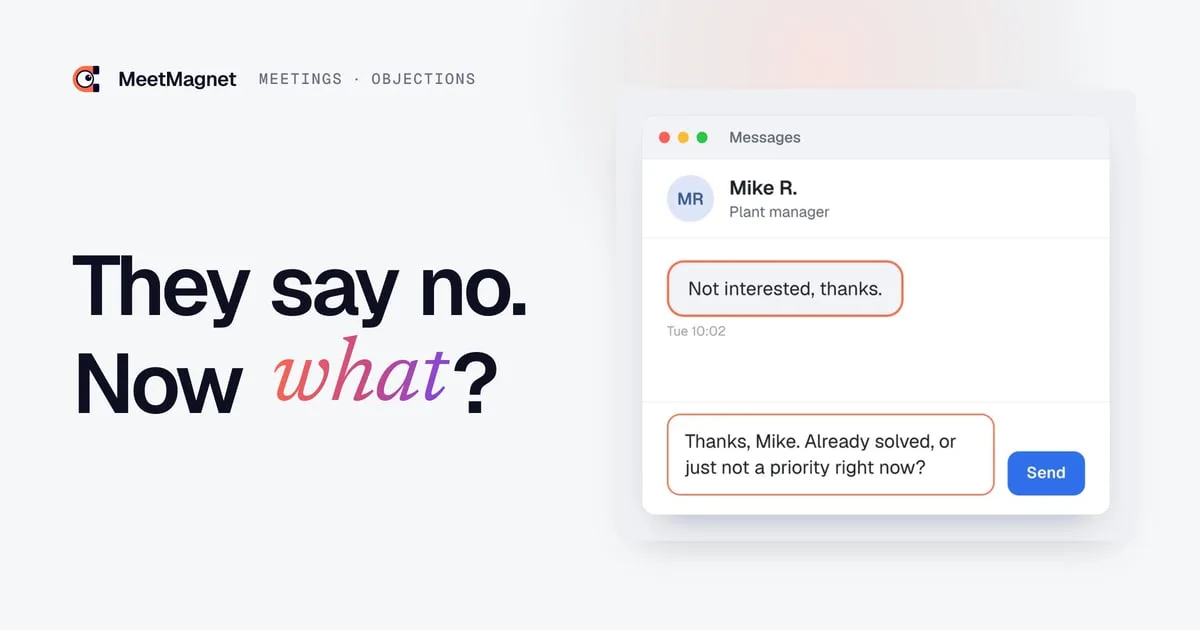
Situation: a plant manager replies “Not interested, thanks” to a first message about how maintenance is organized.
Reply that closes the door: “I understand, but allow me to insist: our solution has a proven track record with many manufacturers and could really help you.”
Reply that keeps the door open: “Thanks for taking the time to reply, Mike. Just so I don’t write to you for nothing: is this something you’ve already solved, or just not a priority right now?”
The second reply lets the person say in one word where they stand. Many people answer, because the question is easy and commits them to nothing.

How should you reply to each type of refusal?
Each type of refusal calls for a different reply. The table below sums up the most common cases.
| Prospect’s reply | What it often means | What you reply |
|---|---|---|
| “Not interested” | Unclear situation | Thanks, plus one question to clarify: solved, or not a priority? |
| “Not now” | The topic exists, later | “When would it make more sense to talk about this again?” and you note the date |
| “I’m not the one who handles this” | Wrong contact | “Who would be the right person? May I reach out and mention you?” |
| “We already have a provider” | Solution in place | A question about what works well, without criticizing the provider |
| “Stop emailing me” | Firm refusal | A one-line apology, and you never write again |
The last case is simple: you respect the request immediately, you log it, and the person comes out of every sequence. Pushing gets you nothing and can create a compliance problem.

What should you do when the prospect already has a solution?
When a prospect replies that they already have a provider or a tool, don’t criticize that choice and don’t jump into a comparison. The best reply shows interest in what works: “Glad you have that in place. What works best for you today?”
This question does two things. It shows you are listening, and it sometimes brings out a gap the person hadn’t put into words: “it works, but we never get enough qualified meetings,” for example. If nothing is missing, you’ve learned something about your market, and the door stays open for later.
How do you reply to “not interested” on the phone?
On the phone, “not interested” often comes in the first few seconds, before the person really knows why you are calling. The rule stays the same: don’t argue. Acknowledge the refusal, then ask a single short question: “I understand, I won’t keep you. Just so I know: is this something you’ve already solved, or is it just not the right time?”
If the answer opens a door, offer to send two lines by email or to call back on a specific date. If not, thank them and hang up: a short, courteous call leaves a better impression than a pitch they had to sit through. To prepare the call itself, see how to improve your cold calling.
When can you contact a prospect who said no again?
You can get back in touch with a prospect who said “not now” or “not a priority” when their situation changes. Not after a fixed delay, but when a new fact gives you a real reason to write again:
- A new role: the person changes jobs, or their replacement arrives.
- A hire: the company is hiring for the area you work on.
- An announcement: a new site, a new market, a funding round.
- A post: the person talks publicly about the problem you solve.
The follow-up message builds on that new fact, not on the old refusal. We explain the method in our article on how to reactivate old prospects.

How do you avoid a string of “not interested” replies?
If most of your replies are refusals, the problem usually starts before the reply: with the timing or the target. A prospect who has no reason to care about the topic this week will reply “not interested,” however good the message is.
Three questions help you diagnose it:
- Did the person have a recent event that made the topic relevant to them right now?
- Was the first message about their situation, or about your offer?
- Was it the right person, the one who owns the topic in the company?
Starting from a buying signal clearly cuts down on refusals, because you are writing to people who are already dealing with the topic. That is the principle we describe in our method for going from a buying signal to a meeting, and in our article on why your prospects don’t reply.
How do you learn from your refusals?
Every refusal carries information, as long as you write it down. A simple spreadsheet is enough: the prospect, the signal that prompted the message, the type of refusal and the date when it would make sense to talk again. After a few weeks, patterns start to show.
- Lots of “not now”: the target is right, but the timing is off. You need more recent signals.
- Lots of “I’m not the one”: you are targeting the wrong roles. Rethink the job titles of the people you contact.
- Lots of “we already have a solution”: the market is already equipped. Look for companies that are changing how they are organized.
- Lots of firm refusals: the message reads like a mass mailing. Rework your opening line.
This tracking turns a discouraging run of refusals into a precise diagnosis. It also keeps you from contacting, by mistake, someone who asked not to be contacted again.
Can a refusal lead to a meeting?
Yes, more often than you might think. A respectful answer to a “not now” leaves a good impression, and the conversation picks up easily when the time comes. An “I’m not the one” handled well gives you the name of the right person, along with an internal referral. A “we already have a provider” can reveal a need right next to it.
At MeetMagnet, every reply from a prospect is classified before anyone answers it: firm refusal, not the right time, wrong person, lukewarm interest or genuine question. The suggested reply follows that classification, it is reviewed before sending, and a firm refusal immediately stops all messages.
Frequently asked questions
How do you reply to a prospect who says "not interested"?
In one or two sentences: thank them for replying, respect their refusal and ask at most one easy question to understand, for example whether the topic is already solved or just not a priority. Don't argue, and don't pitch your offer again in this reply.
Should you push after a refusal in prospecting?
No. Pushing turns a polite refusal into irritation and damages your image. If the refusal is about timing, note when to bring it up again. If the person asks not to be contacted, remove them immediately from all your sequences and never write to them again.
When should you contact a prospect who said no again?
When their situation changes: a new role, a hire in your area, an announcement or a post showing the problem is current. The follow-up message builds on that new fact, not on the old refusal, and it never goes to someone who asked not to be contacted.
Why do you get so many "not interested" replies?
Often because the message goes out at the wrong time or to the wrong person. A prospect who has no reason to care about the topic this week will say no, however good the message is. Starting from a buying signal clearly cuts down on refusals.
Etienne Douillard
Co-founder and CEO, MeetMagnet
An engineer and entrepreneur for over five years, Etienne works every week with B2B SMEs on signal-based prospecting.
From intent to booking
MeetMagnet spots who has a reason to talk to you right now, writes the opener that stands out, and a real person keeps it on track.