Prospect follow-up email: when to follow up and what to write
By Etienne DouillardPublished 7 min read
Contents
- When should you follow up with a prospect?
- How many follow-ups should you send before stopping?
- What should you write in a follow-up email?
- How do you follow up after a first reply?
- How do you follow up after sending a quote?
- Why do your follow-ups go unanswered?
- Which subject line should you use for a follow-up email?
- Should you follow up on a different channel?
A prospect who doesn’t reply hasn’t necessarily said no. Maybe they never saw your message, they were travelling, or the topic simply wasn’t a priority that week. A follow-up email gives them another chance to reply, without annoying them. For a small business owner or a B2B salesperson, the whole game is following up at the right time, with a fresh angle, and knowing when to stop.
When should you follow up with a prospect?
Follow up with a prospect three to seven business days after your first message. Any earlier and the follow-up feels like pressure, because the person hasn’t had time to read the first one yet. Any later and they’ve forgotten your first message, so your follow-up turns into a brand new cold contact.
The right timing also depends on the context:
- After a first message with no reply: three to five business days.
- After a first reply, followed by silence: two to three days, because the conversation is already open.
- After an out-of-office reply: the day after the return date they gave.
- After a “not right now”: on the date the person gave you, or during the month they mentioned.

⚠️ The last case is the one most people get wrong. A “get back to me in January” is not a rejection: it’s a scheduled follow-up. Writing it down and actually honoring it makes a real difference to what happens next. Put it in your CRM or your calendar the same day, with a short note on what was said, so you don’t have to rebuild the context months later.
How many follow-ups should you send before stopping?
One or two follow-ups are enough in the vast majority of cases. Beyond that, every extra message wears down the relationship without really improving your odds of a reply, and it damages your company’s image with someone who could become a customer later on.
👉 A simple rule: stop after two follow-ups with no reply, and wait for a new signal before writing again. A new role, a company announcement or a post on your topic will give you a genuine reason to come back, which works far better than a fourth follow-up.

Example
Situation: a procurement director hasn’t replied to a first message, sent a week ago, about restructuring his supplier base.
Follow-up that gets ignored: “Hi, just circling back on my previous email. Did you get a chance to take a look?”
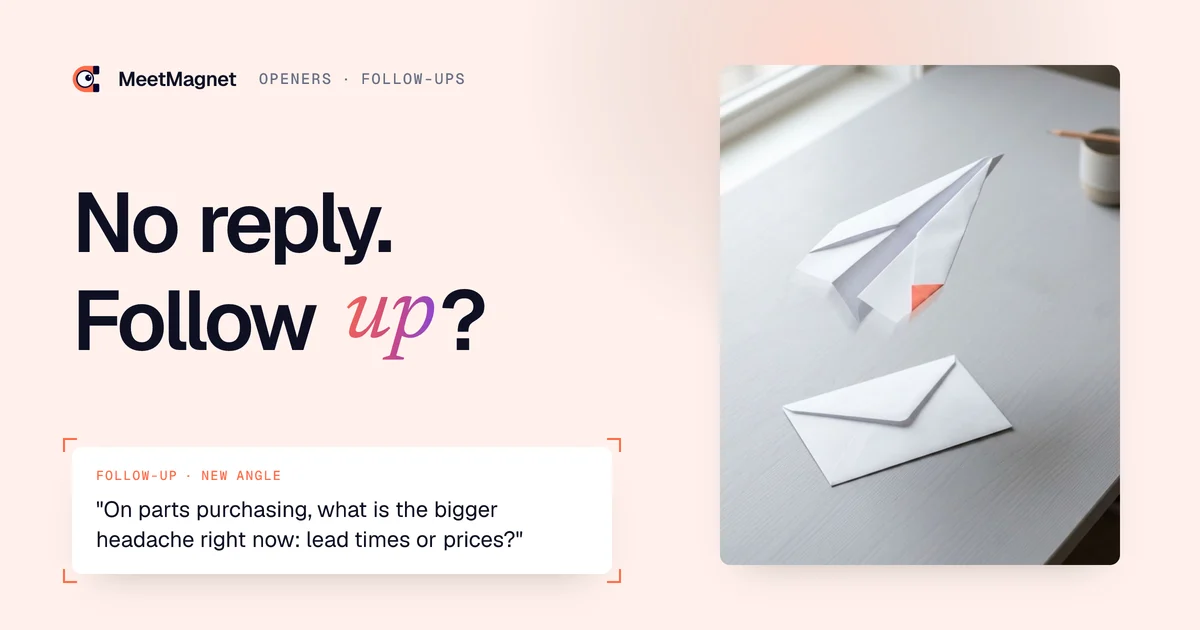
Follow-up that gets a reply: “Hi Mike, let me ask it a different way: on your parts purchasing, is the bigger headache right now lead times or prices?”
What should you write in a follow-up email?
A good follow-up email brings something new. It doesn’t repeat your first message and it doesn’t ask “did you get my email?”. It changes the angle, to give the person a different way in.
Here are four angles that work:
- A different question: the first message asked whether the topic was on their radar; the follow-up asks which part of it causes the most trouble.
- Useful information: a public figure, a regulatory change or an industry trend, tied to what you know about the person.
- A different contact: “You may not be the one handling this: who would be the right person to talk to?”
- 💡 A clear way out: “If now isn’t the right time, just let me know and I won’t follow up again.” This line often gets a reply, because it takes the pressure off.
📌 Keep the follow-up email short: three to five lines. No attachment, no slide deck, and no meeting request yet if the person has never replied. Read it once on your phone before sending it, since that’s where most people will see it first.
How do you follow up after a first reply?
Following up after a first reply is easier, because the conversation already exists. The prospect showed some interest, then the thread went quiet, usually for a mundane reason: a packed day, or a message read on a phone and then forgotten.
In this case, your follow-up picks up the last point of the exchange and suggests a concrete next step. This is often the right moment to propose a meeting, with two specific time slots. Our article on the meeting request email gives you templates to use.
| Situation | Timing | What to write |
|---|---|---|
| No reply to the first message | 3 to 5 business days | A different, more specific question |
| Reply, then silence | 2 to 3 days | The last point of the exchange, then two time slots |
| Out-of-office reply | Day after their return | One line recalling the original question |
| “Not right now” | The date they gave | A reminder of what was said |
| Two follow-ups with no reply | Stop | Wait for a new signal |
How do you follow up after sending a quote?
After you send a quote or a proposal, the follow-up plays a different role: the person already knows your offer, and your job is to help them decide. Follow up on the date you agreed when you sent it. If no date was set, a week gives them time to read it without letting the topic go cold.
The follow-up is about the decision, not about whether the document arrived. Don’t write “did you receive our quote?”, but rather: “Does the proposal match what you had in mind for [topic], or is there anything we should adjust?”. If the quote is stuck on a specific point, such as budget, timing or someone to convince internally, that’s the moment to suggest a short call to sort it out.
Why do your follow-ups go unanswered?
If your follow-ups regularly go unanswered, the problem rarely lies with the follow-up itself. It lies with the first message: there was no specific reason to send it to that person, at that moment. No follow-up can fix a poorly chosen target.

🔍 You can diagnose it with three questions. Did the person have a visible need? Did your first message talk about their situation or about your offer? Was the timing tied to a recent event? If the answer is no to any of these, you’re better off revisiting your targeting than piling on more follow-ups. We cover this in detail in why prospects don’t reply.
This is also where buying signals help. A message sent because someone just changed roles, opened a new site or posted about a problem you solve has a reason to exist, and its follow-up does too.
Which subject line should you use for a follow-up email?
❌ The subject line of a follow-up email should never announce that it’s a follow-up. “Following up”, “Re: my previous email” or “Did you see my message?” tell the recipient they’ve already ignored this topic once, and invite them to do it again. A good subject line picks up the person’s topic instead, in just a few words.
Three approaches work well:
- Pick up their topic: “Your parts purchasing” rather than “Following up”.
- Put the new question in the subject line: “Lead times or prices?”, short and direct.
- Reply in the same thread when following up after an exchange, so the person finds the context without having to search for it.

For more subject line examples, sorted by situation, see our guide to cold email subject lines.
In the body, the first line matters as much as the subject line: it’s what shows up in the inbox preview. It should deliver the new angle straight away, with no apology and no recap of your previous message.
Should you follow up on a different channel?
Switching channels can help, as long as you keep the same logic. If your first message went out on LinkedIn, an email follow-up can reach someone who rarely checks their LinkedIn inbox. The reverse is true too.
⚠️ Two rules keep you from coming across as pushy: never send the same message on two channels on the same day, and stop all follow-ups as soon as the person replies, whatever the channel. A reply on LinkedIn makes the email follow-up you had planned unnecessary.
A follow-up is only one step. The goal is still the meeting, as we describe in our method from buying signal to meeting. At MeetMagnet, every follow-up is reviewed before it goes out, takes a different angle from the previous message, and stops as soon as the prospect replies.
Frequently asked questions
When should you follow up with a prospect who doesn't reply?
Three to seven business days after your first message. Any earlier and the follow-up feels like pressure; any later and the person has forgotten your first message. After an out-of-office reply, follow up the day after their return date, and after a "not right now", on the date they gave you.
How many follow-ups should you send?
One or two. Beyond that, each follow-up wears down the relationship without really improving your chances of a reply. After two follow-ups with no answer, stop and wait for a new signal, such as a new role or a company announcement, which gives you a genuine reason to write again.
How do you follow up without being pushy?
Change the angle with every follow-up: a different question, useful information, another contact. Keep it short, with no attachment or slide deck. And give a clear way out, such as "if now isn't the right time, just let me know", which takes the pressure off and often gets a reply.
Should you suggest a meeting in a follow-up email?
Only if the person has already replied once. In that case, pick up the last point of your exchange and suggest two specific time slots. If they have never replied, your follow-up should first ask a new question to reopen the conversation.
Etienne Douillard
Co-founder and CEO, MeetMagnet
An engineer and entrepreneur for over five years, Etienne works every week with B2B SMEs on signal-based prospecting.
From intent to booking
MeetMagnet spots who has a reason to talk to you right now, writes the opener that stands out, and a real person keeps it on track.