B2B lead generation: 10 methods, and why to start from a signal
By Etienne DouillardPublished 14 min read
AI summary
Too long, didn’t read?
Ask your favourite AI to summarise this article and pull out the points that matter for your business.

Contents
- What is B2B lead generation?
- What is the difference between a lead, a qualified prospect and a meeting?
- What are the 10 B2B lead generation methods?
- How do you compare these lead generation methods?
- Why is a lead that starts from a signal more qualified?
- How do you turn a signal into a meeting?
- Which lead generation methods should a small business choose?
- What mistakes cost you B2B leads?
- How do you generate B2B leads from signals without spending all day on it?
- Sources
Every small business owner has been told they need to “generate leads.” Yet the word covers very different things: a form filled out by a student, a business card swapped at a booth, a purchasing director asking for a quote. B2B lead generation is only worth the effort if it fills your calendar with useful conversations. This guide compares ten methods on three practical criteria, effort, time to first leads and lead quality, and explains why the methods that start from a real event at the prospect’s company produce the most serious conversations.
What is B2B lead generation?
B2B lead generation is the set of actions that surface companies likely to buy your offer, with an identified contact inside each one. A lead is therefore a specific person, at a specific company, with whom a sales conversation becomes possible.
This definition has a simple consequence: a name in a spreadsheet is not a lead yet. As long as you do not know why that person might be interested in you now, you have an address, not an opportunity.
There are generally two broad families:
- Inbound leads: the person comes to you (a form, a demo request, a phone call, a message after reading your content).
- Outbound leads: you go to the person (a message, a call, a conversation at a trade show), because you spotted them.
The two families complement each other. Inbound leads arrive with intent, but you do not choose who shows up. Outbound leads let you choose your targets, but you have to give them a reason to reply.
What is the difference between a lead, a qualified prospect and a meeting?
A lead is an identified contact, a qualified prospect is a lead who fits your target and has a reason to buy, and a meeting is the moment that prospect agrees to talk it over with you. Each stage filters the one before it.

Marketing jargon often adds two acronyms. An MQL (marketing qualified lead) has shown interest, for example by downloading a guide. An SQL (sales qualified lead) has been judged ready for a sales conversation. These labels are useful on a large team; in a small business, only one question matters: would this person agree to a twenty-minute call within the next two weeks?
| Stage | What you know | What you still need |
|---|---|---|
| Contact | A name, a company, a job title | A reason to write to them |
| Lead | The person fits your target | Real interest in the topic |
| Qualified prospect | They have a need and the timing is right | Their agreement to talk |
| Meeting | A date is set | A proposal that speaks to them |
👉 Measure your methods at the bottom of the funnel, not the top. A thousand contacts that produce zero meetings are worth less than thirty leads that produce five.
What are the 10 B2B lead generation methods?
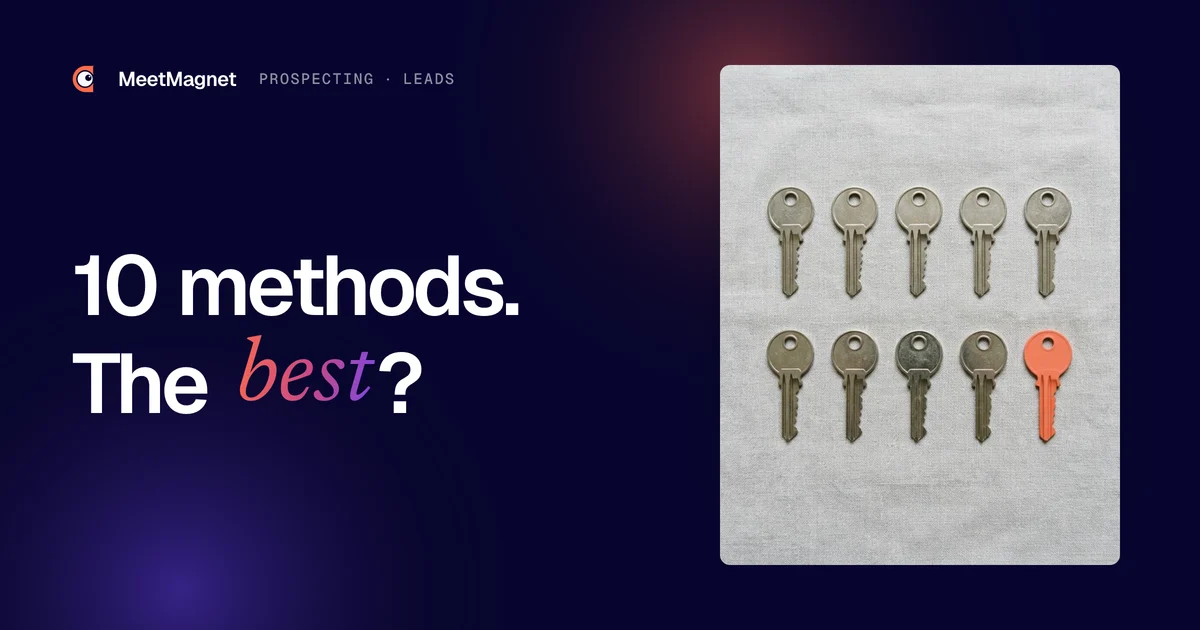
The ten most common B2B methods are SEO, paid advertising, LinkedIn content, cold outreach from a list, trade shows, events you host, referrals, partners, lead marketplaces and prospecting based on buying signals. Each has its own logic, its own timeline and its own type of lead.

1. SEO and content (inbound)
You publish articles, guides or pages that answer your customers’ questions, and search engines send you visitors. Some of them get in touch. It is the most durable method: a good article keeps working for years.
Its limit is time. A young website takes months to rank for competitive searches, and many visitors are students, competitors or the merely curious. 💡 Content works better when it targets very specific questions asked by buyers, rather than broad definitions.
2. Online advertising
Search ads, LinkedIn ads or ads on other networks: you pay to be seen by a targeted audience. The first contacts can come in within days, which makes it the fastest method to launch.
On the flip side, the flow stops as soon as the budget does, and forms filled out in exchange for free content often produce lukewarm leads. Advertising suits offers where the buyer has already put the need into words (“payroll software for small business,” for example).
3. Content and presence on LinkedIn
Posting regularly, commenting on your customers’ posts, sharing what you see in the field: this is what people call social selling. Your profile becomes a storefront, and decision-makers write to you or react to your posts.
It is a long-term, daily effort whose results arrive over weeks or months. It has one valuable advantage: the people who react to your posts are telling you themselves that a topic matters to them.
4. Cold outreach from a list
You build a list of companies based on criteria (industry, size, region, job title), then you email or call. It is the most widely used method, and the most criticized, because it is often done at volume with the same message for everyone.
Done well, it is still useful: it lets you choose your targets. Done badly, it wears down your reputation and your email domain. ⚠️ In France, where this guide’s examples come from, the CNIL (the French data protection authority) allows prospecting emails to professionals without prior consent if the message relates to their job, provided they were informed and can easily opt out; check the rules that apply in your own market.
5. Trade shows
A trade show brings an industry’s buyers together in two or three days. The conversations are real, face to face, and the contacts you make often have a project in mind. It is a very popular method in manufacturing.
It is expensive (booth, travel, team time) and it produces spikes: lots of contacts in one week, then nothing. Without preparation and fast follow-up, many of the business cards end up in a drawer. We cover the method in detail in our article on trade show prospecting.
6. Events you host
A breakfast, a workshop, a webinar, a plant tour: you invite your targets around a topic that concerns them. Attendees spend time with you, which builds trust and makes the next step easier.
Organizing takes work, and attendance is often disappointing for online formats. 🎯 An event works when the topic is a concrete problem your customers face, not a presentation of your offer.
7. Referrals and word of mouth
A happy customer introduces you to a peer, a former colleague, a supplier. For a small business, this is often the best source of leads: trust is already there, and the sales cycle is shorter.
The problem is that you cannot steer it. It depends on how satisfied your customers are and on their network. You can still encourage it: ask directly for an introduction at the end of a successful project, and stay in touch with customers who move to a new company.
8. Partners and referral agents
An accountant, an integrator, a vendor of complementary software or an independent consultant meets your future customers before you do. A well-built partnership brings you leads that have already been introduced.
Finding the right partners and maintaining the relationship takes time. A partner only recommends what they know well and what serves their own customers: the relationship has to be useful both ways.
9. Lead marketplaces and buying leads
Vendor directories, RFP platforms, B2B marketplaces, agencies that sell contacts: you receive requests or lists, paying per contact or by subscription.
The requests are real, but they are often sent to several vendors at once, which pushes prices down. ❌ Purchased contact lists, for their part, are rarely up to date and tell you nothing about the need.
10. Prospecting based on buying signals
You spot a recent event that makes your offer relevant to a company: a new director taking the job, a hire in your area, a post in which an executive talks about the problem you solve, a funding round, a move to new premises. You write to the right person, starting from that event.
It is a form of outbound prospecting, but the starting point changes everything: you no longer contact someone because they are on a list, but because something is happening to them. Our article on B2B buying signals gives twenty-five examples.
How do you compare these lead generation methods?
To choose, compare each method on three criteria: the effort it takes, the time before the first leads and the quality of the leads you get. The table below gives our qualitative assessment for a B2B small business that is just starting out; it is not a measurement, and your results will depend on your market.
| Method | Effort | Time to first leads | Lead quality | Main limit |
|---|---|---|---|---|
| SEO and content | High | Long (several months) | Variable | Not every visitor is a buyer |
| Online advertising | Medium | Short (days) | Average | Stops when the budget stops |
| LinkedIn content | High and ongoing | Medium (weeks) | Good | Requires consistency |
| Cold outreach from a list | Medium | Short | Low to average | No reason to write |
| Trade shows | High, occasional | Short but in spikes | Good | Cost and seasonality |
| Hosted events | High | Medium | Good | Attendance rate |
| Referrals | Low | Unpredictable | Very good | Cannot be steered |
| Partners | Medium | Long | Good | Time to build |
| Marketplaces and bought leads | Low | Short | Average | Competing bids |
| Buying signals | Medium | Short | Good to very good | Requires monitoring |
Two takeaways stand out from this table. The fastest methods (advertising, lists, marketplaces) produce average-quality leads. The methods that produce the best leads (referrals, partners, content) are slow or unpredictable.

📌 Buying signals are the only method that combines a short timeline with good quality, because they add what outbound prospecting lacks: a reason to write.
Why is a lead that starts from a signal more qualified?
A lead that starts from a signal is more qualified because it brings together three conditions the other methods keep apart: the right company, the right person and the right time. A lead’s quality does not depend on its source; it depends on what you know about the situation.
Let’s go back over those three conditions:
- ✅ The right company: one that fits your target (industry, size, structure). A list is enough for this.
- ✅ The right person: the one who owns the topic and can decide or influence. Good targeting by job title is enough here too.
- ✅ The right time: the moment the topic becomes a priority. This is the one criterion that no list or database gives you.
A buying signal gives you that third criterion. A new head of operations often reviews suppliers in the first few months. A company hiring three salespeople will start asking how to equip them. An executive who posts about how hard it is to win customers abroad is living that problem this week.
The signal has a second effect that is often underestimated: it gives you the content of your first message. You no longer have to make up a generic opener; you talk about what is happening to the person. That is what separates a message that gets deleted from one that gets a reply. Before you write, you still need to check that the signal is recent and that it really concerns the person you are contacting.
How do you turn a signal into a meeting?
You turn a signal into a meeting in four steps: spot the event, check that it concerns the right person, write a first message that starts from that event, then suggest a short call when the conversation allows. Skip a step and you are back to cold prospecting.
Example
Situation: a small business sells maintenance services for machine tools. It notices that a precision machining company has just appointed a new production manager, who comes from a larger group.
Message that misses: “Hello, we have specialized in industrial maintenance for twenty years. Our customers reduce production downtime thanks to our method. Would you be available for a 30-minute call this week?”
Message that works: “Hi Claire, congratulations on taking over production. When you take over a shop floor, you usually discover the real condition of the machines in the first few weeks. Is maintenance one of the things you’re looking at right now?”
The first message talks about the company that is writing and asks a stranger for thirty minutes. The second talks about her situation, shows the sender understands what she is going through, and asks a question she can answer in one line. 💡 Suggest the meeting in the second or third exchange, once the person has confirmed the topic concerns them.
We cover these steps in detail in our method for going from a buying signal to a meeting.
Which lead generation methods should a small business choose?
A small business has neither the budget nor the time to run ten methods at once: pick two or three that complement each other, one fast and one durable, and measure them by the number of meetings they produce. The rest can come once those two are running.
Here is a rollout order that works for most B2B small businesses:
- Define your ideal customer: industry, size, the buyer’s job title, and above all the situations that trigger a purchase for them.
- Activate referrals: list your satisfied customers and simply ask them whether they know someone going through the same situation.
- Launch a fast, targeted method: prospecting based on buying signals, which gets you conversations within the following weeks.
- Build a durable method: a regular presence on LinkedIn or a few in-depth pieces of content that answer your customers’ questions.
- Add the rest depending on your industry: a trade show if your buyers attend one, partners if other vendors meet your customers before you do.
- Measure every month: number of leads, number of conversations, number of meetings, for each method.
👀 The trigger situations from step 1 are the starting point for everything else: they are what you will look for as signals, and they will feed your content and your messages.
To build this plan week by week, write it down as a simple prospecting plan: your target, your chosen signals, your messages and a weekly review of the numbers.
What mistakes cost you B2B leads?
The first mistake is counting leads instead of meetings; almost all the others stem from it. A method that produces lots of contacts looks good on a dashboard, but it does not help sales if nobody wants to talk.
The most common mistakes:
- ❌ Sending everyone the same message: a prospect recognizes a mass email from the first line.
- ❌ Letting an inbound lead go cold: a request handled three days later has often already found an answer elsewhere.
- ❌ Buying lists without knowing where they come from: the contacts are often out of date, and you cannot show where the data came from if someone asks.
- ❌ Asking for a meeting in the first message: you are asking for time before you have shown that you understand the situation.
- ❌ Not following up: no reply often means “didn’t see it” or “not now,” rarely “no.”
- ❌ Pushing after a clear no: a person who asks not to be contacted again comes out of all your sequences, immediately.
⚠️ One last mistake is less obvious: switching methods every month. Most methods need a few weeks of tuning (target, message, cadence) before they show what they can do. Judge a method over a quarter, using the same metrics.
How do you generate B2B leads from signals without spending all day on it?
By tracking a few well-chosen signals rather than every possible signal, and by keeping a human in charge of judging each message before it goes out. Manual monitoring works at first, but it quickly turns into a full-time job.
To start by hand, three habits are enough:
- Choose three to five signals that genuinely announce a purchase in your line of business (a new job, a hire, a post about your topic).
- Check them every week on LinkedIn and in your targets’ job postings, using a short list of companies.
- Write within a few days, while the event is recent and the person still remembers it.
That is the work MeetMagnet does. The tool tracks on LinkedIn the intents you define with us (new roles, hires, posts and reactions on your topic), suggests an opener built on each signal, which you review before sending, then runs the sequence across LinkedIn and email. Funnel statistics show, signal by signal, what produces replies and meetings, and the tool connects to Claude to analyze your results.

🚀 Whatever method you choose, keep the same compass: a good lead is a person who has a reason to reply to you this week.
Sources
- “La prospection commerciale par courrier électronique, SMS-MMS et automate d’appel”, CNIL, accessed October 2, 2026, https://www.cnil.fr/fr/la-prospection-commerciale-par-courrier-electronique-sms-mms-et-automate-dappel
Frequently asked questions
What is the best B2B lead generation method?
There is no single one. Referrals often bring the best leads, but you cannot steer them. For a small business, the most effective approach is to combine a fast, targeted method, such as prospecting based on buying signals, with a durable one, such as content or a regular presence on LinkedIn.
What is the difference between inbound and outbound in B2B?
With inbound, the prospect comes to you after finding your content, an ad or your website. With outbound, you reach out by message, call or in person. Inbound brings intent but you do not choose who comes; outbound lets you choose your targets, as long as you give them a reason to reply.
How long does it take to generate B2B leads?
It depends on the method. Advertising, marketplaces and signal-based prospecting can produce first contacts within days or weeks. SEO, partnerships and content take several months. Judge each method over at least a quarter, using the number of meetings it actually produces as your yardstick.
Should you buy B2B lead lists?
It is rarely a good idea. Purchased lists are often out of date, say nothing about the need or the timing, and raise questions about where the data comes from. A short list of well-targeted companies, tracked over time to spot those going through a change related to your offer, works better.
Etienne Douillard
Co-founder and CEO, MeetMagnet
An engineer and entrepreneur for over five years, Etienne works every week with B2B SMEs on signal-based prospecting.
From intent to booking
MeetMagnet spots who has a reason to talk to you right now, writes the opener that stands out, and a real person keeps it on track.