Trade show prospecting: what to do before, during and after
By Etienne DouillardPublished 8 min read
AI summary
Too long, didn’t read?
Ask your favourite AI to summarise this article and pull out the points that matter for your business.

Contents
- Why is a trade show a buying signal?
- Which signals should you look for before the show?
- How do you write the opening line before the show?
- What should you do during the show?
- How do you turn a booth conversation into a meeting?
- Which mistakes should you avoid at a trade show?
- Can you prospect a trade show without attending?
- Sources
A trade show brings together, over two or three days, companies that have decided to spend time and budget on one precise topic. For a small business owner or a B2B salesperson, it is one of the rare moments when buying intent becomes visible before the first conversation even starts. You still have to know how to read it before the show, during the show and in the days that follow.
Why is a trade show a buying signal?
A trade show is a buying signal because it forces every participant to reveal a priority. An exhibitor has booked a stand and prepared a pitch: they are looking for customers, partners or distributors. A visitor has registered and blocked a day in their calendar: they are comparing solutions, keeping an eye on their market or preparing a project.
The format is still very much alive. In France, the UNIMEV observatory reported by Voyages d’Affaires shows that in the second quarter of 2026, B2B trade shows gained 9.3% more exhibitors and 9.4% more visitors year on year. Companies keep going to shows to buy and to sell.

Not every participant is worth the same, though. A trade show mainly gives three kinds of signals:
- The presence signal: the company exhibits or announces it will be there. A timing signal, useful to target the right week.
- The topic signal: someone posts about the theme of the show, comments on a talk or shares the agenda. An interest signal, useful for the opening line.
- The project signal: a product launch, a new plant or a hiring push announced during the show. It is the strongest, because it creates a concrete need in the following weeks.

For the general method, see our guide to trigger events in sales prospecting.
Which signals should you look for before the show?
The useful work starts two to three weeks before the doors open. At that point, calendars are not full yet and announcements start coming in.
- The exhibitor list. It is public for almost every show. It gives you companies, not people: you then need to find the right decision maker in each one, usually the head of sales, the managing director or whoever owns the topic you work on.
- Attendance announcements on LinkedIn. “Come and see us at booth B42”, “I’ll be at the show on Tuesday”: these posts give you the company, the person and the day at once. It is the best starting point, because the person said where they will be.
- Interactions with the show’s page. People who react to posts from the organizer or the speakers show an interest in the theme, even if they don’t attend.
- Recent role changes. A new sales director who visits a show in their first three months is often looking for new suppliers.
- Job postings linked to the theme. A company hiring on the topic of the show is preparing a project: the show helps it compare options.

👉 A simple rule helps you sort: contact first the people who combine two signals, for example an attendance announcement and a recent role change. Our article on how to qualify a buying signal covers this sorting in detail.
How do you write the opening line before the show?
The message before a show should fit in a few lines and talk about the person, not about your booth. The classic mistake is sending the same invitation to every participant. People spot it right away and ignore it.
Example
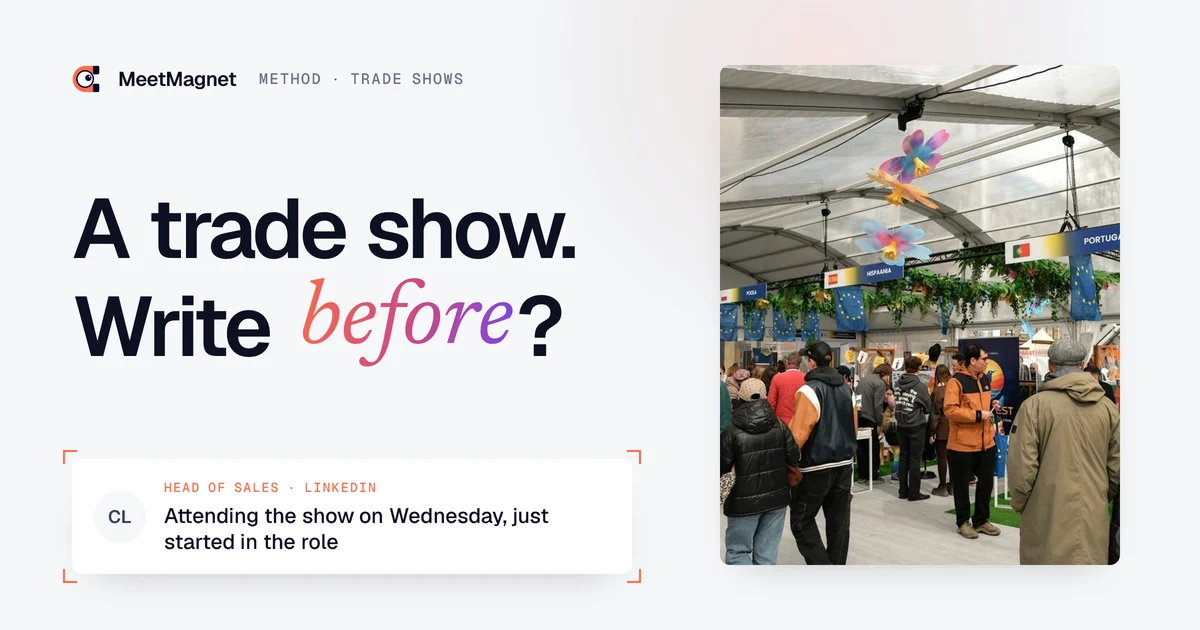
Signal: the head of sales of a small industrial equipment company announces on LinkedIn that she will attend the show on Wednesday, and she has just started in the role.
Opening that gets ignored: “Hi, we are exhibiting at the show, booth C12. Come and discover our solution that improves sales performance.”
Opening that gets a reply: “Hi Claire, starting a new role right before the show is not the quietest timing. Are you going mostly to meet customers, or to look at new distributors?”
✅ The second opening works because it builds on what the person said herself, acknowledges her situation and ends with a single, easy question. It does not ask for a meeting yet: it opens a conversation you can continue on site.
What should you do during the show?
During the show, the goal is not to collect as many business cards as possible, but to write down facts you can reuse. A card with no context is almost worthless three days later.
To approach a visitor at your booth, avoid “Can I help you?”, which almost always gets a “no thanks”. Start from what they are looking at or the company on their badge, then ask an open question about their project: “Are you mostly comparing options, or do you have a specific project this year?”. If the answer shows a need, offer to pick up the conversation after the show rather than running through your presentation standing in the aisle.
After each useful conversation, write one line with:
- what the person is looking for, in their own words;
- the deadline they mentioned, if any;
- the next step you agreed on, and its date.

💡 Also follow what gets posted live. Announcements made during the show, such as a new product, a partnership or a new site, are often the strongest signals of the week, and few salespeople act on them.
If you are not exhibiting, the show is still useful. You can offer a coffee nearby to the people you talked to beforehand, or simply use the show as a reason for an online conversation the following week. What matters is having a precise reason to write.
How do you turn a booth conversation into a meeting?
🎯 A booth conversation turns into a meeting when the follow-up goes out quickly and picks up a precise detail from the conversation. The right window is 24 to 72 hours: after that, the person has met dozens of people and has forgotten you.
The follow-up message has three parts:
- The concrete reminder: “You mentioned your new warehouse opening in Lyon in January.”
- Something useful: a piece of information linked to what they said, with no brochure and no generic presentation.
- The proposal: two precise slots for a 20-minute video call the following week.
If that message goes unanswered, a single follow-up with a new angle is enough: our prospect follow-up email examples show how to write it.
This is the logic we describe in our method from buying signal to meeting: the signal gives you a reason to write, the opening gets the reply, qualification gets the meeting.
For manufacturing companies, which still live largely to the rhythm of trade shows, we also cover the buying signals beyond trade shows.
Which mistakes should you avoid at a trade show?
| Mistake | Why it fails | What to do instead |
|---|---|---|
| Sending the same invitation to the whole exhibitor list | The message is about you, not them | Write only to people with a signal, with an opening on that signal |
| Writing too early, a month before | The person has forgotten the show day | Write two to three weeks before, then the day before if they replied |
| Asking for a meeting in the first message | The request comes with no reason | Ask a question, suggest the meeting once they reply |
| Keeping business cards with no notes | The follow-up becomes generic | Note the need, the deadline and the next step after each conversation |
| Following up three times during show week | Messages pile up in a crowded inbox | One follow-up at most, with a new angle |
Can you prospect a trade show without attending?
📌 Yes, and it is often underestimated. An exhibiting company has paid to be seen: its leaders are available and open to conversations for the whole period of the show. You can write to relevant exhibitors with an opening about their presence, without being there, and suggest a video call after the event.
This is where a detection tool changes the work. MeetMagnet spots on LinkedIn the decision makers who announce they will attend a show or react to its posts, suggests an opening line built on that signal, and lets you approve each message before it goes out.
Sources
- “L’Observatoire UNIMEV confirme la dynamique des salons”, Voyages d’Affaires, 30 July 2026, https://www.voyages-d-affaires.com/observatoire-unimev-dynamique-salons
Frequently asked questions
How long before a trade show should you contact attendees?
Two to three weeks before the doors open. Earlier, the person has forgotten the show by the day itself; later, their calendar is already full. If they reply, a short message the day before lets you confirm a slot on site or a coffee nearby.
Where can you find the list of trade show attendees?
The exhibitor list is public for almost every show. The visitor list rarely is. Attendance announcements posted on LinkedIn, with the person's name and the day they will come, partly fill that gap and give you the best starting point.
Do you need to exhibit to prospect at a trade show?
No. Exhibitors have paid to be seen and stay open to conversations for the whole period of the show. You can write to them with an opening about their presence, suggest a coffee on site if you go, or a video call in the following week.
When should you follow up with a contact met at a trade show?
Within 24 to 72 hours. After that, the person has met dozens of people and no longer makes the connection. The message should pick up a precise detail from the conversation, bring something useful and suggest two slots for a 20-minute meeting.
Etienne Douillard
Co-founder and CEO, MeetMagnet
An engineer and entrepreneur for over five years, Etienne works every week with B2B SMEs on signal-based prospecting.
From intent to booking
MeetMagnet spots who has a reason to talk to you right now, writes the opener that stands out, and a real person keeps it on track.