Lead scoring: score prospects on signals, not clicks
By Etienne DouillardPublished 10 min read
AI summary
Too long, didn’t read?
Ask your favourite AI to summarise this article and pull out the points that matter for your business.

Contents
- What is lead scoring?
- Why does scoring prospects on clicks produce bad scores?
- Which profile criteria should you use to score a prospect?
- Which timing signals should lead scoring take into account?
- How do you build a lead scoring model?
- What thresholds should you set before taking action?
- What lead scoring mistakes should you avoid?
- How can a small business do lead scoring without heavy software?
- Sources
When your list of prospects gets longer, you can no longer write to everyone with the same care. You have to choose where to start. That is what lead scoring is for: giving each prospect a score that tells you whether they deserve your attention this week. But you still need to score the right things, because many scoring models count clicks and email opens that say almost nothing about whether someone wants to buy.
What is lead scoring?
Lead scoring is a method that assigns points to each prospect based on criteria defined in advance, in order to rank contacts by priority. The higher the score, the sooner and more carefully the prospect deserves to be contacted.
A lead score actually answers two different questions, and it is better to keep them apart:
- Is this prospect a fit for me? This is the profile, or “fit”: industry, company size, job title, region. It changes little over time.
- Is this the right time for them? This is behavior and context: a recent change, a project, a question they asked. It changes from one week to the next.
A perfectly targeted prospect with no project is not a priority. Neither is a prospect going through a major change who falls outside your target. Good prospects have both, and that is what the score should bring to the surface.
Why does scoring prospects on clicks produce bad scores?
Because a click or an open measures an interaction with your own messages, not a situation at the prospect’s company. Most marketing automation tools score what they can see best: email opens, clicks, pages visited. These traces are easy to count, but they say little about the desire to buy.
The email open is the clearest example. On iPhone, the Mail Privacy Protection feature, according to Apple, prevents senders from seeing whether their email was opened. Tools that count opens therefore receive skewed data. ⚠️ A prospect can gain points for an email they never read, and jump ahead of a real buyer.
Other clicks raise similar problems:
- ❌ Link clicks may come from a security filter that tests links before anyone reads the email.
- ❌ Page visits also count competitors, job applicants and the merely curious.
- ❌ Downloading a guide shows interest in a topic, not a plan to buy.
These traces are not useless, but they should carry little weight. A model built mostly on them ranks at the top the people who interact most with your campaigns, not the ones who have a need.

Which profile criteria should you use to score a prospect?
Profile criteria check that the company and the person match your real customers: industry, size, role in the decision and geographic area. Define them from your best current customers, not from an imagined ideal.
To find them, look at your ten or fifteen best customers and write down what they have in common. The criteria that come up most often are:
- Industry: the one where your offer has already proven itself.
- Company size: headcount or revenue, whichever matters for your offer.
- The person’s job title: the one who owns the topic, and how much decision power they have.
- Geographic area: if you work on site or in certain languages.
- Equipment or organization: for example, their own plant, a sales team, software they already use.
👉 Keep few profile criteria, four or five at most. Beyond that, scores become hard to read and hard to explain to the team.
Job title deserves special attention. At a small customer company, the owner often decides alone; at a larger company, several people are involved. Our article on the best time to contact a prospect looks at how to spot a hot prospect.
Which timing signals should lead scoring take into account?
Timing signals are recent events showing that a topic is becoming a priority for the prospect: a new role, a hire, a post about your topic, an announced project, growth. They are what separate a well-targeted prospect from a prospect who is ready to talk.
The most useful signals in B2B can be observed publicly:
- ✅ A new role: a new manager often reviews priorities and suppliers in the first few months.
- ✅ A hire in your area: a job posting that describes the problem you solve.
- ✅ A post or a comment: the person talks about the topic themselves, or reacts to someone who does.
- ✅ A change at the company: a funding round, a move, a new site, a new market.
- ✅ A direct request: a contact form, a question, a request for a quote.
The more recent a signal, the more it is worth. A job posting published a week ago counts for more than a new role from ten months ago. 💡 So build a time decay into your model, for example halving the points after two months.
Do not confuse these signals with intent data bought from vendors, which aggregates content consumption on a topic, often at the company level. The difference is explained in our article on intent data vs buying signals.
How do you build a lead scoring model?
You build a lead scoring model by listing your profile criteria and your timing signals, giving each one a number of points, then checking the model against real customers and prospects. The table below is an example to adapt, not a standard: the points depend on your market.
| Criterion | Type | Points (example) |
|---|---|---|
| Industry where you already have customers | Profile | 15 |
| Size in your core target | Profile | 10 |
| Job title that decides or owns the topic | Profile | 15 |
| Area you serve | Profile | 5 |
| New role less than 3 months old | Timing | 20 |
| Hiring in your area | Timing | 20 |
| Post or comment on your topic | Timing | 15 |
| Contact or quote request | Timing | 30 |
| Email open | Click | 0 |
| Homepage visit | Click | 2 |
| Excluded industry or competitor | Exclusion | Removed from the list |
In this example, the profile is worth 45 points at most, and timing can add much more, because timing is what triggers the outreach. An email open earns nothing, for the reasons covered above.

To put the model in place, follow these steps:
- Start from your customers: score your last ten customers with the model. Almost all of them should get a high score.
- Test it on lost prospects: those who never bought should score lower.
- Adjust the points: if a criterion does not separate the two groups, lower it or remove it.
- Set the thresholds: decide at what score you write, and at what score you wait.
- Review the model every quarter: against the meetings and sales you actually got.
📌 A model that does not rank your current customers at the top will not rank your future customers any better.
Example
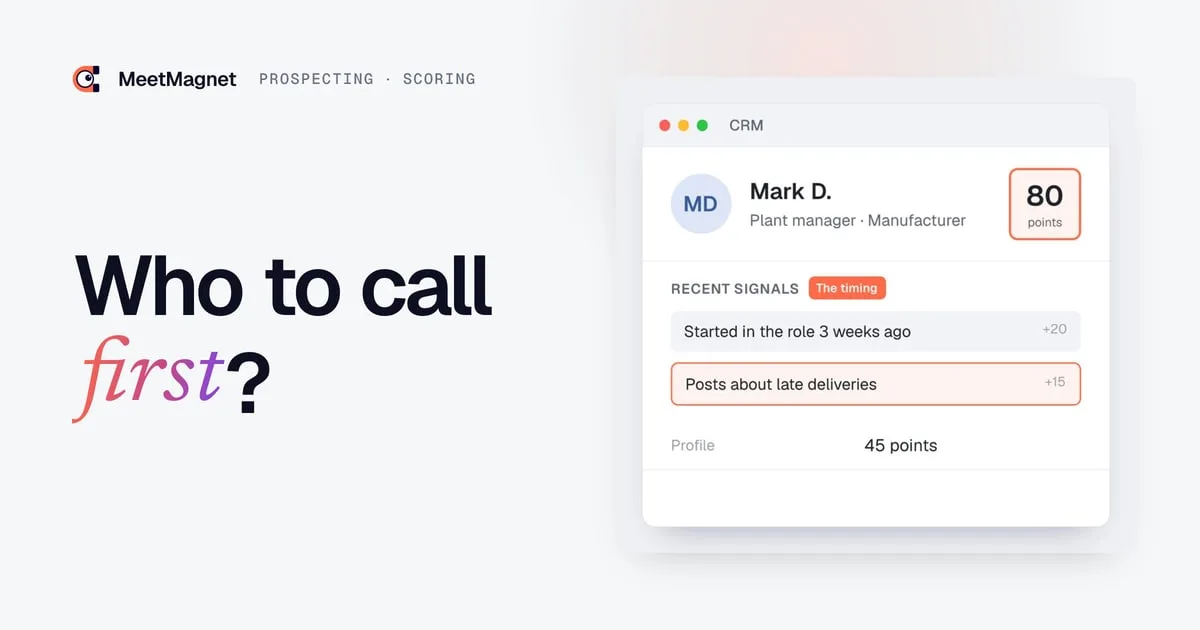
Situation: a consulting firm specializing in manufacturing operations compares two prospects. The first, operations director at a small business in the target, has opened four emails and clicked twice, with no other sign. The second, who became plant manager three weeks ago at a company in the target, posted on LinkedIn about late deliveries at his site.
With a click-based model, the first one comes out ahead. With the model above, the first scores 45 points (profile only) and the second 80 (profile, new role and post): he is the one you write to.
Message that misses: “Hello, I saw you were interested in our content. Would you be available for a demo?”
Message that works: “Hi Mark, I read your post about late deliveries. When you take over a plant, that’s often the first issue that surfaces. Do you already have a lead on it, or are you still diagnosing?”
The message that misses relies on a click the prospect does not remember making. The message that works starts from something the person knows, since he wrote it himself, and asks him a simple question.

What thresholds should you set before taking action?
Set three simple levels: contact this week, keep an eye on, and set aside. Each level matches a specific action; otherwise the score is useless.
| Level | Score (in the example) | What you do |
|---|---|---|
| Priority | 70 and above | Personalized message within a few days |
| Watch list | 40 to 69 | Follow the account and wait for a timing signal |
| Out of target | Below 40 | Do not contact |
The middle level is the most useful. It groups well-targeted prospects who do not yet have a reason to talk to you. 👀 These are the ones to follow closely: the day a signal appears, they move into the first column.
Set the thresholds according to your capacity. If your team can write thirty careful messages a week, the priority threshold should surface around thirty prospects, not three hundred.
What lead scoring mistakes should you avoid?
The most common mistake is scoring activity on your campaigns instead of the prospect’s situation. The others usually come from a model that is too complex or never questioned.
Common pitfalls:
- ❌ Giving points for email opens: the measure is skewed and says nothing about the need.
- ❌ Adding up points with no cap: a prospect who clicks twenty times ends up with a huge score and no project at all.
- ❌ Forgetting how old signals are: a new role from a year ago is not worth much anymore.
- ❌ Piling on criteria: a thirty-line model becomes a black box nobody looks at.
- ❌ Never comparing the score with sales: the model needs to be corrected based on the meetings you actually get.
⚠️ A score does not replace reading the context. Before writing, a human checks that the signal really concerns the person and that it is still current. The method is laid out in our article on how to qualify a buying signal.
How can a small business do lead scoring without heavy software?
A small business can do lead scoring with a spreadsheet and an hour a week: one column per profile criterion, one column for the latest signal and its date, and a formula that adds it all up. Software only adds real value once the model is already good.
A simple setup is enough to get started:
- A list of 100 to 300 accounts in your target, scored once on profile.
- A weekly pass over LinkedIn and these accounts’ job postings, to log new signals.
- A score recalculated every week, including the decay based on how old signals are.
- One action per priority prospect: a message that starts from the signal, then a follow-up if needed.
🚀 What matters is not the precision of the points but consistency: the same model, applied every week, quickly teaches you which signals actually lead to meetings.
When monitoring takes too much time, MeetMagnet handles that part of the work. It tracks on LinkedIn the intents defined with you (new roles, hires, posts and reactions on your topic), suggests an opener for each prospect built on the signal, which you review before sending, and runs the sequence across LinkedIn and email. Funnel statistics show which signals produce replies, which helps you correct your model, and the tool connects to Claude to analyze those results.

Sources
- « Utiliser « Protection de la confidentialité dans Mail » sur l’iPhone », Apple Support, accessed October 2, 2026, https://support.apple.com/fr-fr/guide/iphone/iphf084865c7/ios
Frequently asked questions
What is a good lead score?
A good score is one that ranks your current customers at the top when you run them through the model. The absolute number matters little: what counts is that prospects above the priority threshold have both the right profile and a recent signal that makes your topic relevant to them right now.
Should lead scoring count email opens?
No, or only very little. On iPhone, Mail Privacy Protection prevents senders from knowing whether an email was opened, which skews this metric. Even a real open says little about the need. It is better to score observable facts at the prospect's company, such as someone starting a new role.
What is the difference between lead scoring and lead qualification?
Lead scoring ranks a list of prospects automatically or semi-automatically using a points model. Qualification is the human judgment made about a specific prospect, often during a conversation: do they have a need, a budget, a timeline? Scoring decides who to write to; qualification confirms it is worth continuing.
Can you do lead scoring without software?
Yes. A spreadsheet is enough for a small business: one column per profile criterion, one column for the latest signal observed and its date, and a formula that adds up the points. The key is to update the score every week and compare it with the meetings you actually get.
Etienne Douillard
Co-founder and CEO, MeetMagnet
An engineer and entrepreneur for over five years, Etienne works every week with B2B SMEs on signal-based prospecting.
From intent to booking
MeetMagnet spots who has a reason to talk to you right now, writes the opener that stands out, and a real person keeps it on track.