How many prospects to contact per week to get X meetings? Working it out backwards
By Etienne DouillardUpdated 12 min read
Too long, didn’t read?
Ask your favourite AI to summarise this article and pull out the points that matter for your business.

Contents
- How many prospects to contact per week to get X meetings?
- How do you work the calculation backwards, step by step?
- How many prospects to contact per day?
- What limits your prospecting volume?
- More volume or better prospects?
- Which mistakes break this calculation?
- How do you replace our ratios with yours?
- Sources
How many prospects should you contact per week to get the number of meetings you are aiming for? Most answers online give a figure per day, often designed for mass emailing. Here we do the opposite: we start from your meetings, work back up the funnel with real, dated ratios, and look at what limits the volume. It is not a promise, it is a method, with its assumptions written down in black and white.
📌 Key points
- The calculation fits on one line: meetings you want ÷ share of replies that become a meeting ÷ reply rate = prospects to contact.
- With our ratios (27 client accounts, as of 9 October 2026), 4 meetings a month take about 63 prospects contacted per week, and 72 with the median reply rate of our accounts.
- If your reply rate looks like our lowest account (12%), you need more than twice as many: about 157 per week, beyond what LinkedIn lets you invite.
- Three limits matter more than the calculation: the LinkedIn invitation quota, the number of signals available each week and the size of your target market.
How many prospects to contact per week to get X meetings?
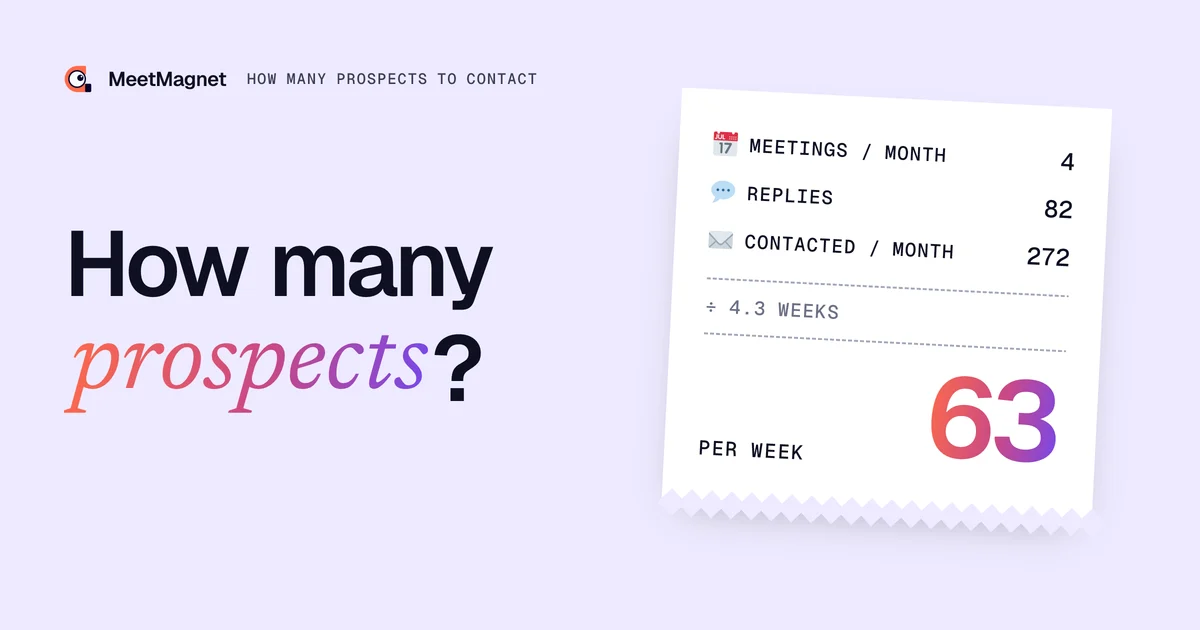
For 4 meetings a month, allow about 63 prospects contacted per week if you get 30% replies and 4.9 meetings per 100 replies, like our client accounts as a whole. With a lower reply rate, the volume climbs fast. The right figure is therefore yours, and the calculation below is there to find it.
Here is the table, for three targets and three reply rates seen on our accounts. The share of replies that become a meeting is set at 4.9 per 100 in all three cases: it is our average, and we do not publish a per-account spread for this ratio.
| Scenario (reply rate) | 2 meetings a month | 4 meetings a month | 8 meetings a month |
|---|---|---|---|
| Cautious: 12%, our lowest account | 78 per week | 157 per week | 314 per week |
| Median: 26%, half our accounts do better | 36 per week | 72 per week | 145 per week |
| Good: 30%, all our accounts together | 31 per week | 63 per week | 126 per week |
Our best account reaches 57% replies. It exists, but you do not build a plan on the best case. 📊 To see where these ratios come from and what they do not tell you, our article on the cold outreach reply rate details how we counted.
👉 Remember: the same target of 4 meetings a month takes 63 to 157 prospects per week depending on your reply rate. Measure it before you set your volume.
How do you work the calculation backwards, step by step?
You start from the result you want and work back up each level of the funnel. You need two ratios, measured over the same period and with the same definitions: the share of replies that become a meeting, and the reply rate per person contacted.
- Set the number of meetings you want per month. Example: 4.
- Divide by the share of replies that become a meeting. With 4.9 per 100: 4 ÷ 0.049 = about 82 replies a month.
- Divide by the reply rate. With 30%: 82 ÷ 0.30 = about 272 prospects contacted a month.
- Bring it down to the week. A month has about 4.3 weeks: 272 ÷ 4.3 = about 63 prospects per week.

One detail changes how you read it: at 4.9 meetings per 100 replies, you need about 19 replies a week to hold 4 meetings a month, whatever your reply rate. 💬 That is 19 conversations to handle every week, on the same day if possible. The volume you contact is only the means of getting those conversations.
Our ratios rest on a precise definition. A prospect contacted is a person who received a first prospecting message, counted once even with several follow-ups. A meeting is a slot accepted or proposed by the prospect, or a request to be called. We do not know how many took place, or how many signed: that information stays with our clients.
In sales calls, I often sum it up like this: “If we contact four people, we won’t get any results. You have to contact 300 people to get 20.” It is an image, not a statistic, but it says the essential thing: volume is not decided by gut feeling, it follows from the target.
👉 Remember: target ÷ meeting conversion ÷ reply rate ÷ 4.3. Write the two ratios and their definition next to the result.
How many prospects to contact per day?
Divide your weekly volume by five working days: 63 prospects per week is about 13 a day. But the day is a poor unit to steer by. Replies arrive several days later, and a one-day gap means nothing.
The “how many per day” question comes mostly from cold emailing, where daily sends are capped to protect deliverability. In signal-based prospecting, the real constraint is not sending: it is the number of people who have a reason to reply this week. 🗓️ Think in weeks, and spread your sends evenly across working days.
On the phone, the logic is the same with another unit. Gong Labs, across 300 million calls, finds that an average rep only gets a conversation with 5.4% of the prospects called, or 19 calls for one conversation (Gong Labs, July 2024). For a call target, you run the same backwards calculation, starting from the conversations you want.
👉 Remember: calculate by the week, spread by the day, and judge by the month.
👉 Replies, but not enough meetings?
Volume is useless if conversations die out after the first reply. Here is how to carry them through to a booked slot.
What limits your prospecting volume?
Three real ceilings come before the calculation: the LinkedIn invitation quota, the number of signals available each week and the size of your target market. A fourth one is often forgotten: the time to reply. The right volume is the smallest of the four.
1. The LinkedIn invitation quota. LinkedIn publishes no figure: its “Invitation limit reached” page only says that all members, Premium included, have a limit, and that an account that hits it is usually blocked for a week. Hublead reports an observed ceiling of about 100 invitations per week, not published by LinkedIn (Hublead, 2026). At MeetMagnet, the default setting is 70 invitations per week. The cautious scenario in the table (157 per week) therefore does not fit on LinkedIn alone: you need email as well, or a better reply rate. All the details are in our article on the LinkedIn invitation limit.
2. The number of signals available. If you only contact people who show a buying signal, your volume depends on what the market produces this week. In our follow-up calls, we aim for around fifty profiles per week per account, and we worry below 20: then you need to widen the topics you track or add other sources. 🔍 Our B2B buying signals examples help you find new ones.
3. The size of your target market. Example: 1,500 decision-makers match your target. At 63 contacts per week, you will have contacted them all in under six months. After that, you will need to come back to them on a new signal, not restart the same sequence.
4. The time to reply. The 19 weekly replies in the calculation need a slot every day. ⏱️ A reply handled two days later loses much of its warmth.

👉 Remember: take the smallest of the four ceilings. If your calculation goes beyond it, it is the target or the reply rate you need to revisit, not the quota.
More volume or better prospects?
Better prospects, almost always, because the volume needed drops as soon as the reply rate goes up. When you contact people for no particular reason, the funnel quickly becomes impossible to fill within LinkedIn’s limits.
Belkins’ LinkedIn study follows 14,077 prospects from 34 client projects in 2025: 18.7% accept the invitation, 17.6% of connected people reply, and 1.3% of connected people book a meeting. Our calculation from those figures: about 0.24 meetings per 100 invitations sent, or roughly 410 invitations per meeting. For 4 meetings a month, you would need close to 380 invitations per week, nearly four times the observed ceiling. ⚠️ Belkins’ definitions are not ours: this is an order of magnitude, not a point-by-point comparison.

What raises the reply rate is writing to someone who has a reason to reply now, with an opener that starts from that fact.
Example
Signal: the operations director of a 120-person manufacturing SME posts that the site is adding a second production shift in January.
Volume opener: “Hi, we help manufacturers improve their performance. Would you have 15 minutes this week?” It goes out to a whole list and comes back with silence.
Opener that gets a reply: “Hi, I saw you’re moving to two shifts in January. The hardest part is usually the handover between shifts: have you already organised it, or is it still to be worked out?” It goes only to people who have this kind of project, and the conversation is about their problem of the moment.
The calculation shows the link: going from 12% to 26% replies cuts the number of prospects to contact by more than half for the same target. 🎯 Work on the target and the opener pays off more than work on volume.
👉 Remember: before raising the volume, raise the share of prospects who have a reason to reply to you.
Which mistakes break this calculation?
The most common mistake is starting from an unrealistic target. A prospect once told me they had noted “10 meeting proposals a week” for a managed prospecting service; my answer was: “Nobody offers ten meetings a week.” For context, The Bridge Group measures in 2025 a median quota of 10 meetings held per month for a full-time SDR, a salesperson whose only job this is, with 112 activities a day at the median (The Bridge Group, February 2025).
The other mistakes come up often:
- Judging after one week. On our accounts, the median time before the first meeting is 16 days. Wait three to four weeks before correcting.
- Calculating on small numbers. On 40 prospects, two more replies add five points. Aim for at least 100 to 200 contacts on the same target.
- Mixing denominators. A rate per email sent and a rate per person contacted cannot be compared. Keep the same definition from one month to the next.
- Forgetting the invitation step. On LinkedIn, someone who does not accept never reads your message: count your invitations separately.
- Setting an activity target too. “Contact 60 decision-makers with a recent signal every week” depends on you; “4 meetings a month” also depends on your prospects.
Our article on sales prospecting metrics shows how to track these figures every week without spending hours on it.
👉 Remember: a realistic target is set on your own figures, after three to four weeks of measurement.
How do you replace our ratios with yours?
Measure your two ratios over three to four weeks, then redo the calculation with them. Our figures are there to get you started; as soon as you have a hundred or so prospects contacted on one target, yours are worth more than ours.
- Count the people contacted over the period, once each, follow-ups included.
- Count the replies written by a human, removing out-of-office and automated messages.
- Count the meetings with a fixed definition: a slot accepted or proposed, or a request for a call.
- Calculate the two ratios, then redo the four steps of the backwards calculation.
- Start again every month. ✅ If a ratio moves, the volume you need moves with it.
In MeetMagnet, these figures can be read in the statistics, channel by channel. On the Managed plan, at €299 excl. VAT per month, a person runs this review with you and adjusts the target and the pace; the Self-serve plan, at €149 excl. VAT per month, lets you steer it yourself. To fit this volume into a full organisation, a prospecting plan sets out who to contact, when and with which message.

The right prospecting volume is neither 100 a day nor a figure copied from a competitor. It is the result of a simple calculation, made from your target and your own ratios, then capped by three very real limits: LinkedIn, the signals available and your target market. Start with our ratios, measure yours for a month, and correct. 🚀
Sources
- MeetMagnet, review of the conversations of 27 paying client accounts (LinkedIn and email), internal data as of 9 October 2026: 15,910 prospects contacted, 4,779 replies, 4.9 meetings per 100 replies, median time of 16 days. Method published in our article on the reply rate.
- Belkins, “LinkedIn B2B outreach statistics: Belkins’ 2026 study”, updated 29 June 2026, accessed 5 November 2026: https://belkins.io/blog/linkedin-outreach-study
- The Bridge Group, “SDR Models, Motions & Metrics: 2025 Research Report”, 6 February 2025, accessed 5 November 2026: https://www.bridgegroupinc.com/research/2025-sdr-models-metrics-report-the-bridge-group
- Gong Labs, “The hidden power of cold calling: Insights from 300M calls”, 18 July 2024, accessed 5 November 2026: https://www.gong.io/blog/the-hidden-power-of-cold-calling-insights-from-300m-calls
- “Invitation limit reached”, LinkedIn Help, accessed 5 November 2026: https://www.linkedin.com/help/linkedin/answer/a550555
- “Types of restrictions for sending invitations”, LinkedIn Help, accessed 5 November 2026: https://www.linkedin.com/help/linkedin/answer/a551012
- Hublead, “LinkedIn Invitation Limit 2026”, accessed 5 November 2026: https://www.hublead.io/linkedin-invitation-limit
Frequently asked questions
How many meetings a month can you expect from B2B prospecting?
It depends on the time you put in and on your target. A useful benchmark: according to The Bridge Group (2025, 351 companies), a full-time SDR has a median quota of 10 meetings held per month. For an SME owner who prospects alongside their day job, aiming for 2 to 4 meetings a month is a reasonable starting point, to be corrected with your own figures.
How many LinkedIn invitations should you send per week?
LinkedIn publishes no figure. Tool vendors observe a ceiling of around 100 invitations per week, and LinkedIn restricts accounts when many invitations are ignored or left pending. On our side, the default setting is 70 invitations per week, spread over working days, to keep some margin.
What is the conversion rate from prospect to meeting?
Across our 27 client accounts, as of 9 October 2026, we get about 1.5 meetings per 100 prospects contacted: 30% replies, then 4.9 meetings per 100 replies. Belkins' LinkedIn study measures 1.3 meetings per 100 connected prospects in its 2025 campaigns. The definitions differ: always compare the same calculation.
How long before you can judge your prospecting volume?
Allow three to four weeks and at least 100 to 200 prospects contacted on the same target. On our accounts, the median time before the first meeting is 16 days: one week of figures says almost nothing. On small volumes, two more or two fewer replies shift the rate by several points.
Should you contact more prospects when meetings are not coming?
Not before you have found the stage that is stuck. If few people reply, it is the target, the timing or the opener. If replies do not turn into meetings, it is the conversation. Doubling the volume of a message that does not work doubles the refusals, and many ignored invitations can get your LinkedIn account restricted.
Etienne Douillard
Co-founder and CEO, MeetMagnet
An engineer and entrepreneur for over five years, Etienne works every week with B2B SMEs on signal-based prospecting.
From intent to booking
MeetMagnet spots who has a reason to talk to you right now, writes the opener that stands out, and a real person keeps it on track.