How to find clients when word of mouth is no longer enough
By Etienne DouillardUpdated 14 min read
Too long, didn’t read?
Ask your favourite AI to summarise this article and pull out the points that matter for your business.

Contents
- How do you find clients without relying on word of mouth?
- Why does word of mouth eventually stop being enough?
- What does a referral really give you?
- How do you know which moments make your clients buy?
- Where can you spot these moments when you have no network?
- What should you say in the first message, without a referral?
- How many follow-ups, and for how long?
- When word of mouth is enough, and when this method does not work
- How does MeetMagnet help you catch these moments?
- Sources
You have clients, and almost all of them came through referrals. It works, but you never know when the next one will arrive. This guide explains how to find clients without relying on word of mouth: understand what a referral really gives you, then go and find the moments a third party used to flag for you. It is written for consultants, freelancers and B2B SME owners who already have clients, not for beginners.
📌 Key points
- Word of mouth works, but you cannot steer it: it comes in fits and starts and dries up as your network wears out.
- A referral is a buying signal passed on by a third party: someone noticed that a company had a need, right now.
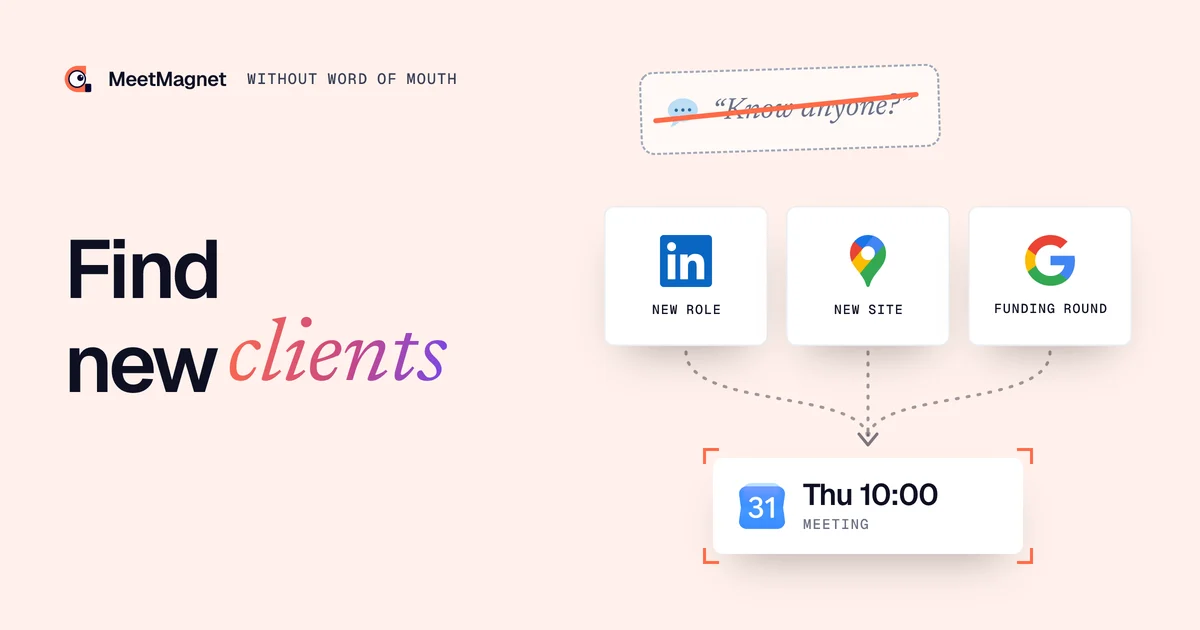
- These moments (hiring, a new leader, an office move, an announced project, a question posted online) are often visible without a go-between.
- The method has six steps: analyse your best clients, work out your signals, spot them, write the opener, offer something, follow up.
- It does not replace referrals: it fills the gaps between them.
How do you find clients without relying on word of mouth?
To find clients without relying on word of mouth, you need to spot for yourself the moments when a company needs you, the ones a client or partner used to flag for you, then write to the right person with a message based on that moment. You are not replacing your network, you are replacing what it did for you: seeing the need before anyone else.
The method, in six steps:
- Analyse where your best clients came from, and what had just happened to them when they bought.
- Work out your signals: the three to five moments that keep coming back.
- Spot them every week, on LinkedIn, in job ads, in the press or in company registers.
- Write the opener: a short message based on the fact, not on your offer.
- Offer something useful, without asking for a meeting straight away.
- Follow up with a new angle, then measure what gets replies.
Bottom line: you are not looking for “more prospects”, you are looking for the same moments that used to bring you referrals.
Why does word of mouth eventually stop being enough?
Word of mouth eventually stops being enough because you control neither the timing, nor the volume, nor the source. It depends on a handful of people who think of you at the right moment. When one of them changes jobs, retires, or you move to another region, the flow stops.
Yet this channel is still the main one for many people. Harvard Business Review reported that independent workers get the vast majority of their assignments through word of mouth, based on a survey conducted for MBO Partners. Another article in the same publication quotes a figure from Influitive, a referral software vendor: 84% of B2B buyers start the purchasing process with a referral. Even the Paris chamber of commerce (CCI Paris Île-de-France) presents a business network as the way to get word of mouth, alongside effective sales prospecting.
So the problem is not effectiveness, it is dependence. In our discovery calls, we analysed conversations with 98 business owners, freelancers and salespeople (clients, prospects, partners, September 2026). 27 of them describe this exact situation: everything comes from referrals, and the flow is irregular. It is one of the most acute pains we found: 59% of what they say about it is rated as high intensity.

The words come back, almost identical:
- “Referrals are great, but you never know when they will come.”
- “I work too much in fits and starts,” says a consultant who has advised leadership teams for ten years, and who wants “a steady flow”.
- A financial adviser summed up his situation for us: 90% of his clients through word of mouth, 9% through partnerships, and not a single meeting from LinkedIn.
Bottom line: if most of your clients come from three or four people, your revenue depends on their calendar, not yours. ⚠️
What does a referral really give you?
A referral gives you three things: a current need (the company is looking now), a person to contact, and the trust of the third party who recommends you. You can find the first two on your own. The third is built through the relevance of your first message.
When a client tells you “call Paul, he has just taken over the plant and wants to review everything”, they are passing on a dated fact. That is exactly what we call a business signal: public or visible information showing that a company has a reason to buy now. Your client spotted it for you. Without them, most of these facts are still visible, on LinkedIn, in a job ad or in the local press. 🔎

| Referral | Signal you spot yourself | |
|---|---|---|
| Who sees the need | A third party, when they think of it | You, every week |
| When it arrives | In fits and starts, without warning | On your own monitoring schedule |
| Volume | Limited to your network | Limited to your market |
| Trust at the start | High, lent by the third party | To be earned by the first message |
| First message | “Paul told me about you” | Starts from the observed fact |
This difference in trust changes the way you write. A referral is a strong signal: you can suggest a meeting right away. A signal you spot alone is weaker, so you first need to open the conversation. 💡 That is why you do not put a calendar link in the first message.
How do you know which moments make your clients buy?
To know which moments make your clients buy, take your ten best clients and note, for each one, what had just happened at their company right before they contacted you. What matters here is not their industry or size, it is the event. Three or four moments almost always come back.
Ask yourself three questions per client:
- Who referred me, and what had that person noticed?
- What had changed for the client: a person, a team, a location, a project, a constraint?
- Was that change visible from the outside, and where?
Example: a transformation consultant who works with managing directors of mid-sized companies. Her projects come in when a new MD takes office and chooses who to work with, or when a transformation “stalls” a few months after a leadership offsite. Both are visible: the new role is announced on LinkedIn, and the offsite and its aftermath are often shared in posts.
Example: an SME that leases IT equipment and had never done cold prospecting. Its clients came at the time of a funding round, a hiring push of 20 to 50 people, or an office move. Three facts you can see on LinkedIn, in job ads and in the press.
| Moment at the client | What it signals | Where to see it |
|---|---|---|
| Hiring for several roles | A growing team, tools and processes to review | Job ads, the company’s LinkedIn page |
| New leader or new manager | Decisions to make in the first 100 days | New role announcement on LinkedIn |
| Office move or new site | Premises, equipment, suppliers to choose | Local press, company posts |
| Announced project | A committed budget, suppliers to find | Press release, the leader’s post |
| Question posted online | A current problem, worded by the person | LinkedIn posts and comments, forums |
| Funding round or takeover | New resources, an organisation to build | Business press, company registers |
These moments become your list of signals. Our articles on trigger events and B2B buying signal examples cover more of them. Cross-check them with your ideal customer profile: a hiring push at a company too small for you is not a signal.
Bottom line: your signals are your old referrals, seen without a go-between. ✅
Where can you spot these moments when you have no network?
You spot these moments where companies and people make them public: mostly LinkedIn in B2B, then job ads, the local press, company registers and trade shows. The goal is not to watch everything, but to check every week the three or four sources where your signals show up.
- 👀 LinkedIn: new roles, posts on a topic linked to your work, questions asked in the comments. One business owner told us he simply typed the name of his market into the LinkedIn search bar to see who was talking about it: that is the manual version of signal monitoring.
- 📄 Job ads: a hire tells you what the company is preparing, and often why.
- 📰 Local and business press: moves, openings, takeovers, funding rounds.
- 🏛️ Company registers: changes of director, new establishments.
This monitoring matters all the more because buyers do their research alone. According to a Gartner survey of 646 B2B buyers, 67% prefer a rep-free experience. So it is not about shouting louder, but about arriving when the question comes up. Our guide to B2B lead generation compares the other channels.
See signals turn into meetings
How we spot buying moments on LinkedIn, and what we write next, on real examples.
What should you say in the first message, without a referral?
Without a referral, the first message has to do what the third party used to do: show that you are writing for a specific reason. It starts from the observed fact, names a credible consequence for the person and ends with an easy question. It talks neither about you, nor your offer, nor a meeting.
This is where trust is won or lost. Gartner finds that 73% of B2B buyers actively avoid suppliers who send irrelevant outreach. A generic message does not just cost you a reply: it puts you among the people buyers ignore.
Example
Signal: the new managing director of a subsidiary announces on LinkedIn that she takes office on 1 October.
Opener that misses: “Congratulations on your appointment! I support leaders through transformation. Would you be free for a 30-minute call?”
Opener that gets a reply: “Hi Claire, the first hundred days at the head of a subsidiary are often when you decide who to work with next. Do you already know which projects you will tackle first?”
The first one could be sent to every new managing director in the country. The second starts from the moment and lets the person talk about her priorities. 🎯

Then offer something that is valuable to the person, without giving everything away: a short list, a three-point diagnosis, a simulator, a write-up of a similar case. It is the question we ask every client who starts with us: “what can you offer a prospect that genuinely helps them?” This gift replaces the credit the third party used to lend you.
How many follow-ups, and for how long?
Plan two or three follow-ups about a week apart, each with a new angle (a question, a resource, a new fact), then stop. And give the method three months before judging it: the first is for finding what gets replies, the next ones for repeating it.
- 🔁 Following up is not repeating the first message: it is giving another reason to reply.
- 🗓️ Block a fixed slot every week for monitoring and messages, like a client meeting.
- 📊 Measure three numbers: messages sent, replies, meetings. An opener is judged on about a hundred people, not on ten.
Let’s be honest about the pace. With our clients, one or two meetings in the first month is a normal start, three to five in the second when the target and the opener are right. Those who get ten or fifteen meetings a month have been with us for a year. To organise all this, follow our guide from buying signal to meeting.
When word of mouth is enough, and when this method does not work
Word of mouth is enough as long as your calendar stays full several months ahead and your clients do not depend on one or two people. And the signal-based method does not work everywhere: it requires your clients to leave visible traces, and you to already know what you sell and to whom.
Four cases where it is better not to start with this:
- ❌ Your target is not on LinkedIn: tradespeople, shopkeepers, private individuals, some independent professions. Signals are rare there; rely on partners, referrers, the field and reviews.
- ❌ You are starting with no clients at all: you do not yet know which moments make people buy. Start with your first clients, then come back to step 1.
- ❌ Your offer is still vague: the best signal will not save a message that does not clearly say what you solve.
- ❌ Your market is tiny and already known: if you personally know the forty possible buyers, a phone call beats monitoring.
In every case, keep what works. A referral is still the best meeting you can get: ask for one after every successful project. Signal monitoring comes on top, so that the next gap does not catch you by surprise. 🤝

How does MeetMagnet help you catch these moments?
Every day, MeetMagnet watches LinkedIn to spot decision-makers in your target who show a buying moment linked to your offer: a new role, a post, a question, a reaction to a discussion in your field. It drafts an opener based on that fact, which you review, then follows up on LinkedIn and by email until a meeting is booked.

What the tool does not do: choose your market for you, or replace your referrals. In the Managed plan, at €299 excl. VAT per month, someone from our team starts from your best clients with you to set the signals and openers, then reviews the results every month. The Self-serve plan, at €149 excl. VAT per month, leaves that setup to you. Details are on our pricing page.
Word of mouth brought you your best clients: that proves your buying moments exist. What is left is to see them yourself, every week, instead of waiting for someone to flag them. Start with your last ten clients and the question “what had just happened?”: the answer is your first list of signals. 🚀
Sources
- “The Freelance Economy Still Runs on Word of Mouth”, Justin Fox, Harvard Business Review, 9 October 2014, accessed 5 November 2026, https://hbr.org/2014/10/the-freelance-economy-still-runs-on-word-of-mouth
- “How B2B Sales Can Benefit from Social Selling”, Harvard Business Review, 8 November 2016, accessed 5 November 2026, https://hbr.org/2016/11/84-of-b2b-sales-start-with-a-referral-not-a-salesperson
- “Comment conquérir de nouveaux clients ?”, CCI Paris Île-de-France, updated 25 June 2026, accessed 5 November 2026 (in French), https://www.entreprises.cci-paris-idf.fr/fiches-pratiques/comment-conquerir-de-nouveaux-clients
- “Gartner Sales Survey Finds 67% of B2B Buyers Prefer a Rep-Free Experience”, Gartner, 9 March 2026, accessed 5 November 2026, https://www.gartner.com/en/newsroom/press-releases/2026-03-09-gartner-sales-survey-finds-67-percent-of-b2b-buyers-prefer-a-rep-free-experience
- “Gartner Sales Survey Finds 61% of B2B Buyers Prefer a Rep-Free Buying Experience”, Gartner, 25 June 2025, accessed 5 November 2026, https://www.gartner.com/en/newsroom/press-releases/2025-06-25-gartner-sales-survey-finds-61-percent-of-b2b-buyers-prefer-a-rep-free-buying-experience
- MeetMagnet analysis of recorded conversations with 98 people (clients, prospects, partners), pains coded by family and intensity, September 2026.
- MeetMagnet discovery call notes, September and October 2026 (people and companies anonymised).
Frequently asked questions
How do you find clients quickly when your network dries up?
Start with former clients and prospects who show something new: a new role, a hiring push, an announced project. They are the fastest contacts to convert, because they already know you. At the same time, start watching your signals: allow one to two months before the first meetings come in on a regular basis.
How do you find clients without a network as a consultant or freelancer?
Without a network, you need to replace the third party who used to flag needs for you. List the moments when a company needs a consultant like you (new role, reorganisation, hiring, project), spot them on LinkedIn, in job ads or in the press, then write to the person concerned with a message based on that fact.
Should you stop asking for referrals?
No. Referrals remain the channel that converts best, because they come with a third party's trust. The problem is not using them, it is depending on them. Keep them, ask for one after every successful project, and add a source you control to fill the gaps between two referrals.
How long does it take to replace word of mouth?
Allow three months for signal-based prospecting to run steadily. The first month is for finding the signals and the opener that get replies, the second for adjusting, the third for keeping the pace. With our clients, one or two meetings in the first month is a normal start, not a failure.
Which channels should you use to find B2B clients?
In B2B, LinkedIn is the channel with the most visible moments: new roles, posts, questions, hiring. Job ads, local press, company registers and trade shows complete the picture. Email and phone then serve to make contact. The channel matters less than the moment you choose to write.
Etienne Douillard
Co-founder and CEO, MeetMagnet
An engineer and entrepreneur for over five years, Etienne works every week with B2B SMEs on signal-based prospecting.
From intent to booking
MeetMagnet spots who has a reason to talk to you right now, writes the opener that stands out, and a real person keeps it on track.