Cold outreach reply rate in B2B: 2026 benchmarks, and ours
By Etienne DouillardUpdated 11 min read
Too long, didn’t read?
Ask your favourite AI to summarise this article and pull out the points that matter for your business.

Contents
- What is the average cold outreach reply rate in B2B in 2026?
- What are our figures, and how did we count them?
- Why is the reply rate not enough to judge your prospecting?
- What is a good cold outreach reply rate?
- How long does it take to get a first meeting?
- What makes each stage of the funnel go up or down?
- How do you calculate your own prospecting reply rate?
- Sources
The cold outreach reply rate in B2B ranges from under 1% to over 30% depending on what you count: cold email vendors’ reports publish 0.45% to 3.43% replies per email sent, and our 27 client accounts get 30% replies per prospect contacted, on LinkedIn and by email. But that figure flatters. What tells the truth about your prospecting is the share of replies that turn into a meeting: 4.9 per 100 replies for us. Here are our figures, how we counted them, what they do not say, and how to calculate yours.
📌 Key points
- A reply rate can only be compared with another rate calculated the same way: per email sent or per person contacted, the gap can be 1 to 60.
- Out of 15,910 prospects contacted by 27 client accounts, 30% replied (median per account: 26%, ranging from 12% to 57%).
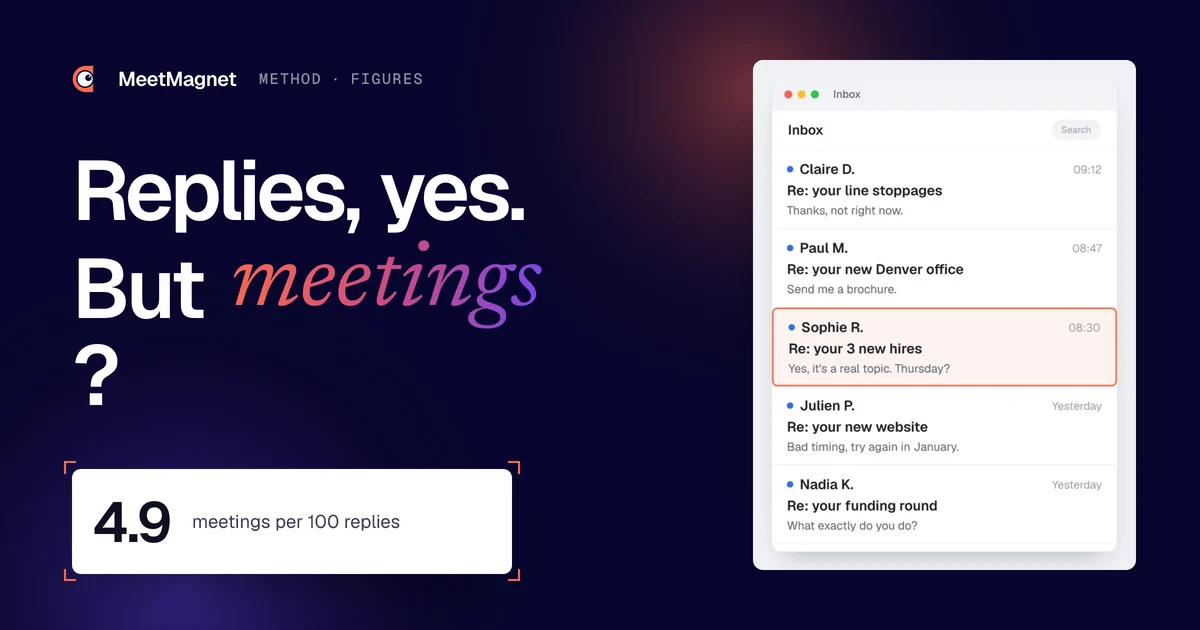
- Only 4.9 replies out of 100 become a meeting or a call request: that is the stage where prospecting is won or lost.
- It takes a median of 16 days to get the first meeting: judge a campaign over three to four weeks, not three days.
What is the average cold outreach reply rate in B2B in 2026?
There is no single average rate, because each source divides by something different. The most solid public benchmarks cover cold email and divide replies by the number of emails sent, follow-ups included. Our figures divide the people who reply by the people contacted. Both are correct, and they do not measure the same thing.
| Source | Channel | What is divided by what | Period | Rate |
|---|---|---|---|---|
| Instantly 2026 report | Cold email | All replies ÷ emails sent | 2025 | 3.43% |
| Belkins 2026 study | Cold email | Unique replies ÷ emails sent | 2025 | 0.45% |
| Our 27 client accounts | LinkedIn and email | People who reply ÷ people contacted | As of 9 October 2026 | 30% |
Instantly’s report aggregates campaigns from thousands of customer workspaces in 2025 and reports an average reply rate of 3.43%, with the top 10% of senders above 10%. Belkins’ study covers 7.5 million emails sent in 2025 and finds 0.45% replies per email sent. 🔍 Belkins also explains that its earlier studies divided by the people who had opened the email, which gave much higher rates for the same campaigns.
Why such a gap with our 30%? First, a sequence of four emails counts as four sends but only one person: dividing by sends mechanically crushes the rate. Second, our accounts write to people spotted through a buying signal, with an opener built on that signal, often on LinkedIn where the message arrives after an accepted invitation. This is not mass sending to a bought list, and it would be dishonest to present our rate as “ten times better” than an email vendor’s.

What are our figures, and how did we count them?
Our figures come from the real conversations of 27 paying MeetMagnet client accounts, as of 9 October 2026. Out of 15,910 prospects contacted, 4,779 replied: 30%. The median rate per account is 26%, ranging from 12% for the lowest account to 57% for the highest, with LinkedIn and email combined.
A figure without a method is worthless. Here is what we counted, and how.
- A prospect contacted: a person who received a first prospecting message from a client account. They count once, however many follow-ups they received.
- A reply: a message written by the prospect, whatever its content (interest, question, refusal, “not now”).
- A meeting: a time slot accepted or proposed by the prospect, or a request to be called. A vague promise (“let’s talk again after the summer”) does not count.
- The period: each account’s whole period of activity up to the snapshot, which mixes recent accounts and accounts more than a year old.
- Names: no client is named, the figures are aggregated.
What we do not know needs saying too. ⚠️ We do not know whether every meeting actually took place, or how many led to a sale: that information stays with the client. Our figures mix LinkedIn and email without separating them, and 27 accounts do not represent every sector. Finally, these are accounts prospecting on signals with reviewed openers: the result shows what this method produces, not what prospecting produces in general.
Why is the reply rate not enough to judge your prospecting?
Because a reply is not a meeting. Across our 27 accounts, 100 replies produce 4.9 meetings or call requests, which is 1.5 meetings per 100 prospects contacted. The reply rate measures the attention you get; the conversion of replies into meetings measures what your prospecting really brings in.
Scaled to 1,000 prospects, the funnel looks like this:
- 📤 1,000 prospects contacted on a signal, via LinkedIn or by email;
- 💬 around 300 replies, many of them polite refusals, questions and “not now”;
- 📅 around 15 meetings or call requests, which is 4.9 per 100 replies.

The big loss is not where people look for it. 🎯 Teams spend weeks rewriting the opener to gain three points of reply rate, while 95 replies out of 100 lead to no meeting at all. Prospecting is won or lost between the first reply and the time slot: a slow answer, a brochure sent too early, a forgotten follow-up, and the conversation dies.
The few public figures point the same way. Belkins’ study counts more than 1,200 meetings for 34,393 replies in 2025, which is around 3.5 meetings per 100 replies, with a definition of a meeting that is not necessarily ours. The orders of magnitude are similar: whatever the method, most replies do not become meetings.
Example
Signal: an operations director at an industrial SME posts that he is looking to reduce line stoppages.
Opener that gets a reply, but no meeting: “Hi Tom, we help manufacturers reduce production downtime. Would you have 20 minutes this week?” Reply: “Thanks, not right now.” One more reply in the rate, zero meetings.
Opener that opens a conversation: “Hi Tom, your post on line stoppages made me think of a question: do you already measure them station by station, or is it still an estimate at the end of the month?” Reply: “An estimate, and that’s exactly the problem.” The conversation is about his situation, and the meeting comes two messages later.
Both openers count the same in the reply rate. Only the second has a chance of ending up in a calendar.
What is a good cold outreach reply rate?
A good reply rate is one that improves on your own target, is always calculated the same way, and produces meetings. In our data, half the accounts exceed 26% replies per prospect contacted, but an account at 15% that converts its replies well can get more meetings than an account at 40% that lets them fade.
Three benchmarks help you read your figure:
- Compare with the same denominator. A rate per email sent compares with vendor benchmarks; a rate per person contacted compares with ours. Mixing the two suggests a success or a failure that does not exist.
- Look at the spread rather than the average. 📊 From 12% to 57% across our accounts: the target, the sector and the quality of the signals weigh more than the tool.
- Always put the meeting rate next to it. A reply rate on its own supports no decision.
For week-by-week tracking, with the five figures to record and how to find the stage that is blocking, our article on sales prospecting metrics details the method. Here, we stick to the reply rate and what it hides.
👉 Replies, but few meetings?
Most meetings are lost after the first reply. Here is how to carry the conversation all the way to a time slot.
How long does it take to get a first meeting?
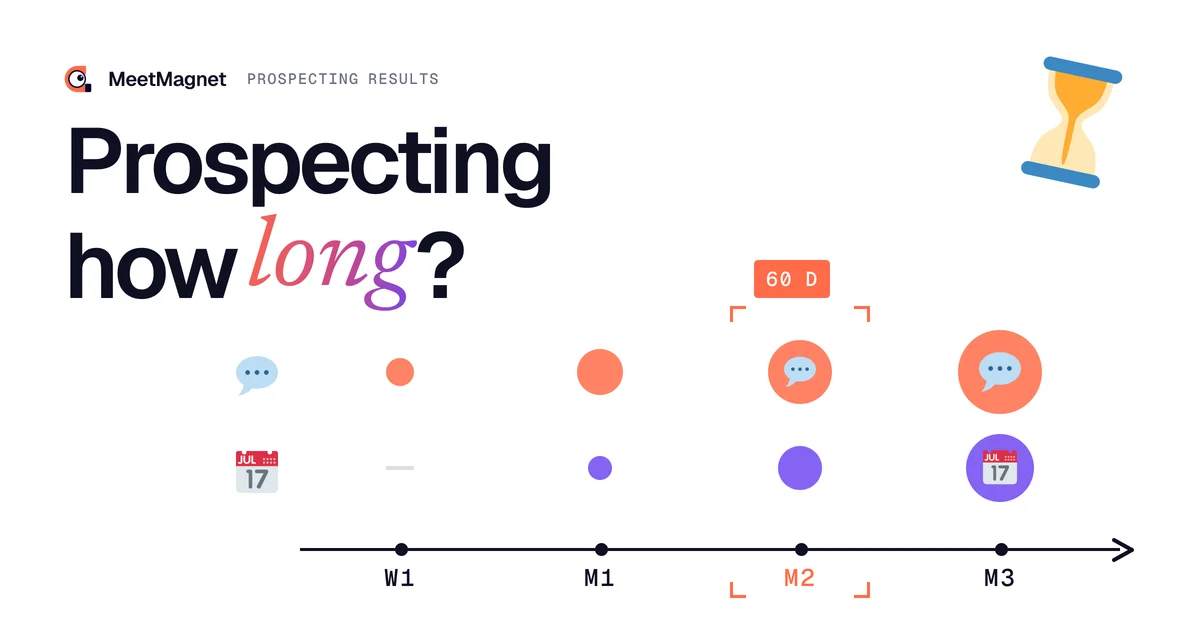
Across our 27 accounts, the median time between launch and the first meeting is 16 days. Half the accounts therefore get their first meeting in just over two weeks, the other half later. ⏳ Judging a campaign after three days means judging it before follow-ups and conversations have had time to play out.

This delay comes from the very shape of prospecting. On LinkedIn, the invitation first has to be accepted; then the reply often comes after a follow-up, and the meeting after two or three exchanges. Each step adds a few days.
In practice, allow three to four weeks of figures before concluding that a target or an opener does not work. On small volumes, a few replies more or less move the rate by several points: a single week means nothing.
What makes each stage of the funnel go up or down?
Each stage has its own levers: the reply rate depends mostly on timing, target and opener, while the conversion into meetings depends on the conversation that follows. Fixing the wrong stage wastes weeks, which is why you first need to know which one is blocking.
What raises the reply rate:
- Write at the right moment. 🕐 Someone who has just changed role, hired or posted about a problem has a reason to reply now. That is the whole point of buying signals.
- Start from the fact, not from your offer. An opener that cites the signal and asks a single question gets more replies than a sales pitch. Our article on why your prospects don’t reply shows openers before and after.
- Land in the right inbox. By email, a message filed as spam will never be read: SPF, DKIM and DMARC come before the copy, as our guide to cold email deliverability explains.
- Follow up without harassing. Some replies arrive after the first follow-up, rarely after the fourth.
What lowers the conversion of replies into meetings:
- Replying too late. 🐢 A reply handled two days later has lost its warmth.
- Selling too early. Sending the brochure and the demo link at the first “why not” closes more doors than it opens.
- Not proposing a time slot. When the interest is there, two specific slots beat a “let me know when you’re available”.
- Taking a “not now” for a no. A follow-up three months later, on a new signal, often restarts the conversation.
This second part is where MeetMagnet has worked hardest: the conversational agent reads each reply, asks the next question and, on the Managed plan, proposes real slots read from the client’s calendar, within minutes. The figure of 4.9 per 100 shows there is still ground to cover, for us as for everyone.
How do you calculate your own prospecting reply rate?
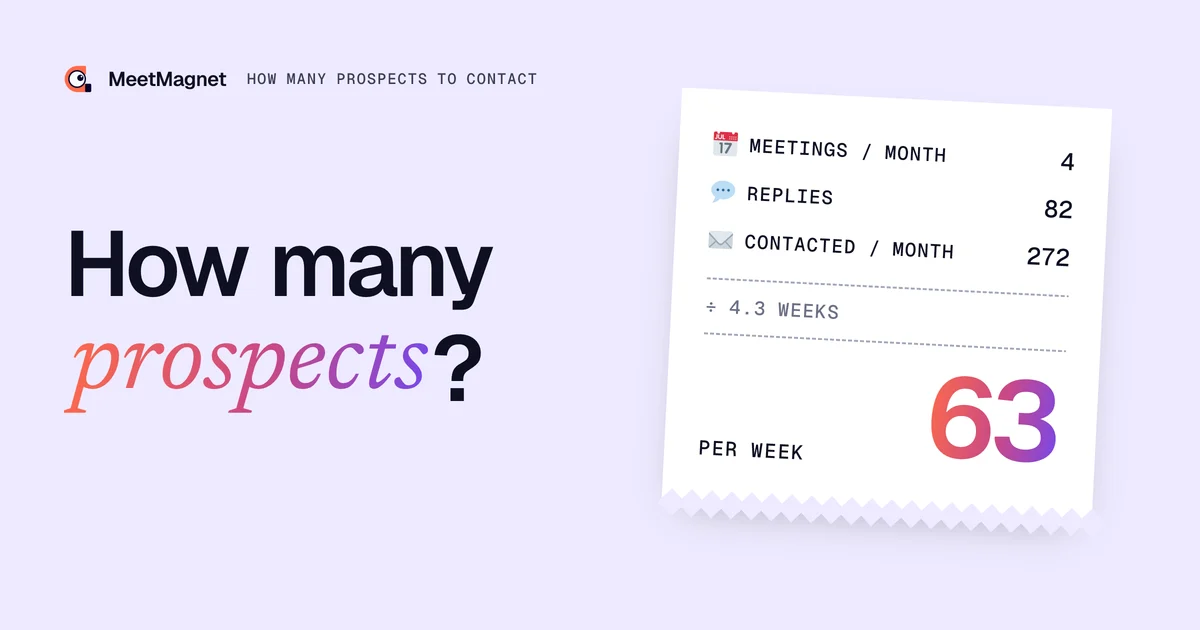
Divide the number of people who replied by the number of people contacted over the same period, then do the same for meetings. These two rates, always calculated the same way, are enough to know whether your prospecting is improving. ✅ What matters is fixing the definitions before you count.
- Choose the period and the target: for example the prospects contacted in September, on a single target.
- Count people, not messages: a prospect who received three follow-ups counts once.
- Count replies written by a human: remove out-of-office messages, automatic replies and invalid addresses.
- Record meetings separately: a slot accepted or proposed, or a call request, with the same definition every month.
- Calculate three rates: replies ÷ contacted, meetings ÷ replies, meetings ÷ contacted.
- Wait for the follow-ups to finish: a prospect contacted on the 28th of the month can still reply the following month.

Take 200 prospects contacted in one month. 46 reply, including 2 out-of-office messages: 44 replies, or 22%. Three become meetings: 6.8 per 100 replies, and 1.5 per 100 prospects contacted. 💡 This account has a reply rate below our median, but a conversion above ours: it has no reason to rewrite everything.
For a rate per channel, keep the same method and simply separate LinkedIn and email. On LinkedIn, many people prefer to divide by accepted invitations rather than invitations sent: that is a valid choice, as long as you stick to it.

If you would rather not keep this table by hand, MeetMagnet’s Managed plan reports these figures every month in the statistics sent to the client, with a review to decide what to change. The pricing page details what is included in each plan.
The reply rate is reassuring because it rises quickly and is easy to compare. But prospecting is judged by the number of meetings it produces, and most opportunities are lost between the first reply and the time slot. Measure your two rates with stable definitions, compare yourself with yourself over three to four weeks, and put your energy where the funnel leaks most. 🚀
Sources
- Instantly, “Cold Email Benchmark Report 2026: Reply Rates, Deliverability and Trends”, accessed 27 October 2026: https://instantly.ai/cold-email-benchmark-report-2026
- Belkins, “What are B2B cold email response rates? Belkins’ 2026 study”, accessed 27 October 2026: https://belkins.io/blog/cold-email-response-rates
- MeetMagnet, snapshot of the conversations of 27 paying client accounts (LinkedIn and email), internal data as of 9 October 2026, accessed 27 October 2026.
Frequently asked questions
Does the reply rate change with the size of the target company?
Yes. The Belkins 2026 cold email study observes that the larger the company, the lower the reply rate: the owner of a small business often reads their own messages. In a large company, it is better to target the person directly concerned by the signal rather than senior management.
Should a negative reply count in the reply rate?
Yes, in the overall reply rate: it proves the message was read and triggered a reaction. But you need to separate it from positive replies and from meetings. A polite refusal today can also become a conversation later, if the person shows a new buying signal a few months on.
How many prospects do you need for a reliable reply rate?
Below a hundred prospects contacted, the rate moves a lot: two extra replies add several points. It is better to wait for at least 100 to 200 people contacted on the same target, and three to four weeks of follow-ups, before comparing two openers or changing target.
Do replies to follow-ups count in the reply rate?
Yes. You count the person who replies, whichever message in the sequence prompted them. To improve your follow-ups, however, you can note at which step each reply arrives. That shows whether the first message carries the campaign or whether the follow-ups are doing the work.
Is a very high reply rate always good news?
Not necessarily. A provocative message or an overly broad question can get lots of people to reply without creating real interest. If the reply rate rises but meetings do not follow, the message grabs attention without opening a useful conversation. It is always the number of meetings that settles it.
Etienne Douillard
Co-founder and CEO, MeetMagnet
An engineer and entrepreneur for over five years, Etienne works every week with B2B SMEs on signal-based prospecting.
From intent to booking
MeetMagnet spots who has a reason to talk to you right now, writes the opener that stands out, and a real person keeps it on track.