How to end a prospecting email: 15 closing lines that get replies
By Etienne DouillardPublished 12 min read
AI summary
Too long, didn’t read?
Ask your favourite AI to summarise this article and pull out the points that matter for your business.

Contents
- Why doesn’t “I look forward to hearing from you” work?
- What are the 3 ways to end an email that get a reply?
- Which closing lines should you use to end a first prospecting email?
- How do you end a follow-up email?
- How do you end an email after the prospect’s first reply?
- Which closing line should you choose for each situation?
- Which prospecting email endings should you ban?
- What should go in a prospecting email signature?
- How do you tie the end of the email back to the signal that prompted it?
- Sources
The last sentence of a prospecting email often decides whether you get a reply. The prospect has read the opening line, skimmed the body of the message, and reaches the end with a single question in mind: what do you want from me? If the ending is vague, they put off replying until later, which means never. If it is clear and easy, they reply in ten seconds. Here is how to end a prospecting email, with 15 closing lines sorted by situation.
Why doesn’t “I look forward to hearing from you” work?
“I look forward to hearing from you” doesn’t work in prospecting because it asks for nothing specific. It signals that you are waiting, without saying for what. The prospect has to figure out the next step on their own: a meeting, an opinion, a document, a no? Faced with that effort, most people do nothing.
The phrase also has a tone problem. It comes from formal business correspondence, where a reply is expected. In a first email, nobody owes you a reply: writing it creates pressure that rings false. 🤔
Finally, it is everywhere. Readers skip it the way they skip “Best regards.” An ending the eye no longer reads cannot trigger any action.

👉 The rule: the last sentence should ask a question that can be answered without thinking, in one word or one click.
What are the 3 ways to end an email that get a reply?
Email endings that get a reply almost always belong to one of these three families. Each one matches a different level of commitment from the prospect.
- The easy closed question. It can be answered with yes, no or one word. Example of the format: “Is this on your radar this year?” It fits a first contact, when you don’t yet know whether the topic is current.
- The choice between two options. It offers A or B, and both answers teach you something. Example of the format: “Already sorted, or still open?” It avoids a flat no, because the prospect is choosing instead of refusing.
- The meeting request with two time slots. It sets a length, a format and two specific times. It fits once the prospect has already shown interest, and only then.
The classic mistake is jumping straight to the third family in a first email. Asking someone who doesn’t know you for 30 minutes of their calendar is asking for far too much, far too soon. 🎯 The right order follows the conversation: first you check that the topic exists, then you help them place it, then you propose the meeting.

Which closing lines should you use to end a first prospecting email?
To end a first prospecting email, use a closed question or a choice about the prospect’s situation, not about your offer. The first email is there to find out whether the topic is alive on their side. Here are six closing lines to adapt to your topic.
- Closing line 1: “Is this on your desk right now, or more of a next-year thing?” (choice between two options)
- Closing line 2: “Are you the one handling this, or should I reach out to someone on your team instead?” (choice, useful when you are unsure who to talk to)
- Closing line 3: “If I send you the checklist we use for [topic], would you take a look?” (closed question, with a light offer)
- Closing line 4: “Have you already made a call on [topic], or is it still open?” (choice)
- Closing line 5: “A yes or a no is all I need: is this worth a conversation?” (closed question, direct)
- Closing line 6: “If it’s not a priority right now, a quick ‘not now’ will save you a follow-up from me.” (explicit way out)
✅ Closing line 6 often works surprisingly well. By giving the prospect a polite way to say no, you get replies from people who would not have written anything, and among them, some “not now, but in January” answers.
💡 These endings work all the better when the email opens on a real fact about the prospect. A closing question cannot rescue a generic opening line: if the first sentence is not about them, they will not read the last one. To work on that first sentence, see our sales opening line examples.
Example
Signal: a mid-sized trucking company announces on LinkedIn the appointment of a new head of logistics, who started this month.
Ending that falls flat: “I would be delighted to present our solution in a meeting. Best regards, and I hope to hear from you soon.”
Ending that gets a reply: “The first few months in a role like yours are often spent revisiting priorities. Is route planning part of that for you, or is it not the project of the moment?”
The second ending ties the question to the original fact and leaves two possible answers, both easy. The head of logistics can write “yes, actually” or “no, the fleet comes first.” Either way, you learn something and the conversation has started.
How do you end a follow-up email?
To end a follow-up email, change the angle instead of repeating the question from the first email. The prospect did not reply to the first ending: asking it again word for word produces the same silence. The follow-up should bring a new fact, a lighter option or a clear way out. The timing and content of follow-ups are covered in our article on the prospect follow-up email; here, we only talk about the last sentence.
- Closing line 7: “I saw that [new fact]. Does that change anything for [topic]?” (closed question, based on a new signal)
- Closing line 8: “Would a 15-minute call work better, or two pages to read first?” (choice, lowering the level of commitment)
- Closing line 9: “Should I take it that this is already handled on your end? If so, I’ll leave it there.” (closed question, inviting them to clarify)
- Closing line 10: “When would be the best time to pick this back up: after the summer, or at the end of the year?” (choice, accepting the delay)
- Closing line 11: “I’ll close this out on my end. If [topic] comes back up, one line is all it takes to restart.” (end of sequence, with no reproach)
Closing line 7 is the strongest when you have a real reason to write again: a new hire, a post, a new location. 🚀 A follow-up that brings a fact is not really a follow-up at all: it is a new first message, better informed.
⚠️ Save closing line 11 for the last message in a sequence. It should not sound like a threat (“this is your last chance”) or a reproach (“I haven’t heard back”). It closes politely and leaves the door ajar.
How do you end an email after the prospect’s first reply?
After a first positive reply, end with a specific meeting proposal: a length, a format, two time slots. This is the only point where the third family makes full sense. The prospect has shown the topic interests them, and now you need to spare them the back-and-forth over calendars.
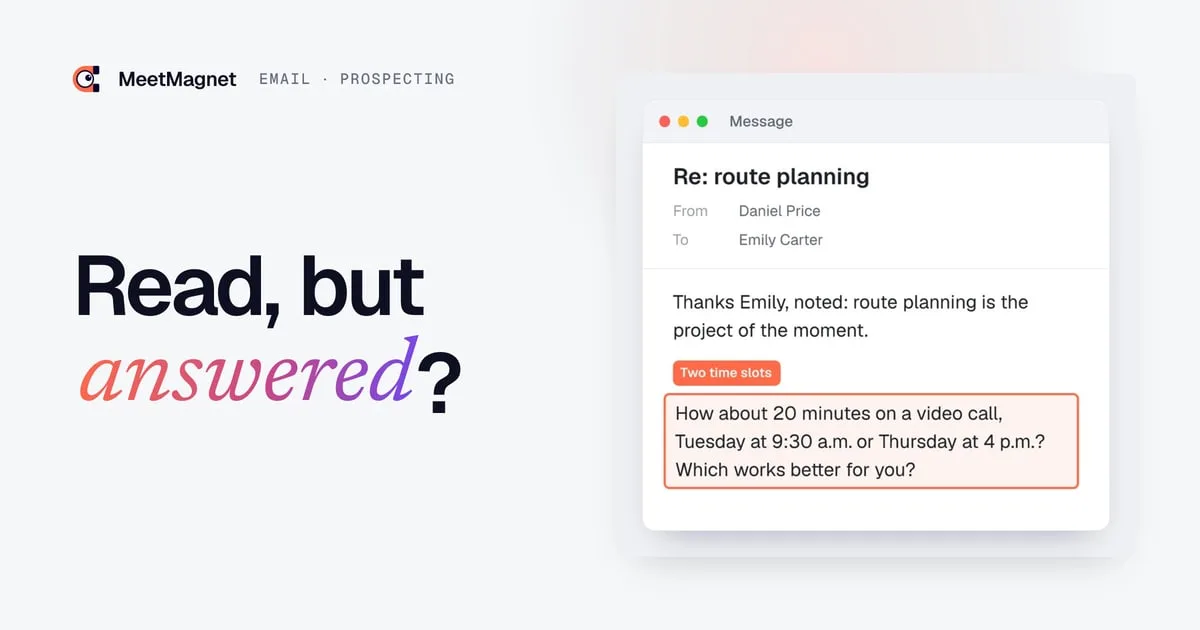
- Closing line 12: “How about 20 minutes on a video call, Tuesday at 9:30 a.m. or Thursday at 4 p.m.? Which works better for you?” (two time slots)
- Closing line 13: “I’ll send you an invite for Thursday at 11 a.m.; if that time doesn’t work, just reply with another one.” (time slot set, can be changed)
- Closing line 14: “To make the call useful for you, what would you rather we look at first: [point A] or [point B]?” (choice, preparing the meeting)
- Closing line 15: “Would you like me to invite [the person you mentioned] too, so you don’t have to repeat everything?” (closed question, widening the meeting)
📌 Two time slots are better than a calendar link sent on its own. The link forces the prospect to open a page, look for a time and fill in a form. Two times in the text can be confirmed in one word. The link can come as an extra, after the two slots. For the request email itself, its templates and how to pick time slots, see our guide to the meeting request email.
Which closing line should you choose for each situation?
Which closing line to choose depends on two things: what you already know about the prospect, and what you want to learn from their reply. The table below sums up the 15 closing lines.
| No. | Closing line (opening words) | When to use it | Intended effect |
|---|---|---|---|
| 1 | “Is this on your desk right now…” | First email, topic uncertain | Gauge urgency |
| 2 | “Are you the one handling this…” | First email, unsure of the contact | Find the right person |
| 3 | “If I send you the checklist…” | First email, cautious prospect | Get a first, light yes |
| 4 | “Have you already made a call…” | First email, decision likely underway | Find out if the spot is taken |
| 5 | “A yes or a no is all I need…” | First email, busy target | Get a short reply |
| 6 | “A quick ‘not now’…” | First email, heavily solicited target | Get the undecided to reply |
| 7 | “I saw that [new fact]…” | Follow-up with a new signal | Follow up on a real fact |
| 8 | “A 15-minute call, or two pages…” | Follow-up after silence | Lower the bar |
| 9 | “Already handled on your end?” | Follow-up, unsure of interest | Clarify the situation |
| 10 | “After the summer, or at the end of the year?” | Follow-up, topic not ready yet | Get a date to pick it back up |
| 11 | “I’ll close this out on my end…” | Last message in the sequence | Close cleanly |
| 12 | “Tuesday at 9:30 a.m. or Thursday at 4 p.m.?” | After a positive reply | Set the meeting |
| 13 | “I’ll send you an invite…” | Very busy, interested prospect | Avoid back-and-forth |
| 14 | “What would you rather we look at…” | Meeting accepted | Prepare the conversation |
| 15 | “Invite [the person] too…” | Several decision-makers involved | Bring the right people together |
Read the table in the order of the conversation: closing lines 1 to 6 open, 7 to 11 follow up, 12 to 15 turn interest into a meeting. 👀 The same person can receive three closing lines from three different families over the course of your exchanges, and that is normal.
Which prospecting email endings should you ban?
Ban every ending that asks for nothing specific or asks for too much too soon. They sound polite, but they leave the prospect with nothing to do. Here are the most common ones.
- ❌ “I look forward to hearing from you”: you are waiting, but for what?
- ❌ “Feel free to get back to me”: the prospect doesn’t feel anything, they forget.
- ❌ “Let me know if you have any questions”: they didn’t ask you anything.
- ❌ “What do you think?”: the question is too open, it requires writing a real answer.
- ❌ “When are you available for a call?”: it leaves the prospect to do the scheduling work.
- ❌ “Thanks in advance for your reply”: it assumes a reply nobody owes you.
- ❌ Three questions in a row: the prospect doesn’t know which one to answer, so they answer none.
✅ A simple test before sending: read your last sentence and ask yourself whether it can be answered from a phone in under ten seconds. If not, rewrite it.

What should go in a prospecting email signature?
A prospecting email signature should be short, make it clear who is writing and offer an easy way to stop receiving messages. It comes after the closing question, never in its place: the last sentence the reader sees should remain the question.
A useful signature fits in four lines:
- First and last name, so the prospect knows who they are replying to.
- Title and company, to establish your credibility.
- A direct phone number, for those who prefer to call.
- An opt-out line, for example “If you’d rather not get my emails, just let me know.”
The fourth line is not just a matter of courtesy. In France, the CNIL, the French data protection authority, points out that every commercial email must make it possible to know the identity of the sender and to easily refuse further messages, including when writing to business professionals. Other countries have their own rules, so check the ones that apply to your recipients. 📌 A clear sentence at the bottom of the email meets that requirement and reassures the reader.

Remove everything else: banners, quotes, social media icons. A newsletter-style signature makes the email look like a mass mailing.
How do you tie the end of the email back to the signal that prompted it?
The end of the email works best when it picks up the fact that made you write. If the opening line is about a new hire, the closing question is about that hire; if it is about a new plant, the question is about that plant. The prospect then sees a message that is consistent from the first line to the last, written for them.
That consistency is hard to keep up when you are writing to dozens of people a week. That is what MeetMagnet does: the tool tracks on LinkedIn the intents you have defined (new role, hiring, posts on your topic), suggests an opening line built on that signal, with a matching closing question, and every message is reviewed before sending. The sequence continues on LinkedIn and by email, and the funnel stats show which endings get replies, then meetings.
Sources
- “La prospection commerciale par courrier électronique, SMS-MMS et automate d’appel”, CNIL, accessed October 2, 2026, https://www.cnil.fr/fr/la-prospection-commerciale-par-courrier-electronique-sms-mms-et-automate-dappel
Frequently asked questions
How do you end a prospecting email?
End with a single question that is easy to handle from a phone: a yes or a no, a choice between two options, or two specific time slots if the prospect has already shown interest. The question should be about their situation, ideally about the fact that made you write, not about your offer.
What can you use instead of "I look forward to hearing from you"?
A specific question that says what you expect. For example: "Is this on your plate this quarter, or more of a next-year thing?" The prospect then knows what to answer and can do it in a few words, whereas "I look forward to hearing from you" leaves them to invent the next step.
Should you suggest a meeting in the first prospecting email?
Generally, no. Asking someone who doesn't know you for thirty minutes of their calendar is too big an ask. It is better to first check that the topic concerns them with a closed question, then suggest two specific time slots once they have replied and shown real interest in your topic.
What should go in a prospecting email signature?
Four lines are enough: first and last name, title and company, a direct phone number, and a simple sentence for opting out of further messages. Remove banners, quotes and rows of icons, which make the email look like a newsletter rather than a message written for one specific person.
Etienne Douillard
Co-founder and CEO, MeetMagnet
An engineer and entrepreneur for over five years, Etienne works every week with B2B SMEs on signal-based prospecting.
From intent to booking
MeetMagnet spots who has a reason to talk to you right now, writes the opener that stands out, and a real person keeps it on track.