AI SDR: definition, how it works, limits and tools
By Etienne DouillardUpdated 18 min read
Too long, didn’t read?
Ask your favourite AI to summarise this article and pull out the points that matter for your business.

Contents
- What exactly is an AI SDR?
- How does an AI SDR work?
- What is an AI SDR used for? Use cases
- What are the benefits of an AI SDR?
- What does an AI SDR really do, task by task?
- Which tasks can you delegate safely?
- What must stay human?
- What are the real risks of an AI SDR?
- Can you replace an SDR with AI?
- How much does an AI SDR cost, and which tools should you choose?
- When should you keep a human rather than an AI SDR?
- How do you frame an AI SDR so it books meetings?
- How does MeetMagnet split the work between AI and humans?
- Sources
An AI SDR is software that uses artificial intelligence to do part of the work of an SDR, the Sales Development Representative in charge of landing the first meeting: finding prospects, spotting the right moment, writing a first message, following up and proposing a time slot. Here is its definition, how it works, its use cases, its benefits and limits, what it costs and what must stay human, with figures from 27 client accounts we support.
📌 Key takeaways
- An AI SDR replaces tasks, not a salesperson: research, sorting, first drafts and follow-ups delegate well, choosing the target and running the meeting do not.
- The real risks are well known: generic messages, factual errors, LinkedIn’s terms of use, the transparency required by the AI Act since 2 August 2026, and email deliverability.
- An in-house SDR costs €50,000 to €70,000 a year all-in, software €149 to €299 excl. VAT per month: the gap is real, but the two do not do the same job.
- The weak link is not sending, it is turning a reply into a meeting: that is where a human still makes the difference.
- Gartner predicts 10 AI agents per seller by 2028, yet fewer than 40% of sellers will say their productivity improved (Gartner, July 2026).
What exactly is an AI SDR?
An AI SDR is a tool that carries out on its own, within a set framework, the steps that come before the first meeting: finding the right contacts, detecting a buying signal, writing a message, sending it, following up and proposing a time slot. People also talk about an AI SDR agent when the tool chains these steps together without human approval between each one.
What does SDR stand for, and what does an SDR do?
SDR stands for Sales Development Representative, sometimes called a business development rep. It is the salesperson who handles the first stage of the sale. Their job:
- Find the companies and decision-makers that match the target.
- Contact these prospects on LinkedIn, by email or by phone.
- Qualify their interest: the right person, a real need, the right time.
- Land the first meeting and hand it over to the salesperson who closes, often called an Account Executive.
In SMEs, the founder often fills this role, between two customer meetings. An AI SDR takes over part of this job, mostly the first two steps.
What types of AI SDR are there?
The term covers three very different setups, from the assistant that writes on request to the agent that converses on its own.
| Setup | What the AI does | What the human does |
|---|---|---|
| Writing assistant (ChatGPT, Claude) | Writes a draft on request | Finds prospects, sends, converses |
| AI-augmented SDR | Researches, sorts, prepares messages and follow-ups | Chooses the target, reviews, runs the conversation |
| Autonomous AI SDR | Researches, writes, sends and replies on its own | Sets the framework at the start, looks at the results |
👉 The AI-augmented SDR is currently the setup with the best balance between time saved and risk taken. Full autonomy goes faster, but every message goes out under your name without anyone having read it.
How does an AI SDR work?
An AI SDR works in five steps that repeat every day: it starts from your target, spots the prospects who have a reason to buy now, writes a message from that context, sends it and follows up within set limits, then reads the replies to propose a time slot and update the CRM.
- Target and data: you describe your ideal customer (industry, size, job titles), your exclusions and your current customers. The tool relies on this data and, if connected, on your CRM.
- Detection: every day it monitors the tracked sources (LinkedIn, job ads, press, reviews) and spots buying signals: a new role, a hiring drive, a post on a topic related to your offer.
- Writing: a language model writes a first message from the signal and your tone guidelines. This is the step where human review matters most.
- Sending and follow-ups: messages go out on LinkedIn or by email, at a limited pace, with spaced follow-ups and an immediate stop if the person says no.
- Conversation and meeting: the tool reads every reply, classifies it (interest, question, refusal, out of office), suggests the next step, reads the calendar to offer two slots and logs everything in the CRM.
Bottom line: the quality of an AI SDR depends less on the language model than on steps 1 and 2. A vague target and weak signals produce off-target messages, whatever the tool.
What is an AI SDR used for? Use cases
An AI SDR is used for everything that comes before the first meeting and repeats itself: prospecting new accounts, answering inbound requests fast, following up with dormant prospects and keeping the CRM up to date. Six use cases come up again and again in B2B SMEs.
| Use case | What the AI SDR does | What you gain |
|---|---|---|
| Prospecting on buying signals | Spots who has a reason to buy and writes from the fact | Messages that land at the right time |
| Qualifying inbound requests | Answers a form or demo request within minutes | A prospect who does not wait until tomorrow |
| Follow-ups | Follows up at the right interval, with a new angle | No forgotten follow-up |
| Reactivating old prospects | Spots those who come back with a new signal | Known contacts who become active again |
| Booking meetings | Reads the calendar, offers two slots, sends the invitation | Less back and forth |
| Updating the CRM | Logs exchanges, statuses and next steps | An up-to-date pipeline without data entry |
For reactivation, our article on reactivating old prospects lays out the method.
What are the benefits of an AI SDR?
The benefits of an AI SDR come from its consistency: it works every day, at the same level, without forgetting anyone. For an SME without a dedicated salesperson, that is often the difference between prospecting that keeps running and prospecting that stops as soon as the founder gets busy.
- Responsiveness: a reply or an inbound request handled within minutes, evenings included.
- Coverage: every tracked signal, every day, instead of the ones you happen to see in your feed.
- Consistency: every follow-up goes out at the right time, every refusal is respected.
- Cost: a few hundred euros a month, instead of a salary.
- Measurement: every message, reply and meeting is counted, so it can be adjusted.
The benefit disappears if the messages become generic: 73% of B2B buyers actively avoid suppliers who send them irrelevant outreach, according to a Gartner survey of 632 buyers (Gartner, June 2025). An AI SDR that quickly sends messages unrelated to the prospect damages your image faster than a human would.
What does an AI SDR really do, task by task?
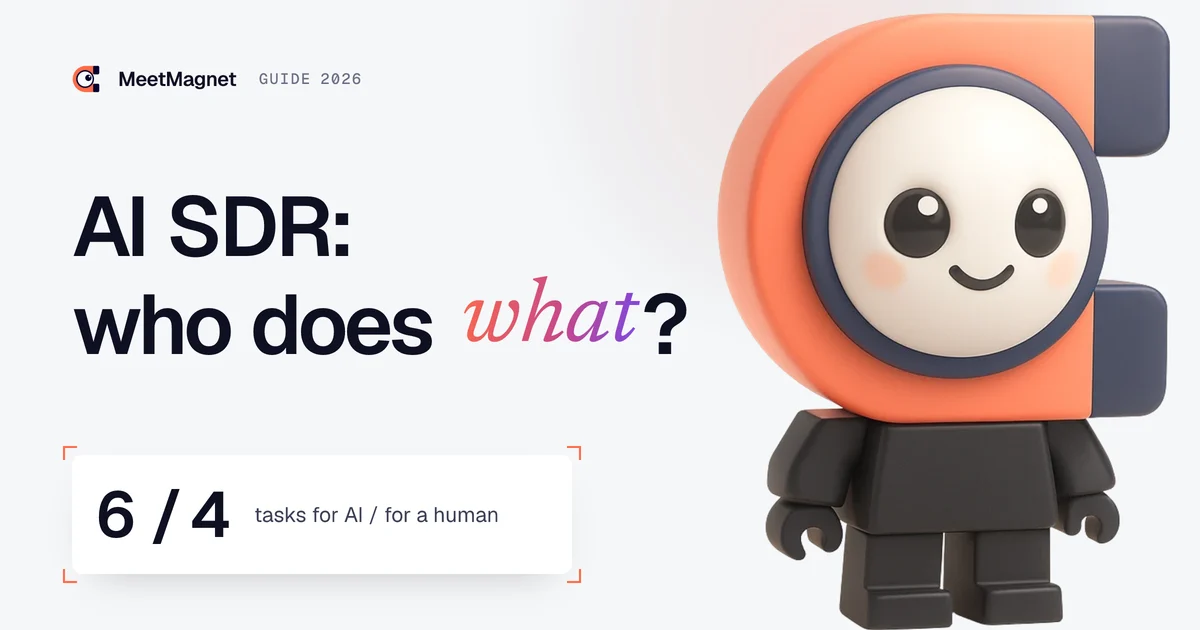
An AI SDR is excellent at what is repetitive and verifiable (research, sorting, follow-ups), average at what has to be written, and weak at what is negotiated or happens face to face. Here is who does each task of an SDR’s day best.
| Task | Human SDR | AI SDR | Who should handle it |
|---|---|---|---|
| Building the prospect list | Slow, a few dozen a day | Fast, hundreds a day | The AI, on a target set by the human |
| Detecting buying signals | Whatever turns up in their LinkedIn feed | Every day, across all tracked sources | The AI |
| Sorting and prioritising | By gut feeling | By consistent rules | The AI, with rules reviewed by the human |
| Choosing the target and the offer to push | Understands the market | Applies what it is given | The human |
| Writing the first message | Accurate, but slow | Fast, sometimes generic | Both: AI first draft, human review |
| Following up | Often forgets | Never misses a follow-up | The AI |
| Answering a simple question | When they have time | Within minutes | The AI, within a written framework |
| Handling an objection or a tricky case | Reads between the lines | Misses the point | The human |
| Proposing a time slot | Back and forth by email | Reads the calendar, offers two slots | The AI |
| Running the meeting | Builds the relationship | Cannot do it | The human |
Bottom line: the top half of the table can be delegated, the bottom half needs someone who understands your business and your customer.

Which tasks can you delegate safely?
You can hand an AI SDR every task whose result is easy to check and where a mistake costs little. These are also the longest and least rewarding tasks for a salesperson. Six tasks delegate well, in the order they come up.
- Research: finding the companies and people that match your target, with their job title and business contact details.
- Signal detection: spotting every day who has just started a new role, is hiring, posts about a topic related to your offer or reacts to a discussion in your field. Our B2B buying signals examples list the most useful ones.
- Sorting: removing off-target profiles, competitors and existing customers, and ranking the rest by how fresh the signal is.
- The first draft: an opener built on the signal, which the human reviews and corrects in a few seconds.
- Follow-ups: at the right interval, with a new angle, and an immediate stop if the person says no.
- Booking the slot: reading the calendar, proposing two specific times, sending the invitation.
✅ On these six tasks, AI is more consistent than a human: it does not get tired on Fridays and never forgets Tuesday’s follow-up.
What must stay human?
Four things stay human, because a mistake there is costly and no rule describes them fully: choosing the target, reviewing messages, handling tricky replies and the meeting itself. These are precisely the steps where the first meeting is won, or lost.
- 🎯 Choosing the target: which segment to go after, which offer to push, which accounts never to contact. The AI applies a strategy, it does not decide it.
- ✍️ Reviewing: a message that goes out carries your name. Reviewing takes a few seconds and avoids the forced compliment or the wrong fact. We go through the signs that give away a generated message in our article on AI prospecting messages.
- 🤝 Tricky replies: an annoyed prospect, a pricing question, a “we already have a provider”, a competitor’s customer. Here, an off-target reply closes the door for a long time.
- 📅 The meeting: this is where trust is built. No tool does it for you.
The following example shows the difference between a first draft sent as is and a reviewed message.
Example
Signal: the operations director of an 80-person SME posts on LinkedIn that his factory has just moved to two shifts to keep up with a rise in orders.
Opener sent without review: “Hi James, I was really impressed by your career and your company’s growth. We help manufacturers optimise their performance. Would you have 15 minutes this week?”
Reviewed opener that gets a reply: “Hi James, moving to two shifts is often the point where maintenance becomes the bottleneck: the stoppages you used to catch up on overnight no longer have a slot. Is that an issue for you, or had you planned for it?”
The first message could go to anyone. The second starts from the fact, names a credible consequence and asks an easy question, without asking for a meeting. 💡 It is this work on the opener, more than detecting the signal, that gets people to reply.

See the method on real conversations
What the AI prepares, what the human reviews, and how a reply turns into a meeting.
What are the real risks of an AI SDR?
The risks of an AI SDR are commercial and legal more than technical: messages that all look alike, factual errors, a restricted LinkedIn account, an ignored transparency obligation and emails that end up in spam. Each one can be managed, provided you know about it before launching the tool.
Generic messages
A poorly framed AI SDR produces messages you can spot at a glance: a flattering compliment, an empty phrase, a meeting request straight away. One more message that “sounds like AI” will not be read. ⚠️ The faster the tool sends, the faster it damages your image if the message is weak.
Factual errors
AI can confuse two people with the same name, attribute a post to the wrong company or invent a plausible detail. One mistake about a prospect’s job title is enough to discredit the message.
LinkedIn’s terms of use
LinkedIn prohibits third-party software that automates activity on its site, and warns that the accounts involved risk being restricted or closed (LinkedIn Help, prohibited software and extensions). An AI SDR that sends hundreds of invitations a day from your profile therefore puts your account at stake. 🔒 Check how the tool connects and what volumes it respects.
The transparency required by the AI Act
Since 2 August 2026, Article 50 of the EU Artificial Intelligence Act requires that people who interact directly with an AI system be informed of it, unless this is obvious (AI Act, Article 50). An AI SDR that converses with your prospects on its own falls within this scope. The simplest approach: a human who reviews and owns the exchanges, and an honest answer if the prospect asks who they are talking to.
Email deliverability
On the email side, Google asks senders to keep their reported spam rate below 0.3%, and ideally below 0.1% (Google, email sender guidelines). Sending too much, too fast, from a poorly configured domain can push all your emails into spam, including those meant for your customers. Our guide to cold email deliverability details the settings to get right before you ramp up volume.
Finally, the GDPR still applies: in France, the CNIL accepts email prospecting between businesses if the message relates to the person’s job, they are informed of it and they can opt out easily (CNIL, email prospecting).
Can you replace an SDR with AI?
You can replace a large share of an SDR’s tasks with AI, but not the SDR themselves when the work calls for judgement, negotiation or a relationship. For an SME without a salesperson, the real question is not “human or AI” but “who does what” between the tool and the founder.
Cost explains the interest in the question. An in-house SDR costs €50,000 to €70,000 a year all-in, not counting management time, according to Getalead, which adds that 40% of SDRs leave their job within the first twelve months. Prospecting software costs €149 to €299 excl. VAT per month, or €1,788 to €3,588 excl. VAT per year.
| Option | Annual cost | What it does | What it does not do |
|---|---|---|---|
| In-house SDR | €50,000 to €70,000 all-in | Everything, with judgement | Stay for long: turnover is high |
| Software | €1,788 to €3,588 excl. VAT | Research, sorting, first drafts, follow-ups | Choose the target, run the meeting |
The gap does not mean that a €299 tool replaces a €60,000 employee. It means that an SME can hand the repetitive part to software and keep the human where it matters. To compare the price of a meeting by method, see our page on the cost of a B2B meeting.

📊 Our own figures show where the difference lies. Across 27 paying client accounts (our snapshot of 9 October 2026), 15,910 prospects contacted produced 4,779 replies, a 30% reply rate (median per account 26%, ranging from 12% to 57%), across LinkedIn and email conversations. But these replies only lead to 4.9 meetings or call requests per 100 replies, and it takes a median of 16 days before the first meeting. A meeting, here, is a time slot accepted or proposed by the prospect, or a request to be called; we do not know whether it actually took place.
In other words: getting a reply delegates fairly well, turning it into a meeting much less so. We cover this step in our article on the AI conversational agent.
How much does an AI SDR cost, and which tools should you choose?
An AI SDR costs between 100 and 600 euros or dollars a month depending on the tool, before add-ons, according to the public prices we checked in October 2026. The gap comes down to what is included: prospect volume, signals, channels, and whether or not a human sets up the tool with you.
| Tool | Starting price checked | What is included |
|---|---|---|
| MeetMagnet | €149 excl. VAT/month (Self-serve), €299 excl. VAT/month (Managed) | Buying signals with no credits, opener to review, conversation agent; a human calibrates on the Managed plan |
| Gojiberry | $99/month | Signals, campaigns, up to 1,800 prospects contacted per month |
| lemlist | $109/month per user (multichannel) | Email and LinkedIn sequences; signals as an add-on, $29 per 100 |
| Amplemarket | $600/month (Startup plan, annual, 2 users) | Intent signals, AI writing, job change alerts |
These are the prices on the official pages on the dates we checked, and they change often. Our comparison of the 10 best B2B prospecting software tools gives the details, the limits of each one and screenshots of their sites.
When should you keep a human rather than an AI SDR?
Keep a human, or hire one, when every prospect matters a lot, when the sale depends on the relationship or when your market is small. An AI SDR is most useful when the target is broad, signals are plentiful and nobody has the time to follow them.
| Your situation | What we recommend |
|---|---|
| Fewer than 200 target accounts, high deal value | A human who writes every message, AI for research and signals |
| Long sales cycle, several decision-makers | A salesperson, AI to prepare and follow up |
| SME without a salesperson, target of several thousand contacts | An AI-augmented SDR, with the founder reviewing |
| Sales team already in place, overloaded | AI for research, sorting and follow-ups, salespeople on the conversations |
🧭 A simple test: if a botched message would lose you an account you will never get back, someone must review it before it goes out.
How do you frame an AI SDR so it books meetings?
An AI SDR delivers good results when a human sets the framework at the start, reviews in the early weeks and looks at the numbers every week. Without that framework, it produces volume; with it, it produces conversations that lead to meetings.
- 🗂️ Before launch: the target, the signals tracked, the excluded accounts and the tone of the messages, written down in black and white.
- 👀 The first two weeks: review every message before it is sent, correct it, and note why. These corrections become the tool’s instructions.
- 📈 Every week: replies, meetings, refusals. Fewer replies means the opener is wearing out; replies without meetings means the conversation is stalling.
- 🛑 At all times: any refusal stops the sequence, any tricky reply goes up to a human.
Our article on AI prospecting reviews twelve uses of AI in B2B prospecting.
How does MeetMagnet split the work between AI and humans?
MeetMagnet follows this split: every day it spots the decision-makers on LinkedIn who show a buying signal related to your offer, writes an opener based on that signal, which you review before sending, then follows up on LinkedIn and by email. The conversation agent reads the replies, asks the next question and proposes two slots from your calendar once the context is clear.

What MeetMagnet does not do: choose your market or run your meetings. On the Managed plan, at €299 excl. VAT per month, a member of our team calibrates the target, the signals and the openers with you, then reviews the results at 30, 60 and 90 days. The Self-serve plan, at €149 excl. VAT per month, leaves that setup to you. The details are on our pricing page.
An AI SDR is neither a cut-price salesperson nor a meeting machine. It is a very good executor, which needs a human to choose the target, review, handle tricky cases and run the meeting. Split the work this way, measure the step from reply to meeting every week, and you will quickly see what the tool brings you. 🚀
Sources
- “Prohibited software and extensions”, LinkedIn Help, accessed 27 October 2026, https://www.linkedin.com/help/linkedin/answer/a1341387
- “Article 50: Transparency obligations for providers and deployers of certain AI systems”, AI Act (Regulation (EU) 2024/1689), accessed 27 October 2026, https://artificialintelligenceact.eu/article/50/
- “Règlement (UE) 2024/1689 sur l’intelligence artificielle”, EUR-Lex, accessed 27 October 2026, https://eur-lex.europa.eu/legal-content/FR/TXT/?uri=CELEX:32024R1689
- “Consignes pour les expéditeurs d’e-mails”, Google, accessed 27 October 2026, https://support.google.com/a/answer/81126?hl=fr
- “La prospection commerciale par courrier électronique”, CNIL, accessed 27 October 2026, https://www.cnil.fr/fr/la-prospection-commerciale-par-courrier-electronique
- “Gartner Predicts AI Agents Will Outnumber Sellers 10 to 1 by 2028, Yet Fewer Than 40% of Sellers Will Say Agents Improved Productivity”, Gartner, 28 July 2026, accessed 29 October 2026, https://www.gartner.com/en/newsroom/press-releases/2026-07-28-gartner-predicts-ai-agents-will-outnumber-sellers-10-to-1-by-2028-yet-fewer-than-40-percent-of-sellers-will-say-agents-improved-productivity
- “Gartner Sales Survey Finds 61% of B2B Buyers Prefer a Rep-Free Buying Experience”, Gartner, 25 June 2025, accessed 29 October 2026, https://www.gartner.com/en/newsroom/press-releases/2025-06-25-gartner-sales-survey-finds-61-percent-of-b2b-buyers-prefer-a-rep-free-buying-experience
- Public pricing of MeetMagnet, Gojiberry and lemlist (checked 15 October 2026) and Amplemarket (checked 26 September 2026), official pricing pages
- “Prospection interne vs externalisée : comment choisir ?”, Getalead, François Alonge, 22 March 2026, accessed 27 October 2026, https://getalead.co/blog/prospection-interne-vs-externe
- MeetMagnet snapshot of LinkedIn and email conversations across 27 paying client accounts, 9 October 2026.
Frequently asked questions
Is an AI SDR legal in Europe?
Yes, under three conditions. The message must relate to the person's job and let them opt out easily, as data protection authorities such as France's CNIL require for prospecting between businesses. The tool must respect the platforms' terms of use, since LinkedIn prohibits software that automates activity on its site. And since August 2026, the AI Act requires disclosing that an AI is conversing when that is the case.
What is the difference between an AI SDR and a sequencing tool?
A sequencing tool sends pre-written messages on a fixed schedule. An AI SDR also chooses who to write to, adapts the message to each prospect's context and reads the replies to decide what comes next. The sequencing tool executes a plan, the AI SDR makes small decisions within a given framework.
How long does it take to set up an AI SDR?
Allow two to four weeks. The first week is for setting the target, the signals to track and the tone. The following weeks are for reviewing messages, correcting them and adjusting the instructions based on the first replies. You need at least three to four weeks of figures before judging whether a target or an opener works.
Can an AI SDR call prospects on the phone?
Some tools offer synthetic voices that make calls, but in B2B the results remain shaky: decision-makers hang up quickly on an artificial voice, and the AI Act requires disclosing that it is an AI. In practice, AI prepares the call better than it makes it: it chooses who to call and why.
Should you tell prospects that an AI SDR is writing to them?
If the AI converses directly with the prospect, yes: since 2 August 2026, the AI Act requires that people be told they are interacting with an AI system, unless it is obvious. When a human reviews, approves and signs every message, the human is the one writing. Either way, answer honestly if the prospect asks.
Etienne Douillard
Co-founder and CEO, MeetMagnet
An engineer and entrepreneur for over five years, Etienne works every week with B2B SMEs on signal-based prospecting.
From intent to booking
MeetMagnet spots who has a reason to talk to you right now, writes the opener that stands out, and a real person keeps it on track.