Prospecting: how long until you see results, and how do you know it's working?
By Etienne DouillardUpdated 14 min read
Too long, didn’t read?
Ask your favourite AI to summarise this article and pull out the points that matter for your business.

Contents
- How long does prospecting take to get results?
- What should you see week by week, then month by month?
- Which success metrics should you track, and in what order?
- How do you know if your prospecting is working?
- When should you keep going, adjust or stop prospecting?
- Why does prospecting produce few results in the first month?
- What does a decision dashboard look like?
- What if your target is too narrow or not on LinkedIn?
- How do we measure results at MeetMagnet?
- Sources
How long does prospecting take to get results? It is the first question business owners ask before they start, along with this one: how do you know it’s working, and when should you stop? Here is the week-by-week timeline, the success metrics in order, and the thresholds we use to decide: keep going, adjust or stop.
📌 Key takeaways
- B2B prospecting is judged in three stages: one month for the target and the opener, two months for meetings, three months for a steady pace.
- Read the results in order: prospects found, acceptances, replies, positive replies, meetings, opportunities. The first number that drops tells you what to fix.
- Across our client accounts, the first meeting comes after a median of 16 days: judging a campaign after one week means judging it too early.
- Our rule: around fifteen prospects found in a month, stop; around a hundred and three or four positive replies, keep going.
- Even a salaried SDR takes an average of 3 months to become fully productive, according to The Bridge Group (2025).
How long does prospecting take to get results?
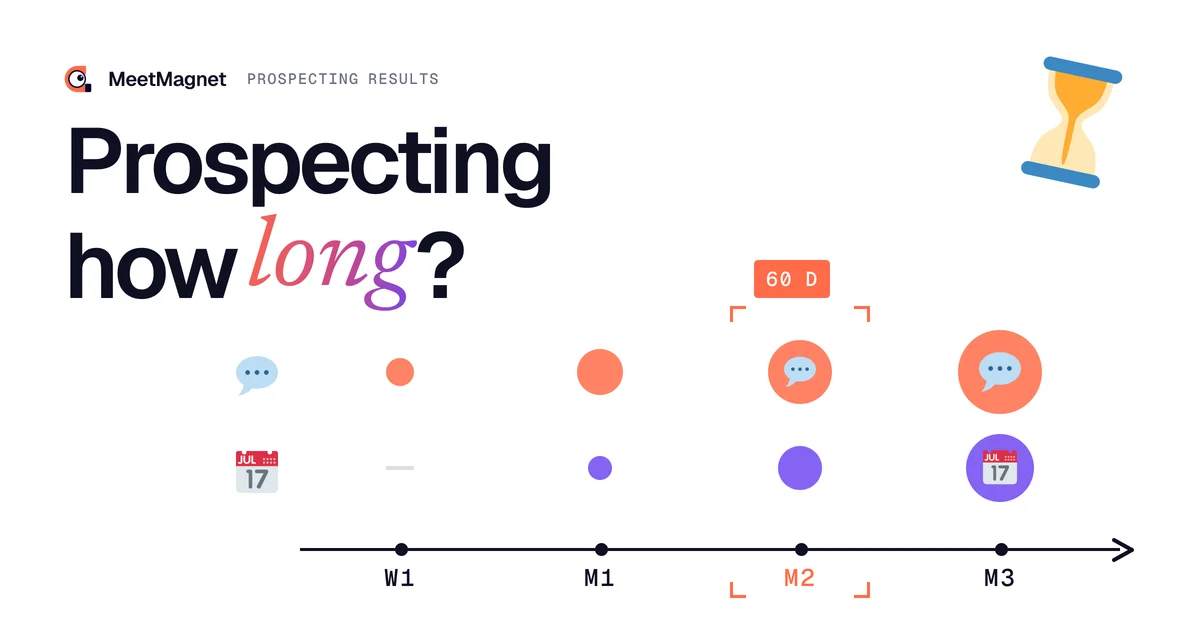
Allow one to two months to get results from B2B prospecting, and three months for a steady flow of meetings. The first month checks that the target exists and that the opener gets replies; the second shows whether replies turn into meetings; the third confirms the pace.
This delay comes from how prospecting works: the invitation has to be accepted, the reply often comes after a follow-up, the meeting after two or three exchanges. ⏳
Across 27 paying client accounts (our data from 9 October 2026, LinkedIn and email), the median time between launch and the first meeting is 16 days. Half of them waited longer. We break these figures down in our article on cold outreach reply rates.
You face the same delay when you hire. The Bridge Group, which studies the SDR teams of 351 B2B companies, measured an average ramp time of 3.0 months for a salaried SDR in 2025, the lowest since 2010 (The Bridge Group, 2025). Hiring does not shorten the wait; we compare the options in our article on the AI SDR.

Bottom line: one month to learn, two to judge, three to stabilise. Before one month, you have no results to judge, only signs.
What should you see week by week, then month by month?
Each period has its own metric. Looking at meetings in week 1 or at the acceptance rate in month 3 means looking at the wrong number at the wrong time. Here is what to check at each stage, with the benchmarks we give our clients.
Week 1: does the target exist?
The first week says nothing about meetings. It answers one question: can you find enough prospects who match the target? 🔍 You approve the first profiles one by one, drop those outside the target and adjust the tone of the messages. If the search only brings up a handful of profiles, now is the time to notice, not in two months.
Month 1: do the target and the opener get replies?
At the end of the first month, look at volume and replies. Around a hundred well-targeted prospects contacted, invitations accepted, replies, and among them three or four positive replies: that is the sign the target and the opener hold up. One or two first meetings may come, but that is not yet the yardstick.
Month 2: do replies turn into meetings?
The second month is the real test. Follow-ups have run, conversations have had time to move forward, and the first month’s corrections apply. 🎯 Our benchmark: around three meetings or three qualified opportunities by the end of the second month. Below that, something serious has to change: the target, the signal you track or the angle of the opener.
Month 3: is the pace steady?
In the third month, you no longer ask whether it works, but how much it brings in. The pace settles: you can work out the cost of a meeting and decide what comes next (keep going, widen the target, add signal sources).
| When | The question | The number to watch | The good sign |
|---|---|---|---|
| Week 1 | Does the target exist? | Prospects found in the target | A steady flow of relevant profiles |
| Month 1 | Does the opener get replies? | Replies and positive replies | Around a hundred contacted, 3 or 4 positive replies |
| Month 2 | Do replies turn into meetings? | Meetings and opportunities | Around 3 meetings or qualified opportunities |
| Month 3 | Does the pace hold? | Meetings per month, cost per meeting | A steady pace and a profitable cost per meeting |

Bottom line: in week 1 you judge the target, in month 1 the opener, in month 2 the conversation, in month 3 the return.
Which success metrics should you track, and in what order?
Six metrics are enough to know whether prospecting works, as long as you read them in the order the prospect moves. Each one depends on the previous one: a reply rate means nothing if the target is wrong, and a meeting only counts if it leads to an opportunity.
- Prospects found: how many people in your target, with a reason to be contacted, you find each week.
- Acceptance rate: on LinkedIn, the share of invitations accepted. When it is low, your profile lacks credibility.
- Reply rate: the share of contacts who reply, whatever they say. Across our accounts it sits around 30%, with wide gaps from one account to another.
- Positive replies: replies that open a conversation (a question, interest, a call request). They are the best leading indicator of meetings.
- Meetings: a time slot accepted or proposed by the prospect, or a request to be called.
- Opportunities: meetings with a decision-maker who has a real need. This is the only measure of success that counts.
The funnel narrows at every step, and that is normal. HubSpot notes, for example, that between 10% and 20% of marketing leads typically become sales-qualified leads, with large variations by industry and source (HubSpot, updated July 2026). 💡 What matters is not the size of each stage, but the stage where things drop.
To track these numbers every week, see our article on the 5 prospecting metrics to track every week. Here, we use them for a different decision: keep going or stop.
Bottom line: the first three metrics judge the target and the opener, the last three judge the conversation and the offer.

How do you know if your prospecting is working?
Your prospecting is working when each step feeds the next: enough prospects in the target, positive replies every week, and meetings that lead to opportunities. The best early sign is the positive reply: it announces the meetings to come.
Three signs show it is working, even before the first meeting:
- ✅ Prospects reply with substance: they talk about their situation or ask a question about what you do, not just “thanks”.
- ✅ Refusals come with reasons: “we already have a supplier” or “not before September” tell you the target is right and the timing is not, yet.
- ✅ Positive replies come from the right roles: decision-makers, not people trying to sell you their services.
Three signs show the opposite, whatever the volume:
- ❌ Replies coming mostly from people outside the target or from salespeople.
- ❌ A decent reply rate, but not a single positive reply after one month.
- ❌ Meetings that never lead to an opportunity.
Sending more fixes none of these three problems. In a Gartner survey of 632 B2B buyers, 73% said they actively avoid suppliers who send irrelevant outreach (Gartner, June 2025). Sending more simply damages your reputation faster.
The following example shows how to recognise a positive reply before the meeting even happens.
Example
Signal: the finance director of a services SME posts on LinkedIn that her company is switching its accounting software before year end.
Weak opener: “Hi Claire, we support SMEs in their finance transformation. Would you have 15 minutes this week?”
Opener that gets a reply: “Hi Claire, switching finance systems at year end often puts the close under pressure. Are you planning to run both in parallel for a while?”
Positive reply: “We’re actually thinking about it. Have you seen this done elsewhere?”
The reply does not contain a meeting yet, but it contains a question. That is exactly what we count as a positive reply: the conversation is open, and a meeting often follows within two or three exchanges.
See how we read results, month by month
What we look at during the first 90 days of prospecting, and how a reply becomes a meeting.
When should you keep going, adjust or stop prospecting?
You should stop prospecting when the target does not produce enough prospects after one month, or when replies still do not turn into meetings at the end of the second month despite corrections. In between, you adjust: one thing at a time, then three to four weeks to see the effect.
These are the thresholds we use with our clients, deliberately simple.
| When | Keep going if… | Adjust if… | Stop if… |
|---|---|---|---|
| End of month 1 | Around a hundred prospects contacted, 3 or 4 positive replies | Replies, but few positive ones or outside the target | Around fifteen prospects found in the month |
| End of month 2 | Around 3 meetings or qualified opportunities | Fewer than 3 meetings, nothing corrected yet | Fewer than 3 meetings, target and opener already corrected |
| End of month 3 | A steady pace, a profitable cost per meeting | Meetings that rarely close | Meetings that never lead to an opportunity |
🛑 The most useful rule fits in one sentence: if, after one month, the search has found only around fifteen prospects in your target, stop, or change source. With so little material, no opener will produce meetings. Conversely, around a hundred well-qualified prospects and three or four positive replies are enough to keep going.
Before you stop, check three things:
- Did the volume really run? A campaign paused two weeks out of four has not been tested. At MeetMagnet, 43% of client departures involve accounts that never really got started (analysis of 79 documented departures, September 2026).
- Did you change only one thing at a time? Otherwise, you cannot tell what worked.
- Is the bottleneck where you think it is? Find the first step that drops before touching anything: the target, the opener or the conversation.
Bottom line: you do not stop prospecting because it is slow, you stop it because a specific number does not move after a correction.
Why does prospecting produce few results in the first month?
The first month produces few meetings because it is for learning: which profiles reply, which openers get a reaction. It is a month of tuning, not of harvest. ⚠️ Judging it on meetings means stopping just as the corrections start to pay off.
Three reasons explain this slow start:
- The delay at each step: acceptance, reply, follow-up, exchange, time slot. Across 300 million calls, Gong found that an average rep needs 19 cold calls to get one conversation, and a top-quartile rep 8 (Gong Labs, July 2024). Whatever the channel, you need a minimum volume before judging.
- Tuning the target: the first days always bring up profiles to drop (competitors, existing clients, roles without decision-making power).
- Lack of consistency: sales reps spend only 28% of their week selling, according to Salesforce’s State of Sales survey of more than 7,700 professionals (Salesforce, 2023). When prospecting relies on the business owner, it stops as soon as they get busy, and the clock resets.
That is why we set the review dates before starting: a check around day 7 for the target, a review with numbers at day 30, another at day 60. Our method from buying signal to meeting gives the full calendar.
What does a decision dashboard look like?
A useful prospecting dashboard fits in one row per week and six columns. Its job is to make the month’s decision without debate.
Example: an account at the end of its first month.
| Week | Prospects found | Acceptances | Replies | Positive replies | Meetings | Opportunities |
|---|---|---|---|---|---|---|
| Week 1 | 25 | 9 | 3 | 1 | 0 | 0 |
| Week 2 | 30 | 12 | 5 | 1 | 0 | 0 |
| Week 3 | 25 | 10 | 4 | 1 | 1 | 0 |
| Week 4 | 25 | 11 | 5 | 1 | 0 | 1 |
| Month 1 | 105 | 42 | 17 | 4 | 1 | 1 |
Reading: around a hundred prospects, four positive replies, a first meeting that has already produced an opportunity. Under our rule, keep going. 📈 The row to watch in the second month is positive replies: if it stays at one a week, the opener or the offer needs reworking.
Three rules to keep it useful:
- 🗓️ Fill it in on the same day every week, in five minutes.
- 📝 Note next to it what you changed, and when.
- 🧮 Judge on four weeks combined, never on a single one.
What if your target is too narrow or not on LinkedIn?
If your target is too narrow or barely present on LinkedIn, the usual timelines do not apply: the problem is not time, it is material. This is the most common edge case, and the leading cause of zero meetings we see among our clients.
Two situations come up again and again:
- A niche that is too narrow: a few hundred companies in your country, few of which post or react online. Widening the geographic area, adding neighbouring roles or simplifying the topics you track is sometimes enough to multiply the volume.
- A target that is not on LinkedIn: doctors, tradespeople, farmers, independent hotel managers. They exist, but leave almost no signal there. You then need other sources: local press (openings, appointments), job ads, reviews, company registers. Our article on buying intent beyond LinkedIn reviews these sources.
In both cases, waiting three months changes nothing. 👉 Check the volume of available prospects in the first week: it is the only number that tells you, before you spend, whether prospecting has a chance of producing meetings.

How do we measure results at MeetMagnet?
At MeetMagnet, we follow this timeline. On the Managed plan, at €299 excl. VAT per month, a member of our team calibrates the target and the openers with you in the first week, then reviews the numbers at day 30, day 60 and day 90: no opportunity at day 30, or fewer than three qualified opportunities at day 60, and we recalibrate the target or the signals. The Self-serve plan, at €149 excl. VAT per month, leaves this tuning to you. Details are on our pricing page.
This follow-up matters as much as the tool: across the 263 client accounts analysed in September 2026, 81% of clients with support got at least one opportunity, against 42% of self-serve clients.
Prospecting should be judged neither after a week nor after a year. Give it one month to prove the target replies, two to produce meetings, three to find its pace, and set before you start the numbers that will make you keep going or stop. 🚀
Sources
- “SDR Models, Motions & Metrics: 2025 Research Report”, The Bridge Group, 2025, accessed 5 November 2026, https://www.bridgegroupinc.com/research/2025-sdr-models-metrics-report-the-bridge-group
- “The hidden power of cold calling: Insights from 300M calls”, Gong Labs, 18 July 2024, accessed 5 November 2026, https://www.gong.io/blog/the-hidden-power-of-cold-calling-insights-from-300m-calls
- “MQL vs. SQL: What they are and how they differ”, HubSpot, updated 31 July 2026, accessed 5 November 2026, https://blog.hubspot.com/sales/sales-qualified-lead
- “10 New Findings Reveal How Sales Teams Are Achieving Success Now” (State of Sales), Salesforce, 6 June 2023, accessed 5 November 2026, https://www.salesforce.com/ap/blog/sales-statistics/
- “Gartner Sales Survey Finds 61% of B2B Buyers Prefer a Rep-Free Buying Experience”, Gartner, 25 June 2025, accessed 5 November 2026, https://www.gartner.com/en/newsroom/press-releases/2025-06-25-gartner-sales-survey-finds-61-percent-of-b2b-buyers-prefer-a-rep-free-buying-experience
- MeetMagnet data on the LinkedIn and email conversations of 27 paying client accounts, 9 October 2026.
- MeetMagnet client analysis, 263 accounts and 79 documented departures, September 2026.
Frequently asked questions
How long does prospecting take to get results?
The first month is for tuning the target and the opener: you see replies, sometimes a first meeting. The second month shows whether replies turn into meetings, and the pace settles in the third. Across our client accounts, the median time to the first meeting is 16 days (October 2026 data).
When should you stop a prospecting campaign?
When the target does not produce enough prospects (around fifteen in a month), or when, at the end of the second month, replies still do not produce three meetings even though the target and the opener have already been corrected. Before stopping, check that the campaign really ran and that you changed only one thing at a time.
How do you measure prospecting results?
Track six numbers in the order the prospect moves: prospects found, invitations accepted, replies, positive replies, meetings, opportunities. The first number that drops shows the step to fix. Log them every week, but only draw conclusions after three to four weeks combined, because small volumes swing a lot.
What are the success metrics of B2B prospecting?
The only real success metric is the opportunity: a meeting with a decision-maker who has a need. Before you get there, the leading indicators are the number of prospects in your target, the reply rate and above all the share of positive replies, which predicts the meetings of the following weeks.
Why does the first month of prospecting produce few meetings?
Because every step takes time: the invitation has to be accepted, the reply often comes after a follow-up, the meeting after two or three exchanges. The first month is also when you correct the target and the tone of the messages. Most meetings come from the second month onwards.
Etienne Douillard
Co-founder and CEO, MeetMagnet
An engineer and entrepreneur for over five years, Etienne works every week with B2B SMEs on signal-based prospecting.
From intent to booking
MeetMagnet spots who has a reason to talk to you right now, writes the opener that stands out, and a real person keeps it on track.