How to add value in a prospecting message: what to offer, profession by profession
By Etienne DouillardUpdated 14 min read
Too long, didn’t read?
Ask your favourite AI to summarise this article and pull out the points that matter for your business.

Contents
- How do you add value in a prospecting message?
- What can you offer that costs almost nothing?
- Example 1: offering prospects, what we do in our own prospecting
- Example 2: the SEO consultant who sends an audit and rankings
- How do you word it in the opener and the follow-up?
- Does giving too much value undervalue your work?
- Which mistakes waste the value you offer?
- How does MeetMagnet help add value in every message?
- Sources
Everyone says you should add value in a prospecting message. But what does that mean in practice? What can you offer that costs you almost nothing but is worth a lot to the prospect? Here is the principle, ideas by profession, two real conversations, how to word it, and the question that always comes up: doesn’t giving too much undervalue your work?
📌 Key points
- Offer a sample of the result you sell, prepared for this prospect, not a generic document or a presentation of your service.
- The right gift takes a few minutes to produce with your tools, and teaches the prospect something about their own situation.
- Offer it first with a short question, send it afterwards: you only produce it for those who say yes.
- Give the result for one case, keep the method and the rest: that is what makes the meeting worthwhile.
- In our own prospecting, the question “can I send you a few prospects for this target?” gets a reply about one time in ten, and sending the prospects gets most of those who said yes to reply.
How do you add value in a prospecting message?
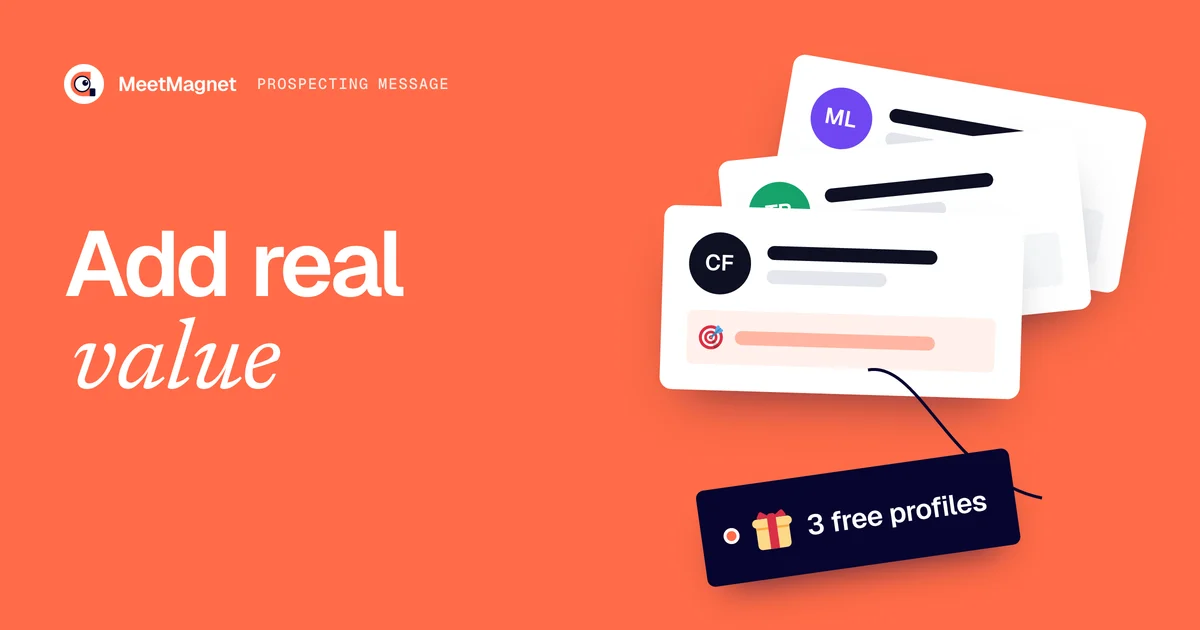
To add value in a prospecting message, offer a piece of the result you sell, prepared for this specific prospect: they can judge it on their own, they learn something about their situation, and they understand what the full job would deliver. It is not a compliment, a pitch for your offer or a white paper.
The logic fits in one sentence we keep repeating to our clients: if the prospect thinks “if I go to this meeting, I will learn something”, they go. 💡 The gift is there to give them that certainty before they even accept.
Buyers say so themselves. RAIN Group, which surveys B2B buyers and sellers, reports that 69% of buyers are influenced, when agreeing to meet, by primary research data relevant to their business, and 67% by content fully customised to their situation (RAIN Group, 114 sales statistics, updated July 2025). The same source says 71% want to talk to sellers early, when they are looking for new ideas.
The opposite is costly: 73% of B2B buyers actively avoid suppliers who send irrelevant outreach, according to a Gartner survey of 632 buyers (Gartner, June 2025).
Bottom line: value is not something you claim (“we help companies to…”), it is something you show, on the person’s own case.
What can you offer that costs almost nothing?
The best thing to offer is what your work already produces, applied to a single case: an extract, a figure, a short list. Your tools already exist, so the cost is low; the prospect could not get it alone, so the value is high.
Three questions to check that a gift holds up:
- Is it a piece of the result? Prospects from a lead generation agency, a ranking from an SEO consultant, a figure from an accountant. Not a brochure.
- Is it made for them? Their website, their target, their sector, their region. If the same document goes to a hundred people, it is advertising.
- Can it be produced in a few minutes? If not, you will not keep up, and you will end up sending the same thing to everyone.

Here is what it looks like by profession. Most of these ideas come from our meetings with clients and prospects in recent months, when we ask them: “what can you offer for free that is valuable to the person?”
| Your profession | What you can offer | What it costs you | What the prospect gains |
|---|---|---|---|
| Lead generation, appointment setting | 3 to 5 prospects spotted in their target, each with its signal | A few minutes with your tool | Contacts they had not seen |
| SEO (search and AI visibility) | Their ranking on 3 searches for their trade, a score and 3 fixes | An analysis tool you already have | They know where they lose clients |
| Accountant, fractional CFO | A rough margin or cash-flow estimate from public data (turnover, headcount, sector) | A template to fill in | A first figure on their situation |
| Recruitment agency | The salary range for the role they are hiring, in their region | Data you already keep | A better-pitched job ad |
| Web agency | Three comments on their homepage, with an annotated screenshot | Ten minutes | Fixes they can make straight away |
| Manufacturer, equipment supplier | An energy or material saving calculation for their case | A calculator | A figure to show internally |
| Manufacturer with a catalogue | “Would you like it in print or digital?” | A catalogue already printed | They choose without committing |
| Coach, LinkedIn profile consultant | A short video review of their profile, a few minutes long | A screen recording | A precise outside view |
What they have in common: the prospect can judge the quality of your work without taking your word for it. 🎯 That is the difference with a promise like “we find qualified leads”.
Example 1: offering prospects, what we do in our own prospecting
What we sell is prospects spotted from business signals. So what we offer is… prospects. Our first message asks one question: “can I send you a few prospects for this target? Is that your target?” On our account, that question gets a reply rate of about 10% (October 2026 figures). Those who say yes get three to five profiles, described by what is happening at their company. ✅ And then almost everyone replies, often with a simple “thanks”, sometimes with much more.
Here is one of those conversations, anonymised. The prospect is a coach who facilitates leadership teams.
Example
Prospect: “Happy to, send me 2 or 3 profiles and I’ll see whether they match my target.”
Us: “Here are 3 profiles. The HR director of a group of private clinics, who is asking how leadership teams work when personal interests come before the company’s. The co-founder of a cybersecurity distributor, whose team has just held a strategy away-day for its leadership team, with workshops. The managing director of a regional group, who has just held her first leadership offsite. Is that the kind of target you mean?”
Prospect: “That’s exactly the right kind of target. Could you find me a few in the Paris area? And would you be up for a 15 or 20 minute call? I’d like to understand how you spot these signals.”
We never asked for a meeting. 🙌 The prospect suggested it, because they saw the result and wanted to understand the method. Notice too that each profile is described by its business signal, not by name and job title: that is what makes the sample credible.

Second case: the head of a roofing company sees the sales angle coming (“I imagine there is something behind this, given your profile?”). The reply goes for honesty first, then proof.
Example
“Yes, there is something behind it, I won’t hide it: we find prospects through business signals, it’s what we do and what we sell. And I’d rather show you what it looks like. Three contacts spotted for your line of work: 1. a partner at a property management firm in Nantes, who is starting a roof renovation on a building he manages, chimneys and cornices included…”

⚠️ Never hide the commercial intent when someone asks. The gift is not there to disguise the sale, it is there to make it useful.
See how we spot these prospects
The signals we track, the openers we write and how a reply turns into a meeting, on real conversations.
Example 2: the SEO consultant who sends an audit and rankings
An SEO consultant (search and visibility in AI engines), whose approach we reworked together, had interested prospects but no meetings. His tool already produces, for any website, a score and three recommendations. He was reluctant to use it in prospecting, for two reasons he put like this.
- 🤔 “Doesn’t giving too much value upfront reduce your value?”
- 💸 “It burns credits and tokens, I don’t want to hand it out to everyone.”
On the first point, the answer was a question: what comes after? His service is recurring, not a one-off job. A single diagnosis does not replace months of follow-up; it shows the follow-up is worth paying for. On the second: yes, the analysis costs a few credits, for us too, but it is what gets replies. And you can cap that cost by producing the analysis only for people who said yes to the offer.
In practice, the message becomes:
Example
Opener with no value: “Hi Claire, we help accounting firms with their SEO. Would you have 15 minutes to talk about it?”
Opener that adds value: “Hi Claire, I searched ‘accountant for start-ups Bristol’ on Google and ChatGPT: your firm is not in the top ten results or in the AI answer, two competitors are. I noted three simple fixes for your website, shall I send them over?”
The prospect gets a fact they can check in ten seconds, on their own case. The three fixes arrive if they say yes, and the meeting is for going further: the full plan, the pages to write, the follow-up.

How do you word it in the opener and the follow-up?
Value comes in two steps: you offer it in the opener, you deliver it in the follow-up or as soon as they say yes. That way you do not produce for people who will not read it, and your follow-up has a real reason to exist.
- The opener: start from the signal and offer. One sentence about what is happening at their company, then a closed, easy question: “shall I send them over?”, “is that your target?”. Our opening line examples show how to start from the signal.
- The delivery: short and readable without an attachment. Three items, one or two lines each, right in the message. A PDF or a link to open loses part of your readers.
- The calibration question. “Is that the kind of target you mean?”, “is that what you are seeing too?”. It gets a reply, and the reply tells you what to prepare next.
- The next step, without pressure. “If you’d like the full version, we can talk for 20 minutes.” Or nothing at all: as in example 1, the prospect often asks.
- The next follow-up, with something new. A new prospect, a new search tested, an updated figure. Our article on the prospect follow-up email covers the angles you can use.
👉 A simple rule: every message should bring something the previous one did not. “Just circling back” brings nothing.
Does giving too much value undervalue your work?
No, giving value does not undervalue your work as long as you offer the result for one case and keep the method, the volume and the ongoing work. It is the objection we hear most often when we suggest this approach.
What undervalues you is not generosity, it is the wrong gift:
- ❌ The generic gift, which can be found elsewhere for free: it says your work is nothing special.
- ❌ The complete gift, which solves the problem in one go: the prospect no longer needs you. A trainer told us this about her PDF guides: “they give too much, in the end they don’t need me”.
- ✅ The sample, which shows the result on one case and makes clear how much is left to do: three prospects, not three hundred; three fixes, not the redesign plan.
The question to ask yourself: what comes after? If you sell a recurring service (prospecting every month, SEO follow-up, bookkeeping), a one-off sample replaces nothing. If you sell a one-off project, give a hint of the diagnosis, never the whole diagnosis.

There is even the opposite effect. Edelman and LinkedIn report that 95% of “hidden decision-makers”, the people who weigh on a purchase without leading it, say they are more receptive to sales outreach when a company shows strong expertise (Edelman and LinkedIn, 2025 B2B Thought Leadership Impact Report). Showing what you can do does not make you cheaper; it makes your price easier to justify. 📈 Our article on B2B buyer psychology explains why a prospect replies to what concerns them.
Which mistakes waste the value you offer?
The most common mistakes are about timing and format more than content: a guide sent too early, an audit that is really a meeting, a resource unrelated to the signal.
The generic guide sent in the first message. This is the most common one. A client who runs language training sent her free guide with the very first contact: over a month of calibration, a reply rate of about 14.5%, but mostly polite thank-yous, five sales conversations and a single meeting (October 2026 review). 🔁 We reversed the order: first a question about what holds people back at work, then the guide as a gift, once the person has described a problem.
Other mistakes come up often:
- The free 45-minute audit. It is a meeting in disguise. The prospect sees it, and declines for the same reason they would decline the meeting.
- A gift unrelated to the signal. If the person has just hired a sales director, an energy savings calculator falls flat, however good it is.
- A calendar link instead of a gift. With a weak signal, a booking link in the first message lowers the number of meetings booked; suggesting two time slots later works better.
- Following up on a resource that never arrived. “Did you get a chance to read the guide?” when the message failed or the link does not open: check first that it actually arrived.
An edge case: the prospect who replies “no thanks” to your offer. Do not send the gift anyway; our article on the prospect who is not interested gives the reply that keeps the door open.
How does MeetMagnet help add value in every message?
Every day, MeetMagnet spots the decision-makers on LinkedIn who show a signal related to your offer, then writes an opener based on that signal, which you review before it is sent. On the Managed plan, at €299 excl. VAT per month, we work out with you what you can offer (prospects, an estimate, an analysis, a short video) and build it into your openers and follow-ups. The Self-serve plan, at €149 excl. VAT per month, leaves that setup to you. Details are on our pricing page.
Before writing your next sequence, ask yourself the question we ask every client: what can you offer for free that takes you a few minutes and will make the prospect think “you went out of your way for me”? Find that sample, offer it with a question, deliver it in the follow-up, and let the prospect ask for the next step. 🚀 To measure the effect, compare your reply rate before and after.
Sources
- “114 Essential Sales Statistics to Improve Performance”, RAIN Group, Mary Flaherty, updated 24 July 2025, accessed 5 November 2026, https://www.rainsalestraining.com/blog/114-essential-sales-statistics-to-improve-performance
- “Gartner Sales Survey Finds 61% of B2B Buyers Prefer a Rep-Free Buying Experience”, Gartner, 25 June 2025, accessed 5 November 2026, https://www.gartner.com/en/newsroom/press-releases/2025-06-25-gartner-sales-survey-finds-61-percent-of-b2b-buyers-prefer-a-rep-free-buying-experience
- “2025 B2B Thought Leadership Impact Report”, Edelman and LinkedIn, survey fielded March and April 2025, accessed 5 November 2026, https://www.edelman.com/sites/g/files/aatuss191/files/2025-07/2025%20Edelman-LinkedIn%20B2B%20Thought%20Leadership%20Impact%20Report_FINAL.pdf
- MeetMagnet meetings with clients and prospects, August to November 2026 (internal notes), and figures from our own prospecting account, October 2026.
Frequently asked questions
What can you offer a prospect to get a meeting?
Offer something they can judge on their own in two minutes and that is about their situation: three prospects spotted for them, their ranking on three searches, a rough estimate, three comments on their website. The meeting then becomes the natural next step: understanding how you found it and what the full job would deliver.
Should you offer a free audit when prospecting?
Yes, if it is short and already done. An audit that requires a two-hour session is a meeting in disguise, not a gift. Send a score, three points and a screenshot, produced in a few minutes with your tools, then offer to talk about it. Keep the full version for the people who reply.
Does giving value away for free undervalue your work?
No, as long as you give a sample of the result and not the method. The prospect sees what you can do, not how to do it without you. If your service is recurring, a one-off sample never replaces the monthly work. The real risk of underselling comes from a generic gift, or one that is too big.
When should you send the free resource: first message or follow-up?
Offer it in the first message with a short question, and send it in the follow-up or as soon as the person says yes. That way you only produce it for people who are interested, and your follow-up finally has something new to say instead of repeating the first message.
Does a lead magnet such as an ebook work in cold outreach?
Rarely as a first message. A generic guide sent cold gets polite thank-yous and few conversations. It works better later, as an answer to a problem the person has just described. What gets a reply on first contact is something prepared for them, not a document sent to everyone.
Etienne Douillard
Co-founder and CEO, MeetMagnet
An engineer and entrepreneur for over five years, Etienne works every week with B2B SMEs on signal-based prospecting.
From intent to booking
MeetMagnet spots who has a reason to talk to you right now, writes the opener that stands out, and a real person keeps it on track.