BANT vs SPIN vs SONCAS: which method should you use to qualify?
By Etienne DouillardUpdated 13 min read
Too long, didn’t read?
Ask your favourite AI to summarise this article and pull out the points that matter for your business.

Contents
- BANT vs SPIN vs SONCAS: what do they mean?
- Which method should you use at which stage of the sale?
- How do you apply the BANT method without running an interrogation?
- Which SPIN questions should you ask during discovery?
- What is the SONCAS method for in B2B?
- BANT or MEDDIC: which one should you choose?
- What does the buying signal tell you before the first message?
- Which mistakes should you avoid when combining these methods?
- Sources
In the BANT vs SPIN debate, there is no loser: the BANT method helps you decide whether a B2B prospect deserves your time, SPIN selling helps you understand their problem, and SONCAS helps you choose the argument that will speak to the person in front of you. They do not compete: each one has its place at a specific moment of an SME’s sales process. Here is what each one is for, the questions to ask, a table to choose, and what the buying signal already tells you before the first message.
📌 Key points
- SONCAS reads motivations, SPIN drives discovery, BANT qualifies. MEDDIC takes over when the sale is long and involves several decision makers.
- In an SME, the useful order is often: SPIN to open, SONCAS to listen, BANT to close the conversation, not the other way round.
- At IBM, the “T” in BANT meant dated decision milestones, not a simple “when are you buying?” question.
- A well-chosen buying signal already partly answers the “T” in BANT and the “S” in SPIN, before you even write.
BANT vs SPIN vs SONCAS: what do they mean?
BANT stands for Budget, Authority, Need, Timing; SPIN refers to four types of questions, Situation, Problem, Implication and Need-payoff (the value of the solution); SONCAS groups six buying motivations, from the French Sécurité, Orgueil, Nouveauté, Confort, Argent, Sympathie: security, pride, novelty, comfort, money and rapport. These are three different tools, born in three different contexts, for three different uses.
BANT comes from IBM. Salesforce dates the framework to the 1950s, and IBM long required it from its partners: its BANT criteria template was mandatory to register an opportunity, and a file without a described budget, authority, need and timeframe was rejected. 📜 Two details in this document shed light on the method: the authority had to be an executive or a line-of-business manager (buyers did not count), and the timeframe required at least two dates of decision milestones.

SPIN comes from Neil Rackham’s research. His team studied more than 35,000 sales calls, made by 10,000 salespeople in 23 countries over 12 years, to understand what the best sellers did in large sales. Huthwaite International, the firm where the research was carried out, remains the reference organisation. 🔬
SONCAS is a French grid. Pipedrive attributes its creation to Jean-Denis Larradet, in 1993, as part of training for car salespeople; an E for Environment is often added (SONCASE). Its origins are less documented than SPIN’s, and it is little known outside France, but it is very widely used in sales training there.
Which method should you use at which stage of the sale?
The right method depends on the question you are asking yourself at that moment: “why would this person buy?” belongs to SONCAS, “what is their real problem?” to SPIN, “should I keep going with them?” to BANT. In an SME, these three questions come up in the same conversation, not in three separate meetings.
| Method | Question it settles | When to use it in an SME | What it does not do |
|---|---|---|---|
| SONCAS | Which motivation dominates for this person? | While listening, then when making your case | Tell you whether the prospect can buy |
| SPIN | Which problem, and how much does it cost? | First exchange and discovery meeting | Sort a list of prospects |
| BANT | Should you continue, and at what pace? | End of discovery, before proposing an offer | Bring out an unspoken need |
| MEDDIC | Who decides, on which criteria and through which process? | Long sale, several decision makers, large amount | Serve at first contact |
For an SME selling to other SMEs, the typical journey looks like this:
- Before writing: you spot a recent fact that makes the topic relevant now, and you check the company and the contact.
- First message: a single question, a Problem question in the SPIN sense, built on that fact.
- First exchange: you work through the Problem and Implication questions, and you note the words that reveal a SONCAS motivation.
- End of the exchange: you confirm the four BANT points, starting with need and ending with budget.
- Proposal: your argument uses the SONCAS lever you heard, not the one you had assumed.

💡 The classic mistake is to take one method and apply it from start to finish. A BANT asked on the very first call feels like an interrogation; a SONCAS argument made before any discovery may be aimed at someone who does not have the problem.
How do you apply the BANT method without running an interrogation?
You apply the BANT method by placing it at the end of discovery, by opening each criterion with a question about the real situation rather than a closed question, and by starting with need. The four criteria are still the right ones; it is the order and the wording that change everything for an SME owner.
Here are example questions, to ask when the conversation calls for them:
- 🎯 Need: “On this topic, what cost you the most time this quarter?”
- 🗓️ Timing: “Is there a date that forces you to decide: a contract ending, a site opening, someone joining the team?”
- 👥 Authority: “The last time you changed supplier on something like this, who was involved in the decision?”
- 💶 Budget: “Does this kind of spend fit into this year’s budget, or does it need separate approval?”
The Timing question is the most useful one, and that is where IBM was right to ask for milestones. A prospect who answers “sometime this year” has no timeline; a prospect who answers “our contract ends in March and we want to test before then” has one.
⚠️ Budget should not rule people out too early. In many SMEs, the budget does not exist until the problem has been costed: that is precisely the job of SPIN’s Implication questions. For the sorting you do before you even write, we have detailed the 4 questions to qualify a B2B prospect; here, we are talking about the qualification you do with the person.
Which SPIN questions should you ask during discovery?
SPIN questions move from context to value: Situation to set the scene, Problem to get a difficulty named, Implication to measure its consequences, Need-payoff to get the prospect to say what a solution would change. The best results come from the last two, because the prospect is the one who puts the stakes into words.
| Type | What it does | Example (industrial SME, maintenance) |
|---|---|---|
| Situation | Sets the context | “How many production lines do you track today?” |
| Problem | Gets a difficulty named | “What stops you from anticipating breakdowns?” |
| Implication | Measures the consequences | “When a line stops on a Friday, what happens to your deliveries the following week?” |
| Need-payoff | Gets the value said | “If you knew three days in advance that a part was about to fail, what would that change for your team?” |

📉 SPIN’s weak point in prospecting is the Situation questions. Huthwaite says so itself: with a prospect who is already well into their thinking, overly obvious situation questions are redundant, and some of that information is now available online. Asking a business owner how many people they employ, when it is written on their LinkedIn page, mostly shows them that you have not prepared anything.
The practical rule is simple: prepare the Situation before the exchange, and keep your speaking time for one Problem question, one Implication question and one Need-payoff question. On how to ask questions that bring out facts rather than polite answers, see our good and bad customer discovery questions.
👉 The signal already does half of the discovery
See how to start from a recent fact to write an opener that gets a reply, then a meeting.
What is the SONCAS method for in B2B?
In B2B, SONCAS helps you choose the argument that matches your contact’s dominant motivation, once you have heard it. It neither qualifies nor discovers: it helps you present your offer in the person’s own words, and understand what lies behind an objection.
Each lever translates into a business concern. A buyer who talks about Security is often thinking about what they personally risk if they pick the wrong supplier.
| Lever | What the person says | What they are looking for |
|---|---|---|
| Security | “We can’t afford a shutdown in the middle of the season.” | Reduce risk, for the company and for themselves |
| Pride | “We want to stay the benchmark in our region.” | Be recognised, stand out |
| Novelty | “We’ve been doing the same thing for ten years.” | Try a different approach |
| Comfort | “My team doesn’t have time to be trained.” | Simplify, save time |
| Money | “It has to pay for itself within the year.” | Control a cost, justify a spend |
| Rapport | “We’ve been working with them for a long time.” | A reliable, pleasant relationship |
👂 To spot the lever, do not guess from the job title: listen. One open question is often enough, such as “what would matter most in your choice?”. In a purchase involving several people, each one has their own lever: the owner talks about Money, the user about Comfort.
SONCAS is also a good grid for reading objections. “It’s too expensive” comes from a Money lever, “we’ll see after the season” from a Security lever, and each calls for a different answer: we cover them in our guide to B2B sales objection handling.
BANT or MEDDIC: which one should you choose?
Choose BANT when the sale is short, with one or two decision makers, which is the case for most sales between SMEs; choose MEDDIC when it lasts several months and involves a buying committee and a large amount. MEDDIC is more precise, but also much heavier to keep up to date.
MEDDIC was created in 1996 at the software company PTC by Dick Dunkel, with Jack Napoli. Its six letters: Metrics (the expected quantified gains), Economic buyer (the person who signs), Decision criteria, Decision process, Identify pain and Champion (the person who argues for your offer internally). 🏢 You can see the kinship with BANT: Authority becomes the Economic buyer and the Decision process, Need becomes Identify pain.
For an SME selling to SMEs, MEDDIC is often oversized. However, two of its ideas are worth keeping even in a simple BANT: look for a Champion, and ask how the decision gets made rather than “who decides”. In an SME, the decision maker is rarely alone: the business partner, the finance manager or the main user often weigh on the choice.
What does the buying signal tell you before the first message?
A buying signal, meaning a recent, public fact such as a new role, a hire or a post on your topic, already partly answers the “T” in BANT and the “S” in SPIN. It tells you why the topic is coming up now, and it gives you the context a Situation question would have asked for.
In practice, the signal does two things:
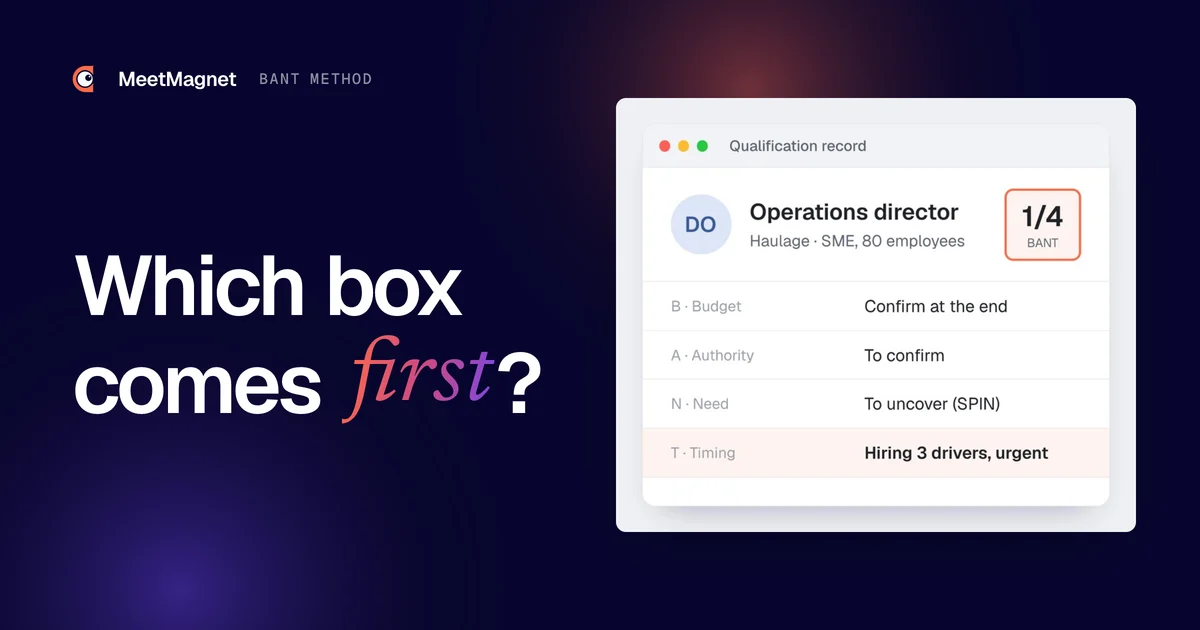
- ⏱️ It sheds light on Timing. A job ad published, a new operations director in post for a month, a site opening announced: these are exactly the milestones IBM asked to date. The signal does not replace confirmation from the prospect, but it gives you a credible hypothesis for the timeline.
- 🧭 It fills in the Situation. You already know what is changing for the person. Your first message can therefore skip Situation and go straight to a Problem question.
Example
Signal: the operations director of an 80-employee haulage SME posts a job ad on LinkedIn for three HGV drivers, stating “urgent, immediate start”.
Opener that falls flat: “Hello, we help hauliers optimise their planning. Would you have 15 minutes to talk about it?”
Opener that gets a reply: “Hi James, I saw your ad for three drivers needed right away. Until they arrive, how are you handling the routes that end up without a driver on the morning itself?”
The first opener asks for a meeting from someone who has no reason to grant it. The second picks up the signal (the Timing), skips Situation and asks a Problem question that James can answer in one line. 📬 His reply will open up Implication, then the rest of BANT.

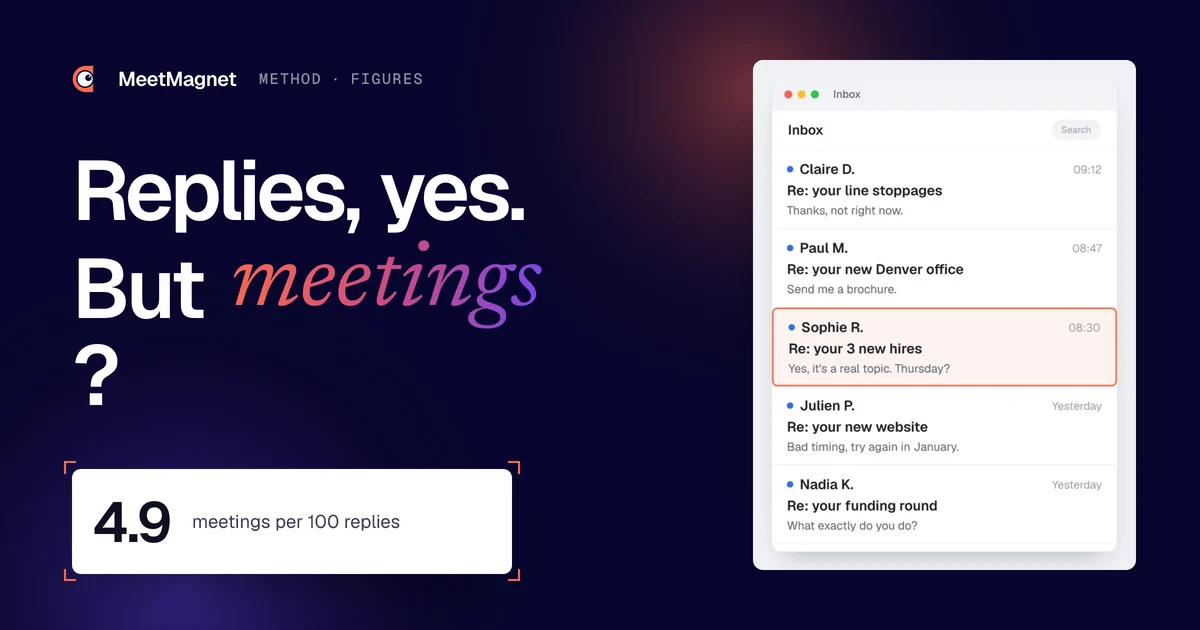
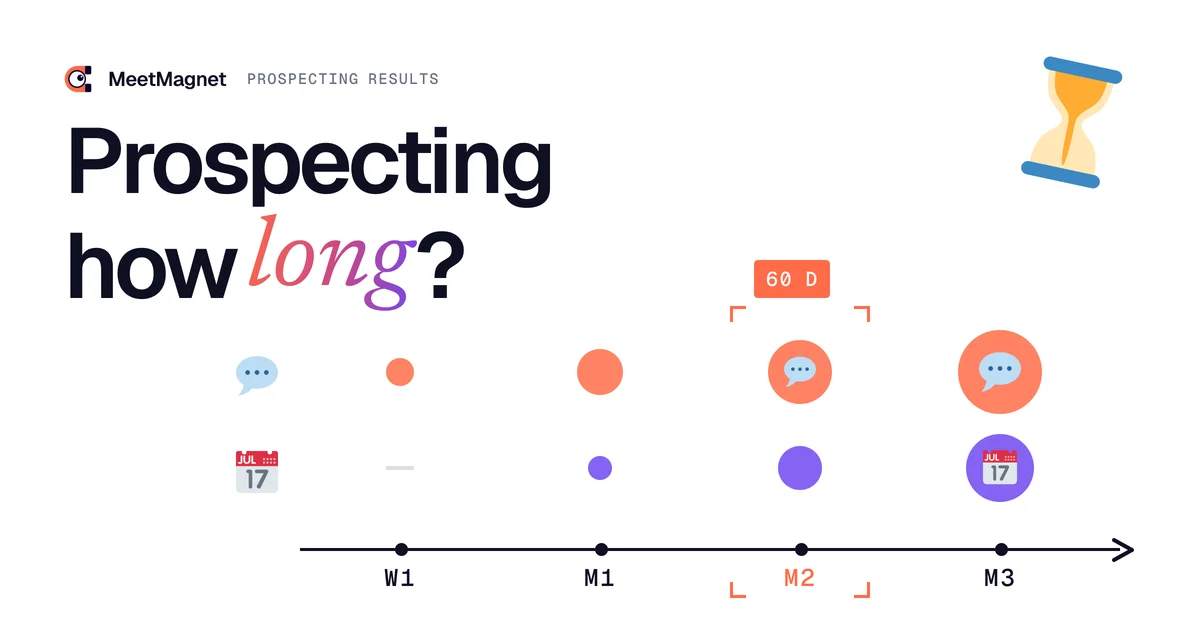
This step matters, because it is where things get stuck most often. Across the prospecting conversations of 27 MeetMagnet client accounts, by direct message and by email (as of 9 October 2026), 30% of contacted prospects replied, but there were 4.9 meetings or call requests per 100 replies, with a median of 16 days before the first meeting. Moving from reply to meeting is therefore where method matters: it is the moment for well-placed SPIN questions and a BANT asked without rushing anyone.

This is also what MeetMagnet does every day: spot the prospects on LinkedIn who show a signal related to your offer, write the opener from that signal, then move the conversation forward with questions until a time slot can be proposed. On how to judge whether a signal is worth a message, read our method to qualify a buying signal, and the list of signals tracked by source.
Which mistakes should you avoid when combining these methods?
The most common mistake is reciting a method instead of having a conversation. The three frameworks are grids for you, not a script to read to the prospect.
- Asking the four BANT questions in a row. Spread them across the exchange, and drop the ones you already have the answer to.
- Making your case before listening. A SONCAS lever assumed from a job title often misses the mark.
- Asking Situation questions whose answer is public. Prepare them, and keep your questions for what you cannot know.
- Disqualifying on Budget in the first exchange. A “no budget” at the start often means “nothing planned”, not “impossible”.
- Forcing MEDDIC onto a €3,000 sale. The framework must stay proportionate to the amount and the number of decision makers. 🙂
No sales method does the work for you, but each one settles a specific question: SONCAS tells you what motivates the person, SPIN helps you understand their problem, BANT tells you whether to continue, and MEDDIC keeps you from getting lost in a sale with several decision makers. In an SME, the biggest gain often comes from before the conversation: writing at the right moment, about a specific fact, means discovery starts already half done. ✅
Sources
- “Budget Authority Need Timeframe (BANT) Criteria Template v3.3”, IBM, accessed 27 October 2026: https://public.dhe.ibm.com/software/pdf/tr/SAMPLE-BANT_for_XYZ_Company_1JF-XXXXXX.pdf
- “What is BANT? The Way to Qualify Better Leads and Close More Deals”, Salesforce, accessed 27 October 2026: https://www.salesforce.com/blog/sales/what-is-bant-lead-generation/
- “SPIN Selling”, Neil Rackham, Routledge (publisher’s page), accessed 27 October 2026: https://www.routledge.com/SPIN-Selling-1st-Edition/Rackham/p/book/9780566076893
- “SPIN Sales Training”, Huthwaite International, accessed 27 October 2026: https://www.huthwaiteinternational.com/sales-training/spin-selling
- “Méthode SONCAS : définition et mise en place”, Pipedrive (in French), accessed 27 October 2026: https://www.pipedrive.com/fr/blog/methode-soncas
- “Who Created MEDDIC? The History Behind the Framework”, MEDDICC, accessed 27 October 2026: https://meddicc.com/resources/who-created-meddic
- LinkedIn and email conversations of 27 paying client accounts, MeetMagnet, as of 9 October 2026 (internal data)
Frequently asked questions
What does the acronym BANT stand for?
BANT stands for Budget, Authority, Need, Timeline (or Timeframe at IBM). Each letter is a criterion to check with the prospect: can they pay, who decides, do they have a problem you solve, and when do they need to decide. The framework helps you decide whether the opportunity deserves your sales time.
Are there variants of the BANT method?
Yes. ANUM reorders the criteria as authority, need, urgency and money. CHAMP starts with the prospect's challenges and treats timing as a question of priority. GPCT BA C&I, proposed by HubSpot, adds goals, plans and consequences. All of them keep the core idea of BANT: check that a deal is real before investing time in it.
Can you use SPIN selling by email or on LinkedIn?
Only partly. A written message can carry a single question, ideally a Problem question built on a recent fact at the prospect's company. Implication and Need-payoff questions work better once the conversation is under way, when the person has replied and described their situation in their own words.
Is the SONCAS method still useful today?
Yes, as a listening grid rather than a persuasion technique. It helps you spot what matters to the person, whether risk, cost, time or image, and present your offer from that angle. It becomes counterproductive when you guess the lever from the job title instead of hearing it in the prospect's own words.
How many qualification questions should you ask in a first meeting?
Few. Three or four well-chosen questions are worth more than a full checklist: one on the problem, one on its consequences, one on the timeline, and possibly one on how the decision gets made. The rest fills in over the following exchanges, without making the prospect feel they are filling in a form.
Etienne Douillard
Co-founder and CEO, MeetMagnet
An engineer and entrepreneur for over five years, Etienne works every week with B2B SMEs on signal-based prospecting.
From intent to booking
MeetMagnet spots who has a reason to talk to you right now, writes the opener that stands out, and a real person keeps it on track.