Hyper-personalized outreach: why your message sounds like AI, and how to find the right tone
By Etienne DouillardUpdated 13 min read
Too long, didn’t read?
Ask your favourite AI to summarise this article and pull out the points that matter for your business.

Contents
- Hyper-personalized outreach: why does the message sound like AI?
- How does a prospect recognize a message written by AI?
- When should you not mention the signal in a prospecting message?
- How do you describe a signal the way a human would?
- What opener structure keeps a message from sounding like AI?
- How do you find the right tone of voice for your prospecting messages?
- Why does adding details make the message sound even more like AI?
- How does MeetMagnet avoid messages that sound like AI?
- Sources
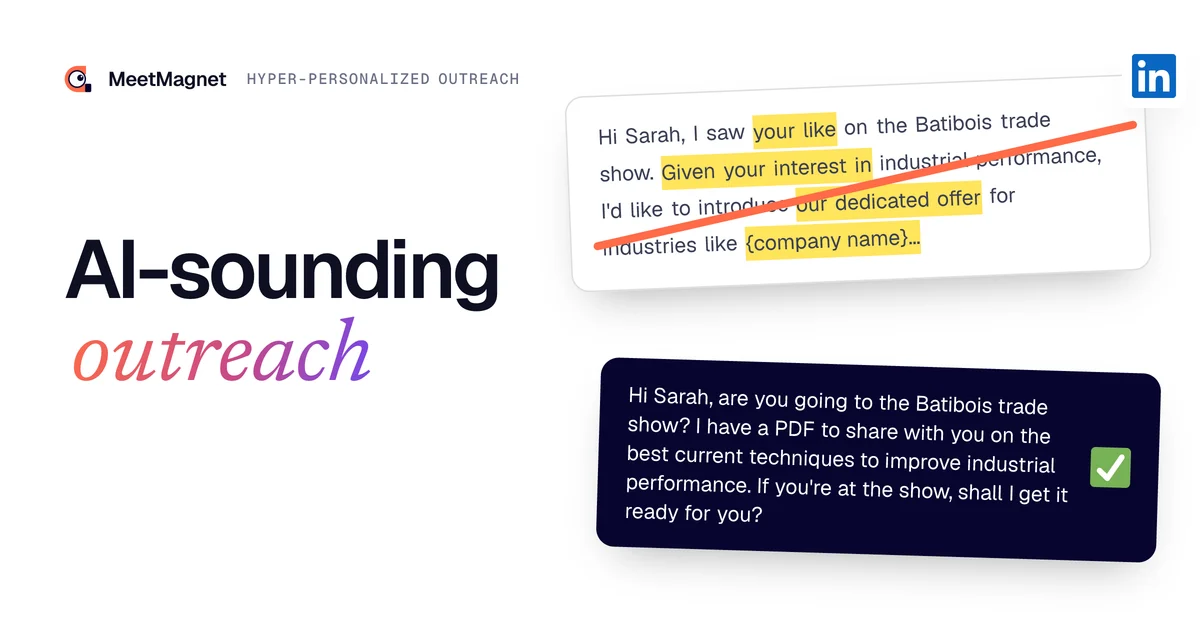
Hyper-personalized outreach was supposed to fix generic messages. With AI, you can quote a prospect’s latest post, career, company and interests in every message. The result: many of these messages “sound like AI” at first glance, and get no reply. Here is why personalization shows, when it is better not to mention the signal, and how we tune a message’s tone so it sounds like you.
📌 Key takeaways
- A hyper-personalized message shows because it is too precise about the person and too vague about their problem. No human sends a stranger an inventory.
- Just because there is a signal does not mean you should mention it. The signal is first a way to choose who to contact and when.
- Describe a signal the way a human would: talk about the topic, never the action (“you liked” is banned).
- The right tone does not come from one prompt. It is built from your own messages, a review at the start and corrections that become instructions.
- AI detectors are often wrong; your prospects, however, can easily tell when a message was not written with them in mind.
Hyper-personalized outreach: why does the message sound like AI?
Hyper-personalized outreach sounds like AI because it shows everything the tool found instead of choosing. Give an AI a profile, a post and a company page, and it tends to use all of it. It then produces a message that stacks up proof of research but says nothing useful to the reader.
A human writing to a stranger does the opposite: they keep one thing, the one related to what they offer, and talk about it simply.
It is the objection that comes up with the most intensity in our sales calls: it appeared in about 11 of the 68 calls we analyzed between August 4 and September 11, 2026. Clients use precise words: “a touch too personalized, a touch too AI”, “trying to sound like a poet”, “you can tell straight away it’s AI”, “the messages are too long”. One prospect summed up the rule: “if it’s the same old ‘Hi, I saw…’ message, I never reply”.
When we are asked whether it shows, our honest answer is: about 50% of the time, yes, if you let the tool write on its own. The rest of this article explains how we bring that number down.
Bottom line: the problem is not a lack of personalization, it is personalization without selection.

How does a prospect recognize a message written by AI?
A prospect recognizes a message written by AI by its form, before even reading the content. The classic signs (compliments, stock phrases, length) are covered in our article on AI prospecting messages. Here are the ones that come from too much personalization.
| What the AI does | What the prospect understands |
|---|---|
| It quotes three or four details about the person | “Software read my profile” |
| It picks up a very precise technical detail from the post | “They didn’t get what I was talking about” |
| It forces a link between the signal and the offer | “They’re looking for an excuse to sell to me” |
| It comments on the action (“you liked”, “you posted”) | “I’m being watched” |
| It writes eight well-turned lines | “Nobody writes like that on LinkedIn” |
⚠️ Do not rely on a detector to test your messages. A study presented by Stanford HAI showed that seven AI detectors wrongly classified 61.22% of essays written by non-native English speakers as AI-generated. The tools get it wrong; the reader decides in three seconds, and the reader is the one who replies or not.
Example
Signal: the marketing director of a 60-person company posts a recap of the trade show where her team was exhibiting.
Hyper-personalized message: “Hi Sarah, I saw your post about the Birmingham trade show, your agency background before joining your company and your interest in marketing automation. I also noticed you’re hiring a communications officer. Congrats on all this momentum!”
Message that gets a reply: “Hi Sarah, after a trade show, the hardest part is often following up with contacts before they go cold. On your side, does sales take over, or marketing?”
The first message proves you read the profile. The second proves you understood the moment. 💡 One piece of information, the one that touches the problem, is enough.
When should you not mention the signal in a prospecting message?
You should not mention the signal when quoting it hurts the message more than it helps. Just because there is a signal does not mean you have to talk about it: the signal tells you who to write to and when, it does not need to appear in the text. Six cases come up regularly for us.
- The signal is a like or a comment on someone else’s post. A like is an interest, not a thought process. Talk about the topic, never the action, and avoid complimenting a post the person did not write.
- The signal is far from your offer. A client told us about one message: “you can feel it wants to link to his profile, but it’s clumsy”. When the link takes effort, it shows.
- The signal is too specific for your topic. Another client got a draft that talked about “loading the steel sheets through to removing the parts” to invite people to an event that had nothing to do with it. That is super personalization, and it is not good.
- The signal touches on private life: an illness, a bereavement, an unwanted departure, a post about family. Do not mention it, and often do not write at all that week.
- Mentioning it would make the person feel watched: several likes listed, a profile visit, an old comment dug up.
- The signal is old. A post from three months ago quoted as news sounds wrong. Our method to qualify a buying signal helps you sort them.
In these cases, write about the problem the signal hints at: the prospect recognizes themselves without feeling observed.

How do you describe a signal the way a human would?
You describe a signal the way a human would by talking about what concerns the person, not about what they did on LinkedIn. A client put it better than we could: rather than the “I saw this, I saw that” list, he preferred “given the activity on your recent posts”. Keep the idea, drop the surveillance.
The rule depends on the type of signal. We call it an interest signal (the person reacts to content) or a moment (the person does or announces something), two ideas explained in our article on the business signal.
| Type of signal | What we write | What we never write |
|---|---|---|
| Interest: a like, a comment on someone else’s post | The topic, summarized: “many CFOs wonder who will own e-invoicing” | “You liked the post by…”, “your project to…” |
| Moment: the person posts, announces, hires | The action and its consequence: “moving to two shifts is often…” | An empty compliment on the post |
| Mention: the person is quoted by someone else | Some context, without attributing the action to them | “Congrats on your project” if it is not theirs |
✅ Three reflexes, taken from our writing rules:
- One piece of information, the one that links the person, your offer and the signal. The others stay in your notes.
- The exact words of the topic, not a vague term that waters it down. “Payment terms” rather than “finance”.
- No invention. Uncertain information does not get used.
Example
Signal: a chief financial officer likes a post about e-invoicing.
Avoid: “Hi Mark, I saw you liked Peter’s post about e-invoicing. How is your paperless invoicing project going?”
Better: “Hi Mark, with the move to e-invoicing, many SME finance directors are wondering who will own the project internally. Is that already sorted on your side?”
The second message does not say where the idea came from, and it lands.
See how we tune the tone on real messages
Openers written from a signal, reviewed before sending, in your tone.
What opener structure keeps a message from sounding like AI?
An opener that does not sound like AI has three parts: a fact or topic stated simply, a credible consequence for the person’s job, and an easy question. It always combines three things: the prospect, what you sell and the signal. If one is missing, the message sounds hollow or forced. Our sales opening line examples apply this structure.
To choose the tone of the question, look at where the person is in their decision. This is a simplified version of the EKB model (Engel, Kollat and Blackwell), which breaks a purchase into stages: recognizing a need, searching for information, comparing solutions.
| Where the person is | Typical signal | What the opener does |
|---|---|---|
| They are becoming aware of a topic | They like content on that topic | It asks an open question, without offering anything |
| They are looking for information | They comment, ask for opinions | It brings a useful idea or observation |
| They are taking action | They hire, launch, roll out | It talks about implementation and its pitfalls |
🎯 The common mistake: answering a simple like as if it were a launched project. Talking about “your project” to someone who is just reading up is wrong, and it shows.
According to RAIN Group, 92% of buyers cite being educated with new ideas among the factors that influence their decision, and 96% cite the seller focusing on value. One useful idea is worth more than three details about the person.
How do you find the right tone of voice for your prospecting messages?
You find the right tone by starting from your own messages, not from a generic prompt. For us, this part has been built through iterations over five years, and it rests on three things: the tone prompt built with the client, systems dedicated to the tone of messages, and a review at the start.
The tone prompt, built with you
At the start, we help each client with what to put in their instructions so that they truly reflect how they write. Here is what goes in:
- ✍️ Two or three messages you wrote yourself that landed a meeting. This is the most useful material.
- The register: formal or casual. One client warned us: “I don’t use first names with people I don’t know”.
- The maximum length and where emojis go.
- Your words, the ones you use, and the ones you never use.
- What you offer, and what you do not promise.
- How to end: a question, a proposal, a signature or nothing.
💡 If you already write with ChatGPT, ask it to summarize how you write. A coach we worked with already had ChatGPT replying to her LinkedIn messages: we had her generate a mini “system prompt” of the way she talks, to send to us to set up her messages.
Systems dedicated to tone
Tone is not tuned in the same step as content. So we built systems dedicated to the tone of messages, based on your examples and your corrections. The most visible result: shorter messages. When a client finds them “too long”, we trim, regenerate and compare the before and after with them.
The review in the first days
👀 For the first fifteen days, every message is reviewed before sending. We often ask the client to correct a message in front of us, to see exactly what bothers them. Each correction becomes an instruction. We only switch to automatic sending once 90 to 95% of messages are right without edits. Replies to prospects work the same way: during the first month, the client answers personally so that the conversational agent learns their tone and objections.

Why does adding details make the message sound even more like AI?
Adding details makes the message sound more like AI because each detail lengthens the text and adds proof of research, not a reason to reply. It is the most common mistake: you think the message lacks personalization, so you add more.
📊 A real case from our clients: one client had one invitation in two accepted, but only a 10% reply rate. People accepted the connection, then ignored the message: “that’s where we lose”. The client himself found his messages “a bit too much”. We reworked them, shorter and simpler.
Consumer figures point the same way. McKinsey found in 2021 that 71% of consumers expect personalized interactions and 76% get frustrated when that does not happen. It is a consumer study, not a B2B buyer study, but the lesson holds: people expect relevance, not a file on themselves. On the B2B side, Gartner surveyed 632 buyers and found that 73% actively avoid suppliers who send irrelevant outreach.
❌ When a message gets no reply, do not add a detail about the person, an explanation or forced familiarity.
✅ Remove, shorten, and check that the message talks about a problem the person really has. If the reply rate stays low, our article on cold outreach reply rates helps you tell whether it is the message or the target.
How does MeetMagnet avoid messages that sound like AI?
MeetMagnet spots decision-makers on LinkedIn who show a buying signal related to your offer, writes an opener from that signal in your tone, and lets you review it before sending. The signal is used to choose who to contact; it only appears in the message if it helps.

On the Managed plan, at €299 excl. VAT per month, a member of our team builds the tone prompt with you, reviews the first messages with you and only switches to automatic once the tone is right. The Self-serve plan, at €149 excl. VAT per month, leaves that tuning to you. The split of work between AI and humans is covered in our article on the AI SDR, and prices are on our pricing page.
Hyper-personalization is not the problem; the lack of selection is. Keep one piece of information, the one that touches the person’s problem, describe it the way you would say it out loud, leave the signal out when it hurts the message, and give the AI your own messages as a model. A short, accurate message in your tone does not sound like AI: it sounds like you. 🚀
Sources
- “The value of getting personalization right, or wrong, is multiplying”, McKinsey & Company, November 12, 2021, accessed November 5, 2026, https://www.mckinsey.com/capabilities/growth-marketing-and-sales/our-insights/the-value-of-getting-personalization-right-or-wrong-is-multiplying
- “AI-Detectors Biased Against Non-Native English Writers”, Stanford HAI, 2023, accessed November 5, 2026, https://hai.stanford.edu/news/ai-detectors-biased-against-non-native-english-writers
- “Gartner Sales Survey Finds 61% of B2B Buyers Prefer a Rep-Free Buying Experience”, Gartner, June 25, 2025, accessed November 5, 2026, https://www.gartner.com/en/newsroom/press-releases/2025-06-25-gartner-sales-survey-finds-61-percent-of-b2b-buyers-prefer-a-rep-free-buying-experience
- “114 Essential Sales Statistics to Improve Performance”, RAIN Group, updated July 24, 2025, accessed November 5, 2026, https://www.rainsalestraining.com/blog/114-essential-sales-statistics-to-improve-performance
- Notes from MeetMagnet calls with prospects and clients (68 calls analyzed from August 4 to September 11, 2026, then calls in September and October 2026).
Frequently asked questions
What is hyper-personalization in sales prospecting?
It means adapting each prospecting message to one specific person, based on what you know about them: their role, their company, what they post or what interests them. With AI, you can do it at scale. The risk is overdoing it: a message that quotes five details about the person reads like a file, not a conversation.
Can a prospect tell that a prospecting message was written by AI?
Often, yes. When we are asked this in sales calls, our honest answer is: about half the time, if you let the tool write on its own. What gives the message away is not AI itself but the list of details, the length, the overly polished phrasing and the forced link to the offer.
Should you always mention the buying signal in the message?
No. The signal is first a way to choose who to contact and when. Leave it out when it is just a like, when it is far from your offer, when it touches on private life or when mentioning it would make the person feel watched. Write about the topic or the problem instead, without saying where the idea came from.
How do you give AI your tone of voice for prospecting messages?
Give it two or three messages you wrote yourself that got a meeting, your rules (formal or casual, length, emojis), the words you use and the ones you never use. Then review the first messages and turn each correction into an instruction, until almost all of them go out without edits.
How long does it take for AI to write like you?
With our clients, allow about fifteen days of review. During that time, every message is approved before sending and every correction improves the instructions. We only switch to automatic sending once 90 to 95% of messages are right without edits. For replies to prospects, learning the tone takes closer to a month.
Etienne Douillard
Co-founder and CEO, MeetMagnet
An engineer and entrepreneur for over five years, Etienne works every week with B2B SMEs on signal-based prospecting.
From intent to booking
MeetMagnet spots who has a reason to talk to you right now, writes the opener that stands out, and a real person keeps it on track.